

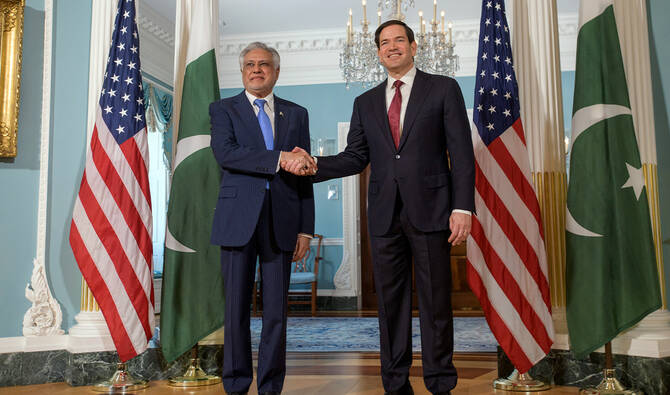

ISLAMABAD: Pakistan’s Deputy Prime Minister and Foreign Minister Ishaq Dar held his first face-to-face meeting with US Secretary of State Marco Rubio in Washington on Friday, with the US official acknowledging Pakistan’s role in promoting international peace and his Pakistani interlocutor seeking broader ties between the two countries.
The meeting is widely viewed as yet another sign of a diplomatic reset after years of estrangement between Islamabad and Washington, particularly during the Afghan war, where diverging perspectives deepened mistrust. High-level bilateral exchanges gradually faded as the US withdrew from Afghanistan.
Earlier this week, however, US State Department Spokesperson Tammy Bruce hinted at a bilateral meeting between the two countries without disclosing details. According to Pakistan’s foreign office, Dar and Rubio held detailed discussions on bilateral relations and explored opportunities for cooperation in trade, investment, agriculture, technology and minerals.
Counterterrorism and regional peace efforts were also high on the agenda.
“Met with Pakistani Deputy Prime Minister and Foreign Minister @MIshaqDar50 today to discuss expanding bilateral trade and enhancing collaboration in the critical minerals sector,” Rubio said in a social media post after the meeting. “I also thanked him for Pakistan’s partnership in countering terrorism and preserving regional stability.”
Dar responded by reaffirming Pakistan’s commitment to strengthening ties with Washington.
“We wish to broaden and deepen our relationship with the United States across the political, economic and security domains,” he said according to an official statement. “Pakistan remains a credible partner for peace, progress and prosperity in the region and beyond.”
Last month, President Donald Trump hosted Pakistan’s army chief, Field Marshal Asim Munir, for a rare one-on-one lunch at the White House in a visit that followed an intense, four-day India-Pakistan military standoff, which ended with a US-brokered ceasefire on May 10.
Dar also paid tribute to Trump for his role in de-escalating the tensions between the two South Asian nuclear-armed neighbors.
The revival of military and political dialogue between the two countries comes as Pakistan is also holding trade talks with Washington after the Trump administration imposed 29 percent “reciprocal tariffs” on Pakistani exports in April.
Pakistan’s finance chief, Muhammad Aurangzeb, who also visited Washington this month, said the two countries were working to shift their economic ties “from one focused on trade to one anchored in long-term investment.”
After meeting US Commerce Secretary Howard Lutnick and US Trade Representative Jamieson Greer, Aurangzeb said priority sectors had been identified, including minerals, mining, artificial intelligence and cryptocurrency regulation.
During Friday’s meeting, Dar also described Pakistan as an attractive destination for US investors and highlighted the role of the Pakistani-American diaspora in strengthening bilateral ties.
“We are optimistic about progress in the ongoing trade dialogue,” he said. “There is alignment between our regional peace objectives and strategic interests.”
Dar is currently on an eight-day visit to the United States, where he kept a busy schedule in New York and chaired several high-profile United Nations Security Council meetings under Pakistan’s rotating presidency this month.
He highlighted the need for multilateralism, peaceful dispute resolution and his country’s own strategic concerns during his engagements at the world body.


