

Britain and Australia to sign 50-year nuclear submarine treaty

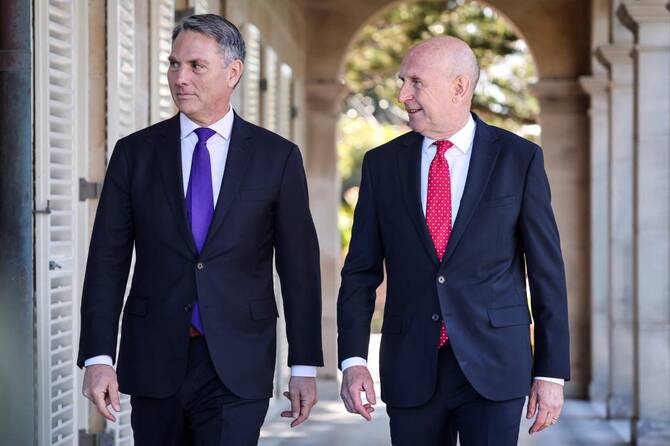
Australia’s Deputy Prime Minister and Minister for Defense Richard Marles, left, walks with Britain’s Defense Secretary John Healey before the start of the Australia-UK Ministerial Consultations meeting in Sydney on July 25, 2025. (AFP)
Short Url
Updated 25 July 2025
Follow

Britain and Australia to sign 50-year nuclear submarine treaty

  • The three-way alliance was announced in 2021 to contend with growing Chinese military might in the Asia-Pacific region
  • It would deliver Australia at least eight submarines including three to five second-hand US Virginia-class submarines

MELBOURNE: Britain and Australia announced they will sign a cooperation treaty to build Australian nuclear-powered submarines and welcomed a review by President Donald Trump’s administration of the United States’ role in the trilateral defense deal.

Britain’s Defense Secretary John Healey and Foreign Secretary David Lammy met Friday with their Australian counterparts Richard Marles and Penny Wong in Sydney for an annual bilateral meeting.

Marles said he and Healey will sign a 50-year treaty Saturday that will underpin bilateral cooperation on building an Australian fleet of submarines powered by US nuclear technology.

“It is as significant a treaty as has been signed between our two countries since federation,” Marles said, referring to the unification of several British colonies to form the Australian government in 1901.

The three-way alliance was announced in 2021 to contend with growing Chinese military might in the Asia-Pacific region. It would deliver Australia at least eight submarines including three to five second-hand US Virginia-class submarines. Britain and Australia would cooperate to build their own SSN-AUKUS submarines.

US reviewing AUKUS trilateral submarine deal

US Defense Secretary Pete Hegseth is reviewing the pact, known by the acronym AUKUS, that was entered into by US President Joe Biden’s administration. There are concerns that the US won’t provide Australia with its first Virginia-class submarine by the early 2030s as planned because US submarine-building was behind schedule.

Marles and Healey declined to speculate on whether Britain and Australia would continue with jointly building submarines if the US pulled out when questioned at a press conference.

“Australia and the UK welcome the review because we see this as a chance for a new administration to renew their commitment to AUKUS. And that’s what we expect,” Healey said.

“Any sort of hypotheticals that you suggest simply aren’t part of the picture,” Healey added, referring to the prospect of Britain and Australia proceeding without the US

The Australian government confirmed this week it had paid the US a second $500 million installment on the AUKUS deal. The first $500 million was paid in February.

The submarines are expected cost Australia up to $245 billion.

The meeting comes as 3,000 British military personnel take part in the largest military exercise ever conducted in Australia.

British aircraft carrier joins Australian war games

More than 35,000 military personnel from 19 nations are taking part in Exercise Talisman Sabre, which began in 2005 as a biennial joint exercise between the US and Australia.

Marles and Healey will inspect the British aircraft HMS Prince of Wales at the northern port of Darwin on Sunday. The carrier is in Australia to take part in the war games.

Lammy said the carrier’s arrival in Darwin was meant to send a clear signal to the world.

“With our carrier strike group docking in Darwin, I think we’re sending a clear signal, a signal of the UK’s commitment to this region of the world. Our determination to keep the Indo-Pacific free and open, and that we stand together,” he said.


Report highlights role of British Muslim charitable giving in supporting UK public services

Updated 05 December 2025
Follow

Report highlights role of British Muslim charitable giving in supporting UK public services

  • The study, “Building Britain: British Muslims Giving Back,” finds that donations from British Muslims are helping to bolster overstretched service

LONDON: British Muslim charitable giving is playing an increasingly significant role in supporting frontline public services across the UK, according to a new report by policy and research organization Equi.

The study, “Building Britain: British Muslims Giving Back,” finds that donations from British Muslims are helping to bolster overstretched services, including local councils, the NHS and welfare systems, at a time of growing financial pressure.

The report estimates that Muslim donors contribute around £2.2 billion ($2.9 billion) annually, making them the UK’s most generous community.

This figure is around four times the national giving average and rises to almost 10 times the average among higher earners.

According to the findings, Muslim-led charities are providing a wide range of support, including housing assistance, emergency cash grants, food provision and mental health services, easing demand on statutory services.

Equi points to evidence from 2023 showing that housing support delivered by the National Zakat Foundation helped prevent evictions that would have cost councils an estimated £28.8 million, with every £1 of charitable spending generating £73 in public sector savings.

The report also highlights a generational shift, with younger British Muslims increasingly directing their donations toward domestic causes such as homelessness, child poverty and mental health challenges.

Despite their growing impact, Muslim charities face a number of barriers, including de-banking, restrictive funding rules, securitization measures and what the report describes as limited recognition from government. Equi argues that these challenges are constraining the sector’s ability to maximize its contribution.

“British Muslim giving is not just generosity but a lifeline for public services that needs recognizing,” said Equi Managing Director Prof. Javed Khan.

“From preventing evictions to supporting mental health, these donations are saving millions for the taxpayer and strengthening communities across Britain. The evidence is clear that Muslim-led action is delivering frontline support where the state is struggling,” he added.

Equi is calling on policymakers to engage more closely with Muslim-led charities and to move beyond what it describes as symbolic recognition.

The report recommends measures such as UK-based match-funding schemes and greater faith literacy within policymaking, which it says could unlock billions of pounds in additional domestic spending while maintaining the UK’s global humanitarian commitments.

The study concluded that with greater collaboration between government and Muslim charities, charitable giving could play an even more transformative role in strengthening public services and social cohesion across the country.