

Saudi team win 4 medals at 2025 International Physics Olympiad

1 / 4
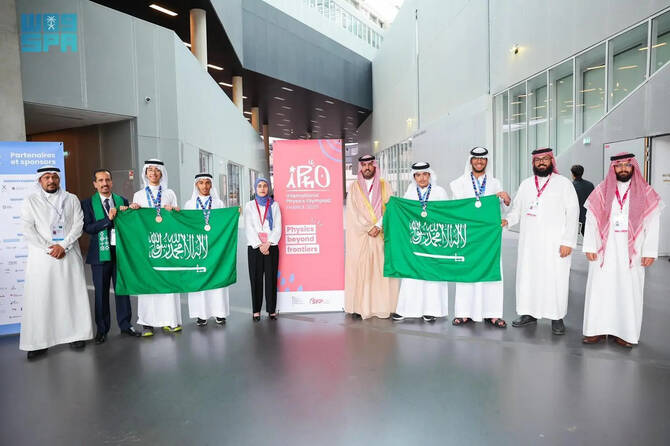
Mazen Al-Shakhs won a silver medal while students Hussein Al-Saleh, Mohammed Al-Arfaj, and Ali Al-Hassan collectively earned three bronze medals. (SPA)
2 / 4
Mazen Al-Shakhs won a silver medal while students Hussein Al-Saleh, Mohammed Al-Arfaj, and Ali Al-Hassan collectively earned three bronze medals. (SPA)
3 / 4
4 / 4
Short Url
Updated 25 July 2025
Follow

Saudi team win 4 medals at 2025 International Physics Olympiad

  • Kingdom’s tally in annual contest now 7 silver and 23 bronze medals, 22 certificates of appreciation

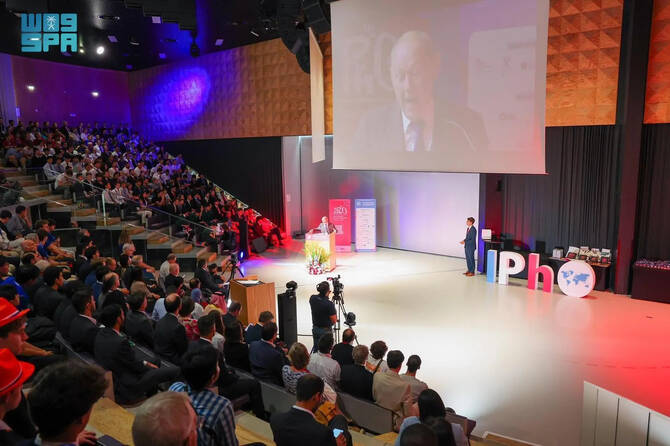
PARIS: Saudi Arabia’s National Physics Team won four medals at the 55th International Physics Olympiad in Paris which ran from July 17 to 25, the Saudi Press Agency reported on Friday.

Mazen Al-Shakhs won silver, while Hussein Al-Saleh, Mohammed Al-Arfaj, and Ali Al-Hassan each won bronze at the IPhO.

The latest medal haul has raised the Kingdom’s overall tally at this annual event to seven silver, 23 bronze, and 22 certificates of appreciation.

A total of 425 students from 85 countries competed in the contest this year.

Saudi Arabia’s achievement was a result of intensive training for the students by the King Abdulaziz and His Companions Foundation for Giftedness and Creativity, or Mawhiba, the SPA reported.

Support was provided by the Ministry of Education, and sponsorship by Saudi Aramco.

The IPhO is an annual competition for high school students, with each national delegation allowed up to five student competitors plus two leaders.

Similar to other Olympiads, member countries take turns hosting the competition. It was first held in Warsaw, Poland, in 1967, and last year in Isfahan, Iran.

In 2026, the host will be Bucaramanga, Colombia.

In the event’s 58-year history, China has emerged as the most dominant, with Russia, South Korea, Taiwan and the US completing the top five.


The founding economy: A blueprint for stability in the First Saudi State

Updated 23 February 2026
Follow

The founding economy: A blueprint for stability in the First Saudi State

  • The establishment of the First Saudi State created a secure environment that facilitated the arrival of caravans, secured vast trade routes, and revived commerce across the Arabian Peninsula

RIYADH: The economy during the founding stage of the First Saudi State served as a fundamental pillar in building the nation, consolidating its influence, and ensuring its stability. This early economic growth was inextricably linked to achieving security, unifying regions, and organizing society—factors that directly stimulated trade, stabilized markets, and enhanced the foundations of daily life in Diriyah and its surrounding areas.
According to Dr. Abdullah Al-Saleh Al-Othaimeen's "Diriyah: Origins and Development during the First Saudi State," published by the King Abdulaziz Foundation for Research and Archives (Darah), the founding economy stands as a historical model reflecting the reciprocal relationship between political stability and early economic prosperity.

Beyond its political and intellectual prominence, Diriyah emerged as a vibrant economic hub. (SPA)

The establishment of the First Saudi State created a secure environment that facilitated the arrival of caravans, secured vast trade routes, and revived commerce across the Arabian Peninsula.
Beyond its political and intellectual prominence, Diriyah emerged as a vibrant economic hub. Its active markets attracted merchants and students from across the region, all of whom benefited from the state-provided stability. The local society relied on diverse activities for its livelihood, including trade, agriculture, and livestock breeding, with horses and camels playing crucial roles in transportation, commerce, and securing roads.
The social and administrative organization upon which the state was founded ensured the continuous availability of goods and sustained market stability. Ultimately, the close relationship between public security and economic growth during this founding phase solidified Diriyah's position as a premier political and commercial center in the Arabian Peninsula.