

British medics say Gaza is ‘televised genocide’ and ‘unlike anything’ seen in war zones

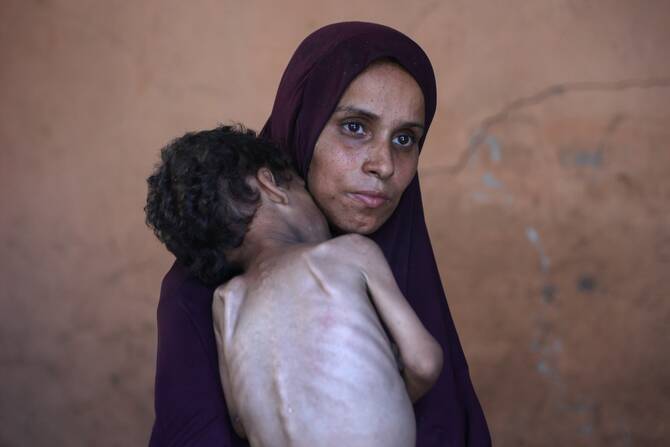
Naeema, a 30-year-old Palestinian mother, carries her malnourished 2-year-old son, Yazan, as they stand in their damaged home in the Al-Shati refugee camp, west of Gaza City, July 23, 2025. (AFP)
Short Url
Updated 24 July 2025
Follow

British medics say Gaza is ‘televised genocide’ and ‘unlike anything’ seen in war zones

  • Medical volunteers have been working tirelessly despite limited supplies, and have witnessed “very obvious ... malnourishment in the community”
  • Dr. Tom Potokar says he lost 11 kg during his recent trip to Gaza, despite bringing food with him, while his Palestinian medical colleagues appeared increasingly fatalistic

LONDON: British healthcare workers volunteering to treat patients in the Gaza Strip report witnessing harrowing injuries, including severe burns and shrapnel wounds as well as cases of extreme starvation due to Israeli attacks and restrictions on aid.

Sam Sears, a 44-year-old paramedic, told the British tabloid Metro that the range of injuries he has seen at a humanitarian medical tent facility in Al-Mawasi, on the southern coast of Gaza, includes blast injuries, shrapnel wounds, gunshot wounds and polytrauma.

He is volunteering with the UK-Med charity as part of a team responding to starvation in Gaza, following the emergence of distressing images of malnourished Palestinians, including some infants, which have prompted widespread condemnation, including from the UK government.

“It’s unlike anything I’ve seen before,” Sears said.

“Especially like nothing I’ve seen in the UK, and I have worked in other areas like Sierra Leone for Ebola and Ukraine in the war, but this here is completely different. It’s like times ten here.

“We are struggling for food here at the moment, let alone (Palestinian) staff that are working with us who have had to manage this for the last 20 months.”

He said that medical volunteers have been working tirelessly despite limited supplies, including fuel, and it was “very obvious (that) we have got malnourishment in the community.”

“We can buy certain things from the market but it’s very scarce, it’s also costing quadruple or more than what it normally would. A kilogram of sugar at the minute is costing $130, so it’s just extortionate,” he said.

The UK-Med charity operates two field hospitals in Gaza, treating 500 people daily, and includes an operating theater for lifesaving surgical procedures.

“The ceasefire is needed, not just a pause but a permanent end to the hostilities,” Sears said. “The people in Gaza have suffered immensely, they have got nowhere to call home ... They are hungry, malnourished, the conflict needs to stop really.”

“The healthcare and aid needs to come in for the 2.1 million people who it’s needed for here,” he added.

Dr. Tom Potokar, a veteran British plastic surgeon who has volunteered in various Palestinian hospitals and has visited Gaza 16 times since 2018, said that the healthcare system is overwhelmed with severe burn victims from Israel’s military actions.

Dr. Potokar told the Telegraph newspaper that he had been operating on 10 to 12 patients suffering burns from blasts each day, with three-quarters of those cases being women or children. “That’s taking the top-10 priority, but there’s still plenty more behind that that needed operating,” he said.

He volunteered nearly two years ago during the initial six weeks after Israel began its attacks on the Gaza Strip in late 2023. He is the founder of the medical charity Interburns, established in 2006, which addresses the lack of burns expertise in poorer nations and war zones. When he arrived for the first time in Gaza in 2018, he discovered that there were only two fully qualified plastic surgeons, one of whom was partially retired.

His most recent visit, with the Ideals international aid charity, was in May and June, during which he witnessed terrible injuries from explosions.

“I saw many cases of bilateral or triple limb amputations, huge open wounds on the back, on the chest, with the lung exposed. Really horrendous blast injuries from shrapnel, and as I say, a lot of them combined with burns as well,” he said.

The most devastating cases involved children, with some cases sustaining about 90 percent burns.

“There’s nothing you can do. Even if there was not a conflict there, in that country, in that scenario, a 90 percent burn (case) when it’s almost all full thickness is not going to survive,” he said.

“But then you are talking about a nine-year-old and some end-of-life dignity, and unfortunately they don’t die in a couple of hours, it takes four or five days, so you see this patient every four or five days, knowing full well that there’s absolutely nothing you can do.”

Dr. Potokar described treating patients who are “skin and bone” due to Israeli aid restrictions leading to mass starvation in Gaza.

“Wounds are just stagnating because they are just not getting food.”

He said that he lost 11 kg during his recent trip, despite bringing food with him. His Palestinian medical colleagues appeared increasingly fatalistic, he said, as more than 100 human rights organizations warned this week that some staff members have become too weak to continue their work due to food shortages.

Dr. Potokar described Gaza as the “world’s first televised genocide” and said that there was a lack of response to end the war in the coastal enclave.

“We are putting plasters on a haemorrhaging aneurysm. The problem is the political initiative, the total lack of global, moral, ethical insight into this and desire to stop it,” he said.


India’s Parliament approves bill to open civil nuclear power sector to private firms

Updated 8 sec ago
Follow

India’s Parliament approves bill to open civil nuclear power sector to private firms

  • The government termed it a major policy shift to speed up clean energy expansion
  • The move carries global significance as India seeks to position itself as a major player in the next wave of nuclear energy

NEW DELHI: India’s Parliament approved new legislation Thursday that enables opening the tightly controlled civil nuclear power sector to private companies.
The government termed it a major policy shift to speed up clean energy expansion while the opposition political parties argued that it dilutes safety and liability safeguards.
The lower house of parliament passed the legislation Wednesday and the upper house on Thursday. It now needs the assent from the Indian president, which is a formality, to come into force.
The move carries global significance as India seeks to position itself as a major player in the next wave of nuclear energy, including with small modular reactors at a time many nations are reassessing nuclear power to meet climate targets and reduce dependence on fossil fuels.
Supporters argue the legislation marks a decisive break from decades of state dominance in nuclear energy while critics say it opens the door to risks, mainly health hazards, that could have long term consequences.
“It marks a momentous milestone for India and signals capable private sector players that the country is open for business in the nuclear energy space,” said Karthik Ganesan, director of strategic partnerships at the Council on Energy, Environment and Water, a think tank.
Junior Minister Jitendra Singh, who oversees the department of atomic energy, told lawmakers that the bill — which has been dubbed Sustainable Harnessing and Advancement of Nuclear Energy for Transforming India — seeks to modernize India’s nuclear framework in line with technological, economic and energy realities. It also retains and strengthens core safety, security and regulatory safeguards.
“India’s role in geopolitics is increasing. And if we have to be a global player effectively, we have to live up to global benchmarks, follow global parameters and adopt global strategies,” Singh said in the lower house, adding that the legislation was necessary to address the country’s growing energy needs.
India wants more nuclear power and has pledged over $2 billion in recent months toward research and allied activities. Nuclear power is a way to make electricity that doesn’t emit planet-warming gases, although it does create radioactive waste.
India is one of the world’s biggest emitters of planet-heating gases and over 75 percent of its power is still generated by burning fossil fuels, mostly coal. India wants to install 100 gigawatts of nuclear power by 2047 — enough to power nearly 60 million Indian homes a year.
Energy experts say that for the world to move away from carbon-polluting fuels like coal, oil and gas, sources like nuclear that don’t rely on the sun and the wind — which aren’t always available — are needed. But some are skeptical about India’s ambitions as the country’s nuclear sector is still very small, and negative public perceptions about the industry remain.
Opposition parties flagged concerns related to several provisions of the bill and urged the government to refer it to a parliamentary panel for examination. The government didn’t adhere to the request.
“The bill doesn’t have sufficient safeguards when it comes to mitigating the bad health of those impacted by living in areas closer to nuclear plants,” Ashok Mittal, a lawmaker from the opposition Aam Admi Party, told The Associated Press.
G. Sundarrajan, an anti-nuclear energy activist, called the bill a “disastrous law,” saying it takes away essential safeguards that are needed to make sure companies invest in safety and reduce the chances of a major disaster that can impact millions from occurring.
“It also provides little recourse for any Indian citizen to claim damages from nuclear companies even if they are affected by radiation leaks or suffer from any other health impact as a result of a nuclear plant in their region,” he said.