

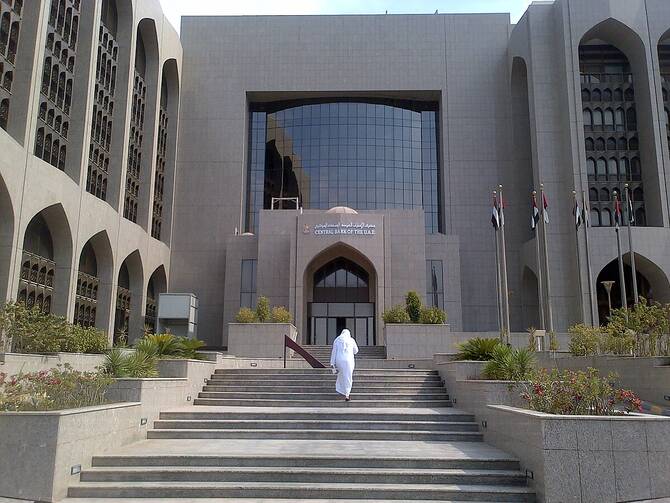

RIYADH: The UAE’s banking sector expanded modestly in April, with total banking assets rising to 4.75 trillion dirhams ($1.29 trillion), driven by higher lending and a sharp increase in non-resident deposits.
According to data from the Central Bank of the UAE, total assets, which include bankers’ acceptances, increased by 0.6 percent from March, continuing an upward trend amid resilient credit activity and growing liquidity.
This comes amid diverging banking trends across the Gulf, with Kuwait reporting a 6.7 percent year-on-year rise in total assets to 93.51 billion dinars ($303 billion) in March, and Saudi Arabia recording a 7.4 percent increase to SR5.3 trillion ($1.41 trillion) in April.
Qatar, meanwhile, recorded a marginal 0.1 percent monthly decline, with assets slipping to 2.07 trillion Qatari riyals ($558.9 billion) due mainly to a 0.5 percent drop in domestic holdings.
In its latest report, CBUAE said “the increase in money supply aggregate M1 (which includes physical currency and demand deposits) by 2.6 percent, from AED 986.2 billion at the end of March 2025 to AED 1,011.9 billion at the end of April 2025.”
It added: “The increase was due to AED 26.9 billion growth in monetary deposits, overriding the AED 1.2 billion decrease in currency in circulation outside banks.”
The increase was driven by a 0.1 percent rise in resident deposits and a 10.9 percent increase in non-resident deposits, which rose to 275.6 billion dirhams.
Gross credit rose 0.9 percent to 2.26 trillion dirhams, supported by a 12.3 billion dirham increase in domestic credit and a 7.1 billion dirham gain in foreign credit.
Lending to the private sector rose 0.6 percent, while government and quasi-government sectors saw gains of 0.7 percent and 1.2 percent, respectively. Credit to non-banking financial institutions fell 4.3 percent.
Within resident deposits, government sector deposits rose by 0.9 percent, private sector deposits by 1.1 percent, while deposits from non-banking financial institutions declined by 9.2 percent. Deposits from government-related entities fell by 6.5 percent.
M2, which includes M1 and quasi-monetary deposits, decreased by 0.1 percent to 2.44 trillion dirhams from 2.437.7 trillion dirhams, as quasi-monetary deposits fell by 27.8 billion dirhams.
Meanwhile, M3 — the broadest measure including government deposits — rose 0.2 percent to 2.90 trillion dirhams on the back of a 6.6 billion dirham increase in government balances.
The monetary base declined by 1.7 percent to 819 billion dirhams at the end of April, compared to 833.1 billion dirhams in March.
This was due to a 2.5 percent reduction in currency issued and a 32 percent decline in banks’ and financial institutions’ reserve accounts.
These were partially offset by a 159.8 percent surge in current accounts and overnight deposits held by banks and other financial corporations at the central bank, and a 3.1 percent increase in monetary bills and Islamic certificates of deposit.


