

Pakistan, Saudi Arabia discuss maritime security, defense ties in high-level military meeting

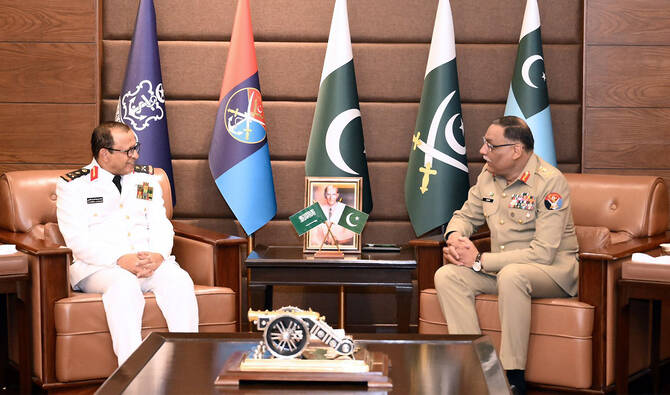
Chief of the Naval Staff of Royal Saudi Naval Forces, Vice Admiral Mohammed bin Abdulrahman Al Ghuraybi (left) calls on Pakistan's Chairman Joint Chiefs of Staff Committee (CJCSC) General Sahir Shamshad Mirza, at Joint Staff Headquarters in Rawalpindi on July 24, 2025. (Pakistan Army)
Short Url
Updated 24 July 2025
Follow

Pakistan, Saudi Arabia discuss maritime security, defense ties in high-level military meeting

  • Saudi naval chief meets top Pakistani general amid deepening security cooperation
  • Leaders discuss evolving regional security dynamics within Middle East, South Asia

ISLAMABAD: Pakistan and Saudi Arabia on Thursday discussed regional security and agreed to enhance bilateral defense cooperation, with a special focus on maritime security, during a high-level military meeting in Rawalpindi, the Pakistan army said.

General Sahir Shamshad Mirza, Pakistan’s Chairman Joint Chiefs of Staff Committee (CJCSC), met Vice Admiral Mohammed bin Abdulrahman Al Ghuraybi, Chief of the Naval Staff of the Royal Saudi Naval Forces, at the Joint Staff Headquarters in Rawalpindi.

Thursday’s meeting comes amid a regional push by both countries to bolster maritime security cooperation, particularly as geopolitical tensions threaten trade routes through the Red Sea and Arabian Gulf.

“[They] discussed the evolving regional security dynamics both within Middle East & South Asia with particular focus on maritime security,” Pakistan’s military media wing, ISPR, said in a statement.

General Mirza underscored the “historical brotherly relations between Kingdom of Saudi Arabia and Islamic Republic of Pakistan,” and “emphasized mutual resolve for enhancing existing bilateral defense cooperation,” according to the statement.

Pakistan and Saudi Arabia have shared close military and strategic relations for decades, including joint training programs, military exercises, and high-level defense consultations. Pakistan has historically provided military assistance and training to Saudi forces, and the two countries routinely hold joint military exercises as well as drills in the Arabian and Red Seas.

In recent years, the relationship has broadened beyond defense. Saudi Arabia extended a $3 billion deposit to Pakistan in 2024 to support Islamabad’s balance of payments. It remains Pakistan’s largest source of foreign remittances, with approximately $7.4 billion received in FY2024–25 — about one-quarter of total remittance inflows.

Bilateral trade and investment are also expanding.

In 2023, Pakistan’s exports to Saudi Arabia were valued at $640 million, while imports stood at $4.5 billion, highlighting both opportunity and imbalance. Saudi investments in Pakistan spiked following 2024 meetings in Islamabad that produced $2 billion in memorandums of understanding spanning energy, agriculture, tech, and mining.

Pakistan PM calls for faster CPEC implementation, pledges security for Chinese workers

Updated 27 February 2026
Follow

Pakistan PM calls for faster CPEC implementation, pledges security for Chinese workers

  • Shehbaz Sharif pushes expanded cooperation in agriculture, IT and mining under CPEC phase two
  • Chinese envoy reaffirms Beijing’s support for Pakistan’s sovereignty and economic development

ISLAMABAD: Prime Minister Shehbaz Sharif on Friday called for speeding up projects under the China-Pakistan Economic Corridor (CPEC) and pledged stronger security guarantees for Chinese workers and investments, during a meeting with China’s ambassador in Islamabad.

Sharif made the remarks as the two countries strive to launch the second phase of CPEC, a multibillion-dollar infrastructure and energy initiative launched in 2015 as part of China’s Belt and Road Initiative (BRI).

CPEC’s first phase focused largely on power generation and transport infrastructure aimed at easing Pakistan’s chronic energy shortages and improving connectivity. The second phase seeks to expand cooperation into industrial development, with an emphasis on special economic zones and export-oriented growth.

“While highlighting the importance of accelerating ongoing CPEC projects, the Prime Minister stressed on the need to enhance cooperation in agriculture and IT and mining & minerals,” said a statement circulated by the PM Office after the meeting.

“He also underscored Pakistan’s resolve to provide a secure and conducive environment for Chinese personnel, investments, and institutions in Pakistan,” it added.

Chinese nationals and projects in Pakistan have faced security threats in the past, including attacks by militant groups targeting infrastructure sites and convoys. Islamabad has repeatedly vowed to tighten security and has deployed special protection units for Chinese workers.

China is Pakistan’s closest ally in the region and a key economic partner, with CPEC widely regarded by Islamabad as central to long-term economic growth.

During the meeting, the prime minister conveyed greetings to Chinese President Xi Jinping and Premier Li Qiang, particularly on the occasion of the Chinese New Year.

China’s Ambassador to Pakistan, Jiang Zaidong, reiterated Beijing’s support for Pakistan’s sovereignty and socioeconomic development, according to the statement. Both sides also exchanged views on regional and international issues and agreed to maintain close coordination.