

Pakistan welcomes World Bank stance on Indus Waters Treaty amid India suspension row

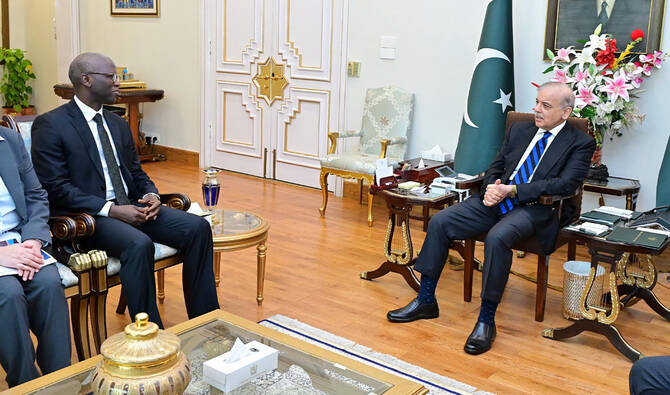
Pakistan's Prime Minister Shehbaz Sharif (right)in conversation with Regional President of the World Bank, Ousmane Dione in Islamabad on July 24, 2025. (Government of Pakistan)
Short Url
Updated 24 July 2025
Follow

Pakistan welcomes World Bank stance on Indus Waters Treaty amid India suspension row

  • Shehbaz Sharif discusses World Bank’s Country Partnership Framework with its regional vice president
  • He also thanks the Bank for its assistance during Pakistan’s 2022 floods that killed over 1,700 people

ISLAMABAD: Prime Minister Shehbaz Sharif on Thursday welcomed the World Bank’s position against India’s unilateral suspension of the Indus Waters Treaty (IWT), describing it as “principled support” for Pakistan during a meeting with the Bank’s regional vice president, Ousmane Dione, who is currently visiting the country.

The IWT, brokered by the World Bank and signed in 1960, governs water sharing between India and Pakistan. Earlier this year, New Delhi announced it was placing the treaty “in abeyance” following a militant attack in Indian-administered Kashmir that killed 26 tourists.

Indian authorities blamed the attack on Pakistan, a charge Islamabad denied while calling for a transparent and impartial international investigation.

The incident also triggered a four-day military standoff between the two nuclear-armed neighbors, which ended with a US-brokered ceasefire on May 10.

“The Prime Minister appreciated the World Bank’s principled support for Pakistan’s legitimate position in light of India’s unilateral and illegal actions to undermine a key international agreement like the Indus Waters Treaty,” said a statement issued by the Prime Minister’s Office after Sharif’s meeting with Dione.

“He reaffirmed Pakistan’s commitment to international law, the pursuit of prosperity, and the maintenance of regional peace, and expressed his resolve to address all issues through dialogue,” it added.

The World Bank’s stance aligns with comments made by its president, Ajay Banga, in May, when he clarified that the IWT contains no provision for unilateral suspension or withdrawal, and that any changes to the agreement must be made mutually by both India and Pakistan.

Banga also noted the Bank’s role in the treaty is strictly administrative, to appoint dispute-resolution experts and manage a trust fund when required, adding the institution has no authority to intervene in political decisions by either country.

During their meeting, Sharif and Dione discussed ongoing development cooperation, including the World Bank’s Country Partnership Framework (CPF), a strategic roadmap for investments in energy, education, governance reforms, and climate resilience.

The prime minister also thanked the Bank for its “swift and generous assistance” during Pakistan’s 2022 floods, which killed over 1,700 people, displaced millions and devastated agricultural land and public infrastructure.

Dione, the Bank’s regional vice president for the Middle East, North Africa, Afghanistan and Pakistan (MENAAP), reaffirmed his institution’s commitment to deepening its engagement with Pakistan.

He praised the country’s ongoing macroeconomic stabilization efforts and expressed confidence in the current administration’s reform agenda aimed at restoring investor confidence and promoting inclusive, sustainable growth.


Pakistan’s deputy PM visits Saudi Arabia for OIC meeting on West Bank

Updated 8 sec ago
Follow

Pakistan’s deputy PM visits Saudi Arabia for OIC meeting on West Bank

  • The session will review Israel’s land registration move in occupied territory
  • Dar will present Pakistan’s stance on Israel’s settlements, annexation plan

ISLAMABAD: Pakistan’s Deputy Prime Minister and Foreign Minister Ishaq Dar embarked on a three-day visit to Saudi Arabia on Thursday, where he is scheduled to attend an emergency meeting of the Organization of Islamic Cooperation (OIC) in Jeddah to discuss Israel’s recent measures in the occupied West Bank.

Israel decided this month to approve land registration procedures in parts of the West Bank for the first time since 1967, drawing sharp criticism from Muslim nations along with several European countries, which described it as a move to ease the path for settlement expansion and annexation.

These countries urged Israel in a joint statement to reverse its decision and end settler violence against Palestinian residents in the West Bank.

“Deputy Prime Minister/Foreign Minister Senator Mohammad Ishaq Dar @MIshaqDar60 has departed Islamabad for Saudi Arabia to attend the Open-Ended Extraordinary Ministerial Session of the Organization of Islamic Cooperation (#OIC) Executive Committee in Jeddah (26–28 February 2026),” the foreign office said in a social media post on X.

“He will hold sideline meetings with counterparts from OIC Member States,” it continued. “During the visit, he will also undertake brief visits to the Holy Cities.”

https://x.com/ForeignOfficePk/status/2026920463377830237?s=20

More than 500,000 Israelis live in settlements and outposts in the West Bank, excluding Israeli-annexed East Jerusalem, alongside nearly three million Palestinians.

Settlements are considered illegal under international law, a position Israel disputes.

Addressing a weekly media briefing during the day, Foreign Office Spokesperson Tahir Andrabi said the OIC conference would review Israel’s attempt to impose its sovereignty over the occupied West Bank.

“In the ministerial session of this OIC event, the Deputy Prime Minister and Foreign Minister will share Pakistan’s perspective on this latest illegal measure by Israel to convert areas of the occupied West Bank into the so-called state land,” he added.