

Pakistan signs maritime deal with Chinese shipping giant to boost fleet, attract investment

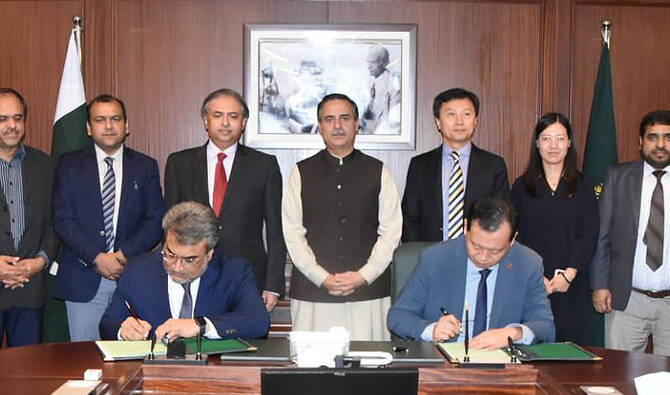
Pakistan's Federal Minister for Maritime Affairs, Junaid Anwar Chaudhry (center, standing) with delegation of China and Pakistan National Shipping Corporation in Islamabad, Pakistan, on July 24, 2025. (Government of Pakistan)
Short Url
Updated 24 July 2025
Follow

Pakistan signs maritime deal with Chinese shipping giant to boost fleet, attract investment

  • Chinese company’s cooperation with Pakistan is expected to cover ship acquisition and operational services
  • The development is part of Pakistan’s broader push to modernize shipping industry, enhance seaborne trade

KARACHI: Pakistan on Thursday signed a memorandum of understanding (MoU) with China’s Shandong Xinxu Group to deepen cooperation in ship leasing, sales and crew management, marking what officials described as a “new chapter” in maritime collaboration between the two countries.

The agreement between the Pakistan National Shipping Corporation (PNSC) and the Chinese firm is part of Islamabad’s broader push to modernize its shipping industry to enhance seaborne trade, Maritime Affairs Minister Muhammad Junaid Anwar Chaudhry said during the signing ceremony in Islamabad.

“This agreement marks the beginning of joint development,” Chaudhry said. “It will strengthen Pakistan’s role in the growth of the shipping industry and create an enabling environment for further investment in the maritime sector.”

Under the MoU, the Chinese company has principally agreed to provide capital and vessels to PNSC, with cooperation covering ship acquisition, leasing, marketing and operational services.

The announcement comes just days after Pakistan halved port charges at Karachi Port, the country’s largest deep-sea facility, as part of a series of reforms aimed at cutting logistics costs and supporting low-emission, climate-resilient maritime practices.

“By lowering operational costs and streamlining logistics, we are not only boosting trade competitiveness but also contributing to climate resilience,” Chaudhry said over the weekend.

The ministry has also decided to deploy technologies such as artificial intelligence and drones to monitor port activity and reduce container dwell times by up to 70 percent.

Shandong Xinxu is one of several Chinese firms expanding investment in Pakistan under the multibillion-dollar China-Pakistan Economic Corridor (CPEC) cooperation.


Majority market participants expect no rate change ahead of Dec. 15 Pakistan policy meeting – survey

Updated 7 sec ago
Follow

Majority market participants expect no rate change ahead of Dec. 15 Pakistan policy meeting – survey

  • Topline survey finds 70% expect State Bank to hold interest rate at 11%
  • Analysis cites flood-driven inflation risk, rising imports as key reasons for caution

ISLAMABAD: Most financial market participants expect Pakistan’s central bank to keep its benchmark interest rate unchanged at 11% when it meets on December 15, according to a new survey by brokerage Topline Securities.

Pakistan’s State Bank has held rates steady since May and maintained the same stance in October, its fourth consecutive pause, after recent floods had a milder-than-expected impact on crops and inflation. The central bank said earlier that the effects of previous interest rate cuts were still filtering through the economy, meaning businesses and consumers were still adjusting to cheaper borrowing. Because of that, the bank felt it was better to keep policy steady for now instead of cutting rates again.

The latest Topline poll reflects that sentiment, with investors largely expecting the bank to hold until inflation pressures ease more decisively. Pakistan has reduced rates sharply over the past 18 months — from a peak of 22% in 2024 to 11% at present — but policymakers have warned that price risks could rise again as imports pick up and agriculture recovers.

Topline said 70% of market participants expect no change, while 30% foresee a cut of 25–100 basis points. No respondents expect an increase despite one member of the SBP board having voted for a rate hike during the September meeting, according to published minutes.

“Continuation of status quo opinion in majority of the participants is driven by floods, higher inflation expected in the second half of FY26, and base effects,” Topline said in its note summarizing the poll.

The brokerage added that lowering rates too soon could encourage non-oil imports at a time when Pakistan is trying to consolidate gains in foreign exchange reserves and keep the balance of payments stable. Price pressure is expected to sit above the central bank’s medium-term 5–7% target range for several months before easing next fiscal year.

Yields in the secondary market also point to stability. Six-month treasury bills are trading near 10.97%, almost unchanged since October, while the six-month interbank benchmark stands at 11.16%.

Pakistan raised its GDP outlook in October to the upper half of its 3.25–4.25% projection range for fiscal year 2026, citing better crop output and improvements in industrial demand. 

The central bank expects reserves to rise to around $15.5 billion by the end of 2025 and close to $17.8 billion by June 2026, assuming planned inflows materialize.