

Pakistan’s deputy PM scheduled to chair Security Council meeting on UN-OIC cooperation today

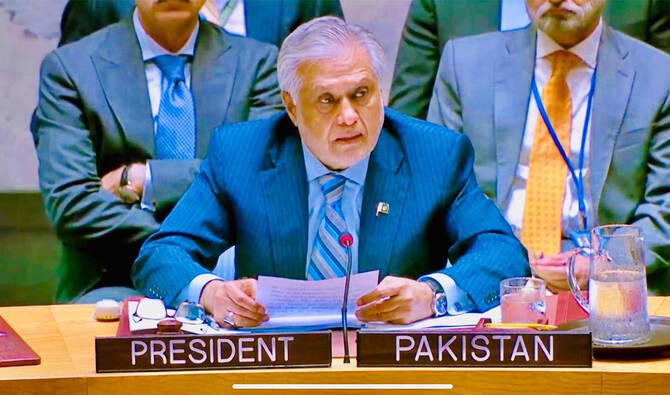
Pakistan's Deputy Prime Minister and Foreign Minister, Ishaq Dar, is presiding over the United Nations Security Council's open debate on the "Situation in the Middle East including the Palestinian Question" in New York, US, on July 23, 2025. (Pakistan's Foreign Office)
Short Url
Updated 24 July 2025
Follow

Pakistan’s deputy PM scheduled to chair Security Council meeting on UN-OIC cooperation today

  • Meeting is among the signature events of Pakistan’s UN Security Council presidency in the ongoing month
  • A presidential statement urging deeper UN-OIC engagement is expected to be adopted during the session

ISLAMABAD: Pakistan’s Deputy Prime Minister and Foreign Minister Ishaq Dar is expected to chair a United Nations Security Council (UNSC) meeting today, Thursday, on ties between the United Nations and the Organization of Islamic Cooperation (OIC), according to Security Council Report, an independent entity that closely monitors the Council’s work.

The meeting is among the signature events of Pakistan’s UNSC presidency this month and falls under the broader agenda of UN cooperation with regional and subregional entities.

A presidential statement, initiated by Pakistan, is expected to be adopted unanimously during the session.

“The agreed text of the draft presidential statement notes the interest of utilising the existing and potential capabilities of the OIC, including through encouraging its member countries to resolve differences peacefully through dialogue, reconciliation, consultation, negotiation, good offices, mediation, and judicial settlement of disputes,” Security Council Report said.

“Among other issues, it recognizes the importance of OIC interaction with the Peacebuilding Commission (PBC) in support of nationally owned peacebuilding efforts and commends OIC member states for their commitment to international peacekeeping and peacebuilding, including through the contribution of troops to UN peacekeeping operations,” it added.

Founded in 1969, OIC includes 57 member states across four continents and serves as a platform for collaboration on political, economic and social issues affecting Muslim communities.

Presidential statements are formal expressions of the Council’s consensus but are not legally binding. They require unanimous approval and are often preceded by complex negotiations.

In a concept note circulated earlier this month, Pakistan said the meeting aimed to take stock of UN-OIC collaboration and identify ways to deepen cooperation on peacekeeping, conflict prevention, counter-terrorism and institutional dialogue.

The note also posed questions about how the UN could help enhance the OIC’s conflict resolution capacity and better align institutional efforts on global peace and security.


Pakistan military says ex-PM Khan’s narrative has become ‘threat to national security’

Updated 7 sec ago
Follow

Pakistan military says ex-PM Khan’s narrative has become ‘threat to national security’

  • Military spokesperson responds to Khan’s fresh criticism of Pakistan’s powerful army chief, whom he accuses of denying him basic rights
  • Lt. Gen. Ahmed Sharif Chaudhry warns army will “come bare knuckle” if Khan and his party do not desist from attacking military leadership

ISLAMABAD: Pakistan military spokesperson Lt. Gen. Ahmed Sharif Chaudhry said on Friday that former prime minister Imran Khan’s narrative against the armed forces has become a “national security threat,” warning him and his party to keep the army out of political statements. 

Chaudhry’s criticism comes in response to Khan’s latest statement, released by his account on social media platform X on Thursday, in which he blamed Chief of Defense Forces Field Marshal Asim Munir for “the complete collapse of the constitution and rule of law in Pakistan.”

Khan, who was ousted via a parliamentary vote in April 2022, blames the country’s powerful army for colluding with his political rivals to keep him away from power. He blames the military and the incumbent government for keeping him in solitary confinement in a central prison in Rawalpindi. Pakistan’s military and the government have strongly rejected his claims. 

“It may seem to you a bit strange coming from me this because that person [Khan] and the narrative he is pushing, it has become a national security threat,” Chaudhry told reporters at a news conference. 

“And that is why it is very important that we come clear, without any ambiguity, without any doubt. We need to come clear and we need to say what needs to be said,” he added. 

Throughout the press conference, Chaudhry kept referring to the former prime minister as a “mentally ill” person. He played video clips of Indian news channels and Afghanistan’s social media accounts promoting Khan’s statements against the military. 

“Why would they not do it? Because sitting in your country, a mindset, a mentally ill person sitting here is saying these things against the military and its leadership,” he said. 

The military spokesperson warned Khan and his party against criticizing the military. He added that while the military welcomes constructive criticism, it should be kept away from political statements. 

“If someone for the sake of his own self, his delusional mindset and narcissistic thinking attacks this armed forces and its leadership, then we will also come bare knuckle,” he warned. 

“There should be no doubt on that.”

Khan, who remains in prison on a slew of charges that he says are politically motivated, continues to be popular among the masses. 

His Pakistan Tehreek-e-Insaf (PTI) party has frequently led rallies to demand his release from jail, including one in May 2023 and another in November 2024 that saw clashes with law enforcement personnel. 

While the former prime minister continues to remain behind bars, rallies organized by the PTI still draw thousands of people across the country and his party still enjoys a sizable following on social media platforms.