

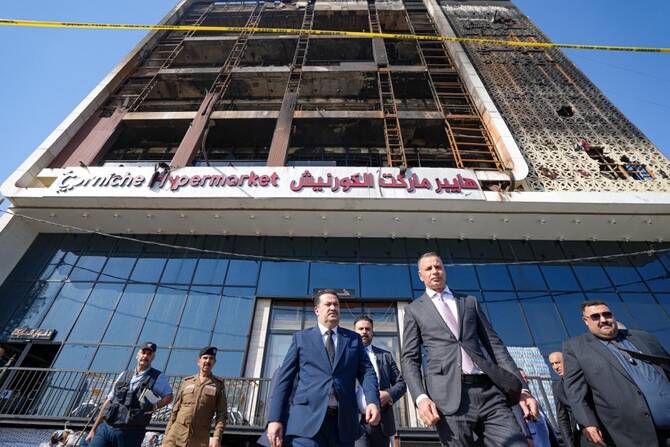
Iraqi governor quits after mall fire

The fire had sparked widespread public anger. (AFP)
Short Url
Updated 23 July 2025
Follow

Iraqi governor quits after mall fire

  • Mohammed Al-Miyahi said he resigned ‘in honor of the blood of the martyrs’

BAGHDAD: The governor of an Iraqi province where a fire in a shopping mall killed more than 60 people resigned Wednesday.

The fire last Wednesday tore through a newly opened shopping center in the town of Kut in Wasit province. 
While an investigation is ongoing, officials and residents have said that lack of safety measures in the building exacerbated the tragedy.
Provincial Gov. Mohammed Al-Miyahi said he had resigned “in honor of the blood of the martyrs, as they are in need of a gesture that may soothe part of their deep wounds, and in loyalty to them and to the people of this province.” 
The provincial council elected a new governor, Hadi Majid Kazzar.
The fire had sparked widespread public anger, with families of the victims demanding the governor’s dismissal and that others responsible for negligence be held accountable. 
They asserted that the blaze was the result of a long history of administrative corruption and weak oversight.
Iraqi parliament speaker Mahmoud Al-Mashhadani had sent an official request to Prime Minister Mohammad Shia Al-Sudani calling for the governor’s dismissal, and the Cabinet decided in a session on Tuesday to refer Al-Miyahi to the investigation.
Al-Miyahi previously said that the building owner did not implement fire safety measures and had not applied for required permits, and that legal complaints had been filed against the owner and shopping center owner.
Poor building standards have often contributed to tragic fires in Iraq. In July 2021, a blaze at a hospital in the city of Nasiriyah that killed between 60 to 92 people was determined to have been fueled by highly flammable, low-cost type of “sandwich panel” cladding that is illegal in Iraq.
In 2023, more than 100 people died in a fire at a wedding hall in the predominantly Christian area of Hamdaniya in Nineveh province after the ceiling panels above a pyrotechnic machine burst into flames.


Trial opens in Tunisia of NGO workers accused of aiding migrants

Updated 3 sec ago
Follow

Trial opens in Tunisia of NGO workers accused of aiding migrants

  • Aid workers accused of assisting irregular migration to Tunisia went on trial on Monday, as Amnesty International criticized what it called “the relentless criminalization of civil society”
TUNIS: Aid workers accused of assisting irregular migration to Tunisia went on trial on Monday, as Amnesty International criticized what it called “the relentless criminalization of civil society” in the country.
Six staff members of the Tunisian branch of the France Terre d’Asile aid group, along with 17 municipal workers from the eastern city of Sousse, face charges of sheltering migrants and facilitating their “illegal entry and residence.”
If convicted, they face up to 10 years in prison.
Migration is a sensitive issue in Tunisia, a key transit point for tens of thousands of people seeking to reach Europe each year.
A former head of Terre d’Asile Tunisie, Sherifa Riahi, is among the accused and has been detained for more than 19 months, according to her lawyer Abdellah Ben Meftah.
He told AFP that the accused had carried out their work as part of a project approved by the state and in “direct coordination” with the government.
Amnesty denounced what it described as a “bogus criminal trial” and called on Tunisian authorities to drop the charges.
“They are being prosecuted simply for their legitimate work providing vital assistance and protection to refugees, asylum seekers and migrants in precarious situations,” Sara Hashash, Amnesty’s deputy MENA chief, said in the statement.
The defendants were arrested in May 2024 along with about a dozen humanitarian workers, including anti-racism pioneer Saadia Mosbah, whose trial is set to start later this month.
In February 2023, President Kais Saied said “hordes of illegal migrants,” many from sub-Saharan Africa, posed a demographic threat to the Arab-majority country.
His speech triggered a series of racially motivated attacks as thousands of sub-Saharan African migrants in Tunisia were pushed out of their homes and jobs.
Thousands were repatriated or attempted to cross the Mediterranean, while others were expelled to the desert borders with Algeria and Libya, where at least a hundred died that summer.
This came as the European Union boosted efforts to curb arrivals on its southern shores, including a 255-million-euro ($290-million) deal with Tunis.