

Indonesia stands to lose in ‘historic’ Trump trade deal, experts say

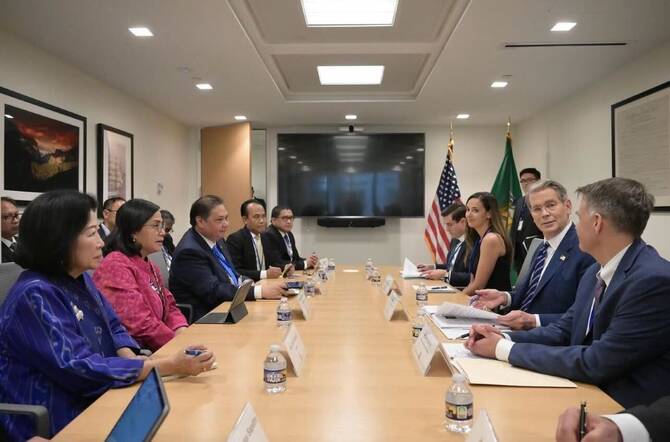
Indonesia’s senior economics minister Airlangga Hartarto and finance minister Sri Mulyani lead tariff talks with US Secretary of the Treasury Scott Bessent, Washington, Apr. 24, 2025. (Indonesia MoF)
Short Url
Updated 23 July 2025
Follow

Indonesia stands to lose in ‘historic’ Trump trade deal, experts say

  • Jakarta to cut tariffs, scrap non-tariff barriers on US goods under new trade agreement
  • US is Indonesia’s second-largest export market, with 2024 exports valued at over $26bn

JAKARTA: Indonesia’s new tariff deal granting the US duty-free access to its market is likely to undermine Southeast Asia’s largest economy, experts say, as the White House announced the agreement’s detailed terms on Wednesday.

Jakarta has agreed to drop its tariff on nearly all American imports to zero and scrap all non-tariff barriers facing American firms, while US tariffs on Indonesian imports would be set at 19 percent, according to a joint statement released by the White House.  

The framework on the US-Indonesia Agreement on Reciprocal Trade was issued following negotiations that took place earlier this month, after President Donald Trump threatened to levy a 32 percent duty on Indonesian exports. 

“The golden age is here … The United States and Indonesia have reached a historic trade deal,” the White House said.

The agreement will also exempt US food and agricultural products from Indonesia’s import licensing regimes, remove barriers for digital trade and remove export restrictions on critical minerals.

Jakarta’s new deal with Washington, which is expected to be finalized in the coming weeks, is putting Indonesia at a disadvantage, experts say. 

“This deal is not benefiting us. We used to face zero tariffs and now it’s 19 percent. Even though this is lower than 32 percent, Indonesia shouldn’t have accepted the deal because we stand to lose here,” Yose Rizal Damuri, executive director at the Jakarta-based Center for Strategic and International Studies, told Arab News. 

The US is Indonesia’s second-largest market after China, with exports valued at over $26 billion in 2024, according to Indonesia’s statistics agency.  

Indonesia has consistently posted trade surpluses with the US in the past decade. Last year, that figure stood at about $16.8 billion. 

The White House’s statement also mentioned “forthcoming commercial deals between US and Indonesian companies,” including aircraft procurement valued at $3.2 billion, purchase of agriculture products such as soybeans, wheat and cotton valued at $4.5 billion, as well as a $15 billion purchase of energy products. 

Indonesia is among other Southeast Asian nations, including Vietnam and the Philippines, which have negotiated for a better tariff deal with the Trump administration.

Vietnam, which agreed to zero tariffs on American exports and 20 percent on its own goods, had a “better” deal compared to Indonesia, said Bhima Yudhistira, executive director at Jakarta-based think tank Centre of Economic and Law Studies.  

“Vietnam’s tariff reduction from 46 per cent to 20 per cent is more significant than Indonesia’s tariff reduction from 32 per cent to 19 per cent. Vietnam’s negotiations were more effective than Indonesia’s. Ideally, Indonesia could achieve even greater reduction,” Yudhistira told Arab News. 

The tariff deal also posed a “high risk” to Indonesia’s trade balance.  

“The government should push for market access to Europe as a form of market diversification … as well as the intra-ASEAN (Association of Southeast Asian Nations) market,” Yudhistira said. 

“It’s better not to depend on exports to the US because the result of these tariff negotiations is still unfavorable to Indonesia.” 


France probes ‘foreign interference’ after malware found on ferry

Updated 2 sec ago
Follow

France probes ‘foreign interference’ after malware found on ferry

PARIS: France is probing possible foreign interference after a Latvian national was arrested and charged over the discovery on a passenger ferry of malware capable of allowing the vessel’s operating systems to be be controlled remotely, the interior minister said Wednesday.
The malware was found on the passenger ferry the Fantastic with a capacity of over 2,000 passengers, belonging to Italian shipping company GNV while it was docked in France’s Mediterranean port of Sete, Paris prosecutors said.
Italian authorities had warned France that the operating system of the vessel could have been infected by a malware known as a Remote access Trojan (RAT) which allows a hacker to gain remote control of a system.
Two crew members, a Latvian and a Bulgarian, whose identities had been signalled to France by the Italian authorities, were detained last week. The Bulgarian was freed but the Latvian charged and placed under arrest in the investigation.
The office of the Paris prosecutor said late Tuesday it had opened an investigation into a suspected bid “by an organized group to attack an automated data-processing system, with the aim of serving the interests of a foreign power.”

- Security warnings about Russia -

France and other European governments have warned that Russia is stepping up a campaign of interference more than three and a half years into its war against Ukraine.
“This is a very serious matter... individuals tried to hack into a ship’s data-processing system,” Interior Minister Laurent Nunez told France Info radio early Wednesday.
“Investigators are obviously looking into interference. Yes, foreign interference,” he said.
Nunez refused to be drawn over whether the attack was aimed at diverting the ship from its route and did not name Russia.
But he said: “These days one country is very often behind foreign interference.”
In a sign of the gravity of the case, the investigation is being led by France’s domestic intelligence service, the General Directorate for Internal Security (DGSI).
After being cordoned off in port, the Fantastic was subjected to an emergency inspection by the DGSI, which led to the seizure of several items.
The vessel was subsequently cleared to sail again after receiving approval from maritime authorities, after technical checks were completed and any danger to those on board ruled out.
Emergency searches were also conducted in Latvia with the support of Eurojust, the European Union’s judicial cooperation arm, and the Latvian authorities.
The Latvian national’s lawyer Thibault Bailly said he believed the “theory of Russian interference evoked in the press seems superfluous.”
“The investigation will shed light on several aspects of this case that are still unclear. In particular, it will demonstrate that this case is not as worrying as it may have initially seemed,” he added.