

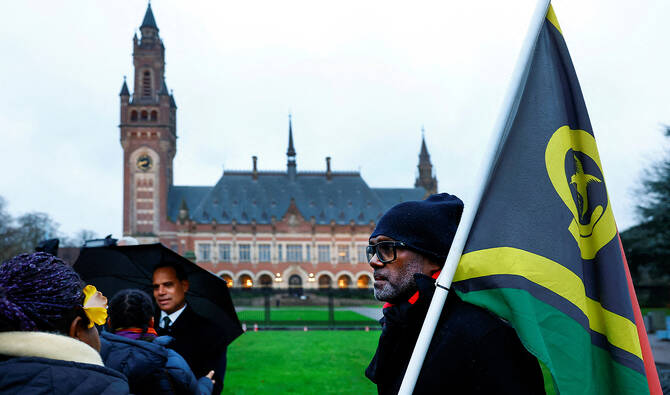

THE HAGUE: The world’s top court will Wednesday deliver a seminal ruling laying out what legal obligations countries have to prevent climate change and whether polluters should pay up for the consequences.
It is the biggest case ever heard at the International Court of Justice and experts say the judges’ opinion could reshape climate justice, with major impacts on laws around the world.
“I think it will be a game-changer for the whole climate discourse we’re going through,” said Ralph Regenvanu, climate change minister of Vanuatu.
The Pacific island nation spearheaded the push for a court opinion amid growing frustration at sluggish progress in UN climate negotiations.
“We’ve been going through this for 30 years... It’ll shift the narrative, which is what we need to have,” Regenvanu told AFP.
The United Nations has tasked the 15 judges at the ICJ, a UN court that adjudicates disputes between nations, to answer two fundamental questions.
First: what must states do under international law to protect the environment from greenhouse gas emissions “for present and future generations“?
Second: what are the consequences for states whose emissions have caused environmental harm, especially to vulnerable low-lying island states?
ICJ advisory opinions are not binding upon states and critics say that top polluters will simply ignore what comes out of the court.
But others note the moral and legal clout enjoyed by the world’s highest court and hope the opinion will make a tangible difference to national climate change policies and ongoing legal battles.
Andrew Raine, deputy director of the UN Environment Programme’s law division, said the ICJ should “clarify how international law applies to the climate crisis.”
“And that has ripple effects across national courts, legislative processes, and public debates,” he told AFP.
To help answer the two questions, ICJ judges have pored over tens of thousands of pages of submissions from countries and organizations around the world.
Analysts say Wednesday’s ruling is the most consequential of a string of recent rulings on climate change in international law as courts become a battleground for climate action.
Those bringing the cases are often from climate-vulnerable communities and countries, alarmed by the pace of progress toward curbing planet-warming pollution from fossil fuels.
The Paris Agreement struck through the UN Framework Convention on Climate Change (UNFCCC) has rallied a global response to the crisis, but not at the speed necessary to protect the world from dangerous overheating.
In December, the iconic Peace Palace in the Hague hosted the court’s biggest-ever hearings, with more than 100 nations and groups giving oral statements.
In what was billed a “David Vs Goliath” battle, the debate pitted major wealthy economies against smaller, less developed states most at the mercy of a warming planet.
Major polluters including the US and India warned the ICJ not to deliver a fresh legal blueprint for climate change, arguing the existing UNFCCC sufficed.
The US, which has since withdrawn from the Paris accord, said the UNFCCC contained legal provisions on climate change and urged the court to uphold this regime.
But smaller states said this framework was inadequate to mitigate climate change’s devastating effects and that the ICJ’s opinion should be broader.
These states also urged the ICJ to impose reparations on historic polluters.
“The cardinal principle is crystal clear. Responsible states are required to make full reparation for the injury they have caused,” said Margaretha Wewerinke-Singh representing Vanuatu.
These states demanded a commitment and timeline to phasing out fossil fuels, monetary compensation when appropriate, and an acknowledgement of past wrongs.
Representatives from island states, many wearing traditional dress as they addressed the court for the first time in their country’s history, made passionate pleas to the robed judges.
“Despite producing less than 0.01 percent of greenhouse gas emissions, on the current trajectory of GHG emissions, Tuvalu will disappear completely beneath the waves that have been lapping our shores for millennia,” said Eselealofa Apinelu from Tuvalu.
Vishal Prasad, director of a campaign by Pacific Island students that pushed the issue before the court, said climate change will become “catastrophic as the years go by, if we do not course-correct.”
“The urgency of the matter, the seriousness of why we’re here, and how important this is, is not lost upon all Pacific Islanders, all small island countries,” he told AFP
“That’s why we’re looking to the ICJ.”


