
ISLAMABAD: Pakistan’s meteorological department on Tuesday warned of glacier lake outburst floods (GLOFs), flash floods and landslides in the country’s mountainous northern regions, as the national death toll from monsoon-related incidents climbed to 242, including at least 116 children.
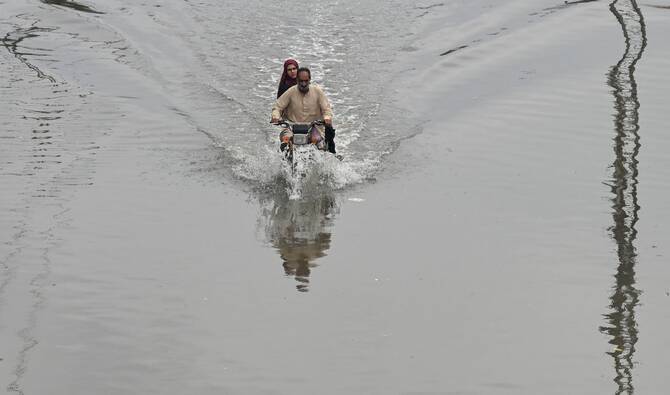
The warning comes amid ongoing heavy monsoon rains that have battered the country since late June, triggering urban flooding, house collapses and deadly flash floods.
At least 21 people, including 12 children, died in the past 24 hours alone, according to Pakistan’s National Disaster Management Authority (NDMA), with many of the fatalities reported from drowning, building collapses and fast-moving floodwaters.

The worst-hit province has been Punjab, Pakistan’s most populous region, where at least 135 people have died. Khyber Pakhtunkhwa (KP) reported 56 fatalities, followed by 24 in Sindh, 16 in Balochistan, six in the federal capital of Islamabad, three in Gilgit-Baltistan (GB) and two in Azad Jammu and Kashmir.
“In continuation to the GLOF alert issued dated July 15, the wet spell is likely to continue and can affect KP and GB in the current week,” the Pakistan Meteorological Department (PMD) said in a public statement.
“The prevailing weather conditions increase the risk of GLOFs, flashfloods, and landslide events in vulnerable glaciated regions of GB and KP.”
Glacier lake outburst floods, sudden discharges of water from glacial lakes, are a growing threat in Pakistan’s north due to accelerated glacial melting driven by climate change. These floods can inundate entire valleys in minutes, destroying roads, homes and livelihoods.
The PMD also warned of landslides and mudslides in areas such as Murree, Galliyat, Azad Kashmir, and Gilgit-Baltistan, cautioning that roads could be blocked and essential connectivity disrupted.
Heavy rains are forecast to continue until July 25.
CLIMATE CHANGE EFFECTS
On Tuesday, urban flooding also hit the capital Islamabad, with viral videos showing cars swept away by torrents of water in Saidpur Village and the upscale Defense Housing Authority (DHA) neighborhood.
One video widely circulated on social media showed a vehicle submerged in floodwater, with a man inside calling for help.
Prime Minister Shehbaz Sharif expressed sorrow over reports of a father and daughter believed to have drowned in the DHA flooding and directed authorities to expedite rescue operations across flood-affected areas.
The monsoon season typically brings 70 to 80 percent of South Asia’s annual rainfall, arriving in June in India and slightly later in Pakistan. While vital for agriculture, the rains also wreak havoc in countries with fragile infrastructure, poor drainage and high vulnerability to climate shocks.
Pakistan, home to more than 7,000 glaciers, is consistently ranked among the countries most at risk from climate change, despite contributing less than 1 percent to global greenhouse gas emissions. It has seen increasingly erratic weather patterns in recent years, including record-breaking heatwaves, droughts, and severe storms.
In May, at least 32 people were killed in separate incidents of torrential rainfall and hailstorms across the country.
In 2022, catastrophic floods caused by a combination of unprecedented monsoon rains and glacial melt submerged nearly a third of Pakistan, killing more than 1,700 people and displacing over 8 million.
That disaster inflicted an estimated $30 billion in economic losses and prompted repeated UN calls for global climate reparations.