

WFP warns Gaza is on brink of full scale famine

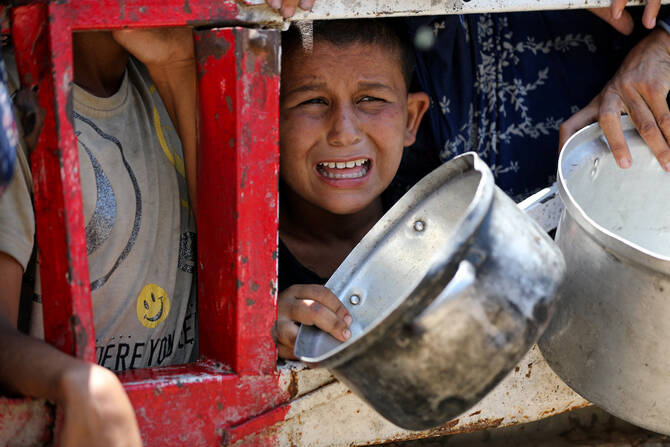
A child reacts as Palestinians gather to receive food from a charity kitchen, amid a hunger crisis, in Gaza City, July 22, 2025. (Reuters)
Short Url
Updated 22 July 2025
Follow

WFP warns Gaza is on brink of full scale famine

  • UN official warns a quarter of the population at risk suffering from acute food shortages
  • Secretary-General Guterres demands protection for civilians harmed by gunfire at aid sites

NEW YORK: The UN World Food Programme warned on Monday that Gaza is teetering on the brink of full-scale famine, with nearly 100,000 women and children suffering from severe acute malnutrition amid rapidly deteriorating humanitarian conditions.

Speaking to reporters at a UN briefing, senior WFP official Ross Smith said that hunger is worsening, and humanitarian access has been severely restricted. 

“A quarter of the population are facing famine-like conditions,” he said. “People are dying from lack of assistance every day.”

Smith stressed that food and humanitarian aid are the only viable solutions at present, but movement inside Gaza remains perilous and limited. “The markets are non-functional. Nothing is really moving inside Gaza for us,” he said, outlining the “minimum operating conditions” required to respond effectively. These include functioning border crossings, reduced wait times and security approvals, and the ability to transport goods freely and safely.

He said the WFP requires a minimum of 100 aid trucks to enter Gaza daily to meet urgent needs. “Until we have that scale of assistance, it’s going to be really, really difficult to control the situation on the ground.”

Smith called for all armed actors to stay away from aid convoys and distribution points. 

Over the weekend scores of people were killed when a crowd surged around a WFP food convoy near a Gaza checkpoint.

“We cannot independently verify the death toll,” Smith said, noting WFP staff on the ground reported at least 40 fatalities, though other reports suggest as many as 80. “One death is too many. This is far, far too many.”

He denied any indication the incident was organized by militant groups, instead pointing to growing desperation among civilians. “These were people putting their lives on the line, trying to get something off a truck,” he said.

Fuel shortages and logistical hurdles continue to hamper aid distribution. Since mid-May, the WFP has managed to deliver less than 10 percent of the required food assistance. Smith said the agency has enough supplies pre-positioned outside Gaza to support the entire population for two months — provided a ceasefire is in place and aid routes are secured.

“We have the capacity, but we need a ceasefire,” he added.

The UN does not use armed escorts for its convoys and has no operational relationship with the Gaza Humanitarian Foundation, Smith confirmed. While the GHF has pushed for collaboration, no agreements are currently in place.

Smith warned that time is running out for thousands at risk of starvation. “Severe acute malnutrition, particularly in children, carries a very high mortality risk. They need treatment immediately,” he said.

The UN continues to press for adherence to existing humanitarian agreements and call for a ceasefire to prevent further tragedy. “Yesterday’s incident is one of the greatest tragedies we’ve seen in Gaza,” Smith said. “It was completely avoidable.”

Meanwhile, the UN Office for the Coordination of Humanitarian Affairs warned that a new mass displacement order issued by the Israeli military is further eroding Gaza’s already collapsing humanitarian infrastructure. 

The directive, covering four neighborhoods in Deir Al-Balah, has forced thousands to flee, with an estimated 50,000 to 80,000 people in the affected area at the time of the order, including 30,000 already displaced sheltering at 57 sites. 

UN staff remain stationed at dozens of locations within the area, and OCHA has stressed that all civilian and humanitarian sites must be protected regardless of military operations.

The order encompasses critical infrastructure, including four health clinics, humanitarian warehouses, and essential water systems such as Gaza’s Southern Desalination Plant. OCHA warned that any damage to these facilities could have life-threatening consequences for civilians. 

Nearly 88 percent of the Gaza Strip now falls under displacement orders or Israeli-controlled zones, effectively confining 2.1 million people to just 12 percent of the territory. 

By cutting across Deir Al-Balah to the Mediterranean, the order further fragments the enclave, choking off humanitarian access.

UN Secretary-General Antonio Guterres expressed serious concern over the latest Israeli evacuation order. He said UN staff remain in the area, despite two UN guesthouses being hit in recent days, even after their coordinates had been shared with the relevant parties. 

“These sites must be protected,” Guterres said, calling once again for the protection of civilians, humanitarian personnel, and infrastructure. He reiterated his urgent appeal for unimpeded delivery of aid and repeated his call for the immediate and unconditional release of all hostages.

Guterres condemned growing reports of malnutrition among children and adults, and denounced the continued violence — including against people trying to access food. 

“Civilians must never be targeted,” Guterres said, adding that Israel is obligated under international law to facilitate humanitarian relief. He stressed that the population remains gravely undersupplied with essentials such as food, water, and medicine.


US military launches strikes in Syria against Daesh fighters after American deaths

Updated 20 December 2025
Follow

US military launches strikes in Syria against Daesh fighters after American deaths

  • “This is not the beginning of a war — it is a declaration of vengeance,” Defense Secretary Pete Hegseth says
  • President Trump earlier pledged “very serious retaliation” but stressed that Syria was fighting alongside US troops

WASHINGTON: The Trump administration launched military strikes Friday in Syria to “eliminate” Daesh group fighters and weapons sites in retaliation for an ambush attack that killed two US troops and an American interpreter almost a week ago.
A US official described it as “a large-scale” strike that hit 70 targets in areas across central Syria that had Daesh (also known as Islamic State or IS) infrastructure and weapons. Another US official, who also spoke on condition of anonymity to discuss sensitive operations, said more strikes should be expected.
The attack was conducted using F-15 Eagle jets, A-10 Thunderbolt ground attack aircraft and AH-64 Apache helicopters, the officials said. F-16 fighter jets from Jordan and HIMARS rocket artillery also were used, one official said.
“This is not the beginning of a war — it is a declaration of vengeance. The United States of America, under President Trump’s leadership, will never hesitate and never relent to defend our people,” Defense Secretary Pete Hegseth said on social media.


President Donald Trump had pledged “very serious retaliation” after the shooting in the Syrian desert, for which he blamed Daesh. The troops were among hundreds of US troops deployed in eastern Syria as part of a coalition fighting the terrorist group.
Trump in a social media post said the strikes were targeting Daesh “strongholds.” He reiterated his support for Syrian President Ahmad Al-Sharaa, who he said was “fully in support” of the US effort to target the militant group.
Trump also offered an all-caps threat, warning the group against attacking US personnel again.
“All terrorists who are evil enough to attack Americans are hereby warned — YOU WILL BE HIT HARDER THAN YOU HAVE EVER BEEN HIT BEFORE IF YOU, IN ANY WAY, ATTACK OR THREATEN THE USA.,” the president added.
The attack was a major test for the warming ties between the United States and Syria since the ouster of autocratic leader Bashar Assad a year ago. Trump has stressed that Syria was fighting alongside US troops and said Al-Sharaa was “extremely angry and disturbed by this attack,” which came as the US military is expanding its cooperation with Syrian security forces.
Syria’s foreign ministry in a statement on X following the launch of US strikes said that last week’s attack “underscores the urgent necessity of strengthening international cooperation to combat terrorism in all its forms” and that Syria is committed “to fighting Daesh and ensuring that it has no safe havens on Syrian territory and will continue to intensify military operations against it wherever it poses a threat.”


Daesh has not claimed responsibility for the attack on the US service members, but the group has claimed responsibility for two attacks on Syrian security forces since, one of which killed four Syrian soldiers in Idlib province. The group in its statements described Al-Sharaa’s government and army as “apostates.” While Al-Sharaa once led a group affiliated with Al-Qaeda, he has had a long-running enmity with Daesh.
Syrian state television reported that the US strikes hit targets in rural areas of Deir ez-Zor and Raqqa provinces and in the Jabal Al-Amour area near Palmyra. It said they targeted “weapons storage sites and headquarters used by Daesh as launching points for its operations in the region.”

Trump this week met privately with the families of the slain Americans at Dover Air Force Base in Delaware before he joined top military officials and other dignitaries on the tarmac for the dignified transfer, a solemn and largely silent ritual honoring US service members killed in action.

President Donald Trump, from left, Defense Secretary Pete Hegseth and Chairman of the Joint Chiefs Air Force Gen. Dan Caine attend a casualty return ceremony at Dover Air Force Base, Delaware, on Dec. 17, 2025,of soldiers who were killed in an attack in Syria last week. (AP)

The guardsmen killed in Syria last Saturday were Sgt. Edgar Brian Torres-Tovar, 25, of Des Moines, and Sgt. William Nathaniel Howard, 29, of Marshalltown, according to the US Army. Ayad Mansoor Sakat, of Macomb, Michigan, a US civilian working as an interpreter, was also killed.
The shooting nearly a week ago near the historic city of Palmyra also wounded three other US troops as well as members of Syria’s security forces, and the gunman was killed. The assailant had joined Syria’s internal security forces as a base security guard two months ago and recently was reassigned because of suspicions that he might be affiliated with Daesh, Interior Ministry spokesperson Nour Al-Din Al-Baba has said.
The man stormed a meeting between US and Syrian security officials who were having lunch together and opened fire after clashing with Syrian guards.
When asked for further information, the Pentagon referred AP to Hegseth’s social media post.