

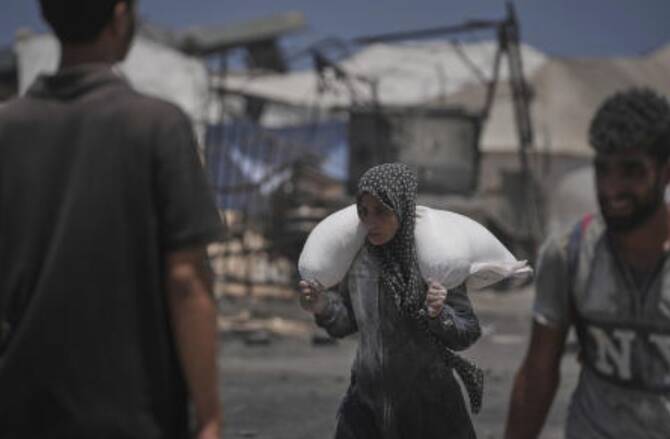

BRUSSELS: EU foreign policy chief Kaja Kallas told her Israeli counterpart Tuesday that Israel’s military “must stop” killing civilians at aid distribution points in Gaza.
Kallas wrote on X that “the killing of civilians seeking aid in Gaza is indefensible.”
“I spoke again with Gideon Saar to recall our understanding on aid flow and made clear that IDF must stop killing people at distribution points,” she wrote.
The European Union early this month said it had struck a deal with Israel to allow more access into Gaza amid Israel’s devastating military operation.
Kallas has laid out a series of actions that EU states could take against Israel unless the dire humanitarian situation in Gaza improves.
“All options remain on the table if Israel doesn’t deliver on its pledges,” Kallas wrote in a post on X.
European Commission president Ursula von der Leyen joined the calls by saying “civilians cannot be targets. Never.”
“The images from Gaza are unbearable,” von der Leyen wrote.
“Civilians in Gaza have suffered too much, for too long. It must stop now. Israel must deliver on its pledges.”
The killing of civilians seeking aid in Gaza is indefensible. All options remain on the table if Israel doesn’t deliver on its pledges.
Kaja Kallas, EU foreign policy chief
In Geneva on Tuesday, the UN said Israeli forces have killed over 1,000 Palestinians trying to get food aid in Gaza since the US- and Israel-backed Gaza Humanitarian Foundation started operations.
An officially private effort, the GHF began operations on May 26 after Israel halted supplies into the Gaza Strip for more than two months, sparking famine warnings.
GHF operations have been marred by chaotic scenes and near-daily reports of Israeli forces firing on people waiting to collect rations in the Palestinian territory, where the Israeli military is seeking to destroy Hamas.
“Over 1,000 Palestinians have now been killed by the Israeli military while trying to get food in Gaza since the Gaza Humanitarian Foundation started operating,” UN human rights office spokesman Thameen Al-Kheetan said.
“As of July 21, we have recorded 1,054 people killed in Gaza while trying to get food; 766 of them were killed in the vicinity of GHF sites and 288 near UN and other humanitarian organizations’ aid convoys.”
Kheetan added: “Our data is based on information from multiple reliable sources on the ground, including medical teams, humanitarian and human rights organizations.”
GHF says it has distributed more than 1.4 million boxes of foodstuffs to date.
“We’re adjusting our operations in real time to keep people safe and informed, and we stand ready to partner with other organizations to scale up and deliver more meals to the people of Gaza,” GHF interim director John Acree said Monday.
The United Nations and major aid groups have refused to cooperate with the GHF over concerns it was designed to cater to Israeli military objectives and violates basic humanitarian principles.


