

Tourists and laborers seek respite as Greece and Balkans gripped by heatwave

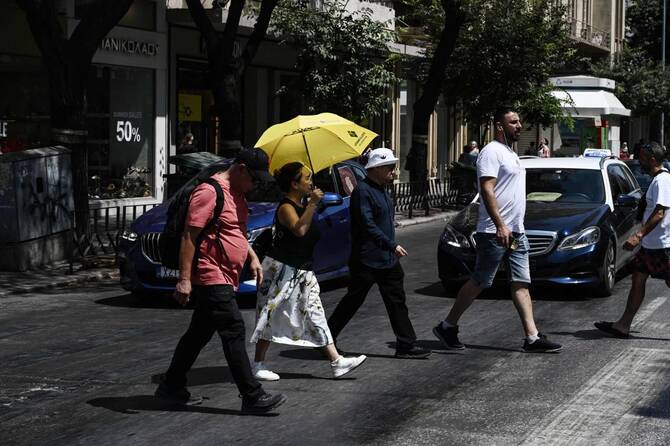
A woman walks with un umbrella in the centre of Thessaloniki on July 20, 2025. (AFP)
Short Url
Updated 22 July 2025
Follow

Tourists and laborers seek respite as Greece and Balkans gripped by heatwave

  • Research published last week showed that the soil surface temperature around Athens rose in some places by as much as 10 degrees Celsius since July 2024

ATHENS: Laborers were pausing outdoor work and tourists seeking out shade on Tuesday as Greece sweltered under its third heatwave of the summer and soaring temperatures gripped the wider Balkan region, fueling wildfires in Albania.

Situated at Europe’s southernmost tip, Greece, which attracts dozens of millions of tourists every year, has always had hot and dry summers. But in recent years climate change has led to longer and more severe heatwaves, as well as destructive floods and wildfires.

Couriers, food delivery riders and builders in the wider area of the Greek capital Athens and other regions were among those ordered to pause work from midday until 5 p.m., as the mercury was expected to climb as high as 43 degrees Celsius, the labor ministry said. Workers with underlying health issues were advised to work remotely to avoid heat stress.

Outside the parliament building in central Athens, a soldier used a towel to wipe the sweat from the face of a presidential guard.

Tourists in Athens, one of the most densely populated capitals in Europe sitting on a plain flanked by mountains, sought out air-conditioned restaurants and stores, and some said they were staying inside in the middle of the day.

ACROPOLIS SHUT

Authorities announced that the Acropolis, which sits on a rocky hill offering barely any shade and is Greece’s most visited ancient site, would be closed for five hours from midday on Tuesday and Wednesday, a common step when temperatures soar.

The heatwave will continue until Sunday, the Greek meteorological service said. Scorching heat also gripped neighboring Bulgaria on Tuesday, with authorities urging businesses to give away water and cut physical labor during high-risk hours.


In Montenegro, major roads were congested as many rushed to the beaches to find relief from the heat. In Albania, firefighters assisted by four aircraft from Italy and Greece battled two wildfires at a national park in the north and near the southwestern village of Dukat.

Last month, large parts of Western Europe sweltered in another severe heatwave that left many dead and triggered forest fires and health alerts across the region. Across the globe, 2024 was the warmest year on record, with temperatures exceeding 1.5 Celsius above the pre-industrial era for the first time.

Research published last week showed that the soil surface temperature around Athens rose in some places by as much as 10 degrees Celsius since July 2024 after fires destroyed vegetation.


South Sudan officers face court martial over civilian massacre

Updated 17 sec ago
Follow

South Sudan officers face court martial over civilian massacre

  • The increasingly unstable country is seeing a surge of fighting between government and opposition forces

JUBA: South Sudanese soldiers, including two officers, will face a court martial over a civilian massacre last month, the army spokesman said Wednesday.

The increasingly unstable country is seeing a surge of fighting between government and opposition forces, much of it in eastern Jonglei state where at least 280,000 people have been displaced since December according to the UN.

At least 25 civilians, including women and children, were killed in Ayod County in Jonglei state on February 21, according to the opposition.

Army spokesman Lul Ruai Koang said that two officers, including a major, and several non-commissioned officers, had been arrested and would face charges in the capital Juba, “before they are arraigned before a competent military court martial.”

He said the deaths were attributed to “some elements” under Gen. Johnson Olony, who was filmed in January ordering troops to “spare no lives” in Jonglei.

Koang said the soldiers had “moved out without the knowledge or authorization of the division commander.”

He also said they had been part of a militia group allied to opposition forces, parts of which had not yet been fully integrated into the army.

Military integration was among the core principles of a peace agreement that ended South Sudan’s five-year civil war in 2018 between President Salva Kiir and his long-time rival, Riek Machar, but it was never implemented.

Koang said the army regretted the loss of lives, adding: “We would like to once again remind our forces that their mandate is to protect civilians and their property, not to do the opposite.”

It followed an impassioned plea from the Sudan and South Sudan Catholic Bishops’ Conference on recent civilian killings — in Ayod, and also in Abiemnom County near the Sudan border where at least 169 people were killed on Sunday.

“We implore you to deploy resources to protect vulnerable populations and foster a climate of dialogue and reconciliation instead of violence and revenge, consoling the bereaved and supporting the afflicted,” it said in a statement.