

Kurdish farmers return to mountains in peace as PKK tensions calm

1 / 4
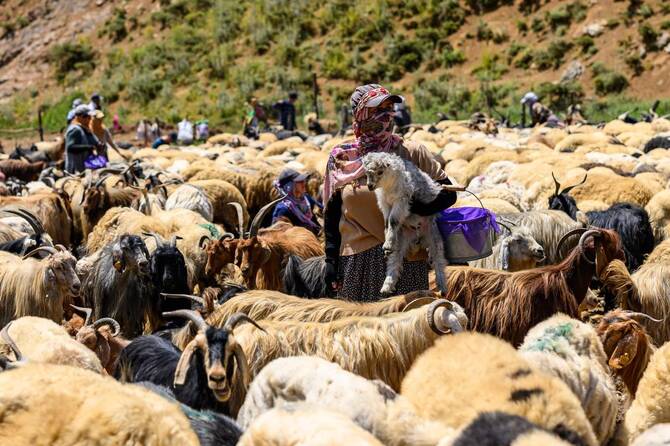
A Kurdish farmer carries a lamb amid a flock of sheep in the mountains of Turkiye’s southeastern Hakkari province on July 12, 2025. (AFP)
2 / 4
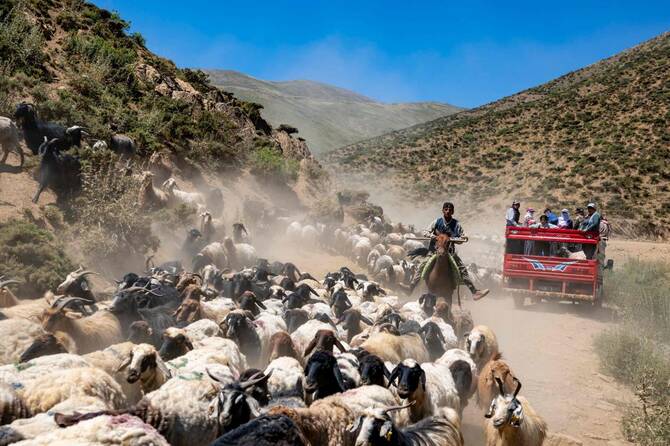
Kurdish workers sit in the back of a truck as it drives past a flock of sheep in the mountains of Turkiye’s southeastern Hakkari province on July 12, 2025. (AFP)
3 / 4
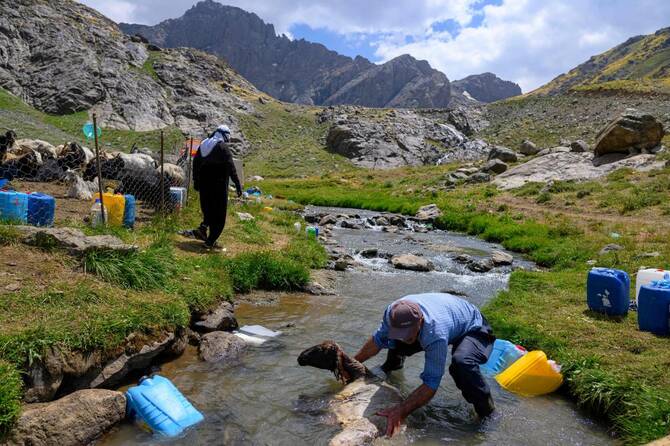
A Kurdish farmer washes a sheep to help it produce higher-quality wool in the mountains of Turkiye’s southeastern Hakkari province on July 12, 2025. (AFP)
4 / 4
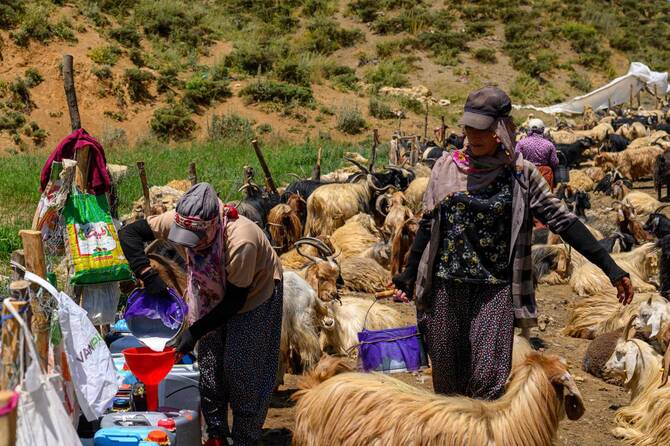
A Kurdish woman pours milk she collected into a jerrycan as she stands amid a flock of sheep in the mountains of Turkiye’s southeastern Hakkari province on July 12, 2025. (AFP)
Short Url
Updated 22 July 2025
Follow

Kurdish farmers return to mountains in peace as PKK tensions calm

  • The conflict has caused 50,000 deaths among civilians and 2,000 among soldiers
  • The Kurdistan Workers’ Party (PKK) was formed in 1978 by Ankara University students

TURKIYE: Deep in the mountains of Turkiye’s southeastern Hakkari province, bordering Iran and Iraq, Kurdish livestock owners and farmers have gradually returned with their animals after decades of armed conflict between Kurdish militants and the Turkish army.

“We’ve been coming here for a long time. Thirty years ago we used to come and go, but then we couldn’t come. Now we just started to come again and to bring our animals as we want,” said 57-year-old Selahattin Irinc, speaking Kurdish, while gently pressing his hand on a sheep’s neck to keep it from moving during shearing.

On July 11 a symbolic weapons destruction ceremony in Iraqi Kurdistan marked a major step in the transition of the Kurdistan Workers’ Party (PKK) from armed insurgency to democratic politics – part of a broader effort to end one of the region’s longest-running conflicts.

The PKK, listed as a terror group by Turkiye and much of the international community, was formed in 1978 by Ankara University students, with the ultimate goal of achieving the Kurds’ liberation. It took up arms in 1984.

The conflict has caused 50,000 deaths among civilians and 2,000 among soldiers, according to Turkiye’s President Recep Tayyip Erdogan.

Alongside with several other men and women, Irinc practices animal husbandry in the grassy highlands at the foot of the Cilo Mountains and its Resko peak, which stands as the second-highest in the country with an altitude of 4,137 meters (13,572 feet).

A place of scenic beauty, with waterfalls, glacial lakes and trekking routes, Cilo has gradually opened its roads over the past few years to shepherds and tourists alike as the armed conflict with PKK died down on the backdrop of peace negotiations.

But the picturesque mountains had long been the scene of heavy fighting between the Turkish army and PKK fighters who took advantage of the rough terrain to hide and strike. It left the Kurdish farmers often at odds with the army.

“In the past we always had problems with the Turkish soldiers. They accused us of helping PKK fighters by feeding them things like milk and meat from our herd,” another Kurdish livestock owner, who asked not to be named, said, rejecting such claims.

“Now it’s calmer,” he added.

Although the peace process brought more openness and ease to the region, tensions did not vanish overnight.

Checkpoints remain present around the city of Hakkari, and also to the main access point to the trekking path leading to Cilo glacier, a major tourist attraction.

“Life is quite good and it’s very beautiful here. Tourists come and stay in the mountains for one or two days with their tents, food, water and so on,” said farmer Mahir Irinc.

But the mountains are a hard, demanding environment for those making a living in their imposing shadow, and the 37-year-old thinks his generation might be the last to do animal husbandry far away from the city.

“I don’t think a new generation will come after us. We will be happy if it does, but the young people nowadays don’t want to raise animals, they just do whatever job is easier,” he lamented.

An open truck carrying more than a dozen Kurdish women made its way to another farm in the heart of the mountains, where sheep waited to be fed and milked.

The livestock graze at the foot of the mountains for three to four months, while the weather is warm, before being brought back to the village.

“We all work here. Mothers, sisters, our whole family. Normally I’m preparing for university, but today I was forced to come because my mother is sick,” explained 22-year-old Hicran Denis.

“I told my mother: don’t do this anymore, because it’s so tiring. But when you live in a village, livestock is the only work. There’s nothing else,” she said.


UN peacekeepers say Israeli forces fired on them in southern Lebanon

Updated 11 December 2025
Follow

UN peacekeepers say Israeli forces fired on them in southern Lebanon

  • “Yesterday, peacekeepers in vehicles patrolling the Blue Line were fired upon by IDF soldiers in a Merkava tank,” UNIFIL said
  • It said that both the peacekeepers and the Israeli tank were in Lebanese territory

BEIRUT: The United Nations Interim Force in Lebanon said Wednesday that Israeli forces fired on its peacekeepers a day earlier in the country’s south, urging Israel’s army to “cease aggressive behavior.”
It is the latest such incident reported by the peacekeepers in southern Lebanon, where UNIFIL acts as a buffer between Israel and Lebanon and has been working with Lebanon’s army to support a year-old truce between Israel and militant group Hezbollah.
“Yesterday, peacekeepers in vehicles patrolling the Blue Line were fired upon by IDF (Israeli army) soldiers in a Merkava tank,” a UNIFIL statement said, referring to the de facto border.
“One ten-round burst of machine-gun fire was fired above the convoy, and four further ten-round bursts were fired nearby,” the statement said.
It said that both the peacekeepers and the Israeli tank were in Lebanese territory at the time of the incident and that the Israeli military had been informed of the location and timing of the peacekeeping patrol in advance.
“Peacekeepers asked the IDF to stop firing through UNIFIL’s liaison channels... Fortunately, no one was injured,” it said.
Last month UNIFIL said Israeli soldiers shot at its troops in the south, while Israel’s military said it mistook blue helmets for “suspects” and fired warning shots.
In October, UNIFIL said one of its members was wounded by an Israeli grenade dropped near a UN position in the country’s south, the third incident of its kind in just over a month.
“Attacks on or near peacekeepers are serious violations of (UN) Security Council Resolution 1701,” UNIFIL said on Wednesday, referring to the 2006 resolution that formed the basis of the November 2024 truce.
“We call on the IDF to cease aggressive behavior and attacks on or near peacekeepers working to rebuild stability along the Blue Line,” the peacekeepers said.
Israel carries out regular attacks on Lebanon despite the truce, usually saying it is targeting sites and operatives belonging to Hezbollah, which it accuses of rearming.
It has also kept troops in five south Lebanon areas it deems strategic.
On Saturday, a UN Security Council delegation visiting Lebanon urged all parties to uphold the ceasefire.
It emphasized that the “safety of peacekeepers must be respected and that they must never be targeted,” after gunmen on mopeds attacked UNIFIL personnel last week.