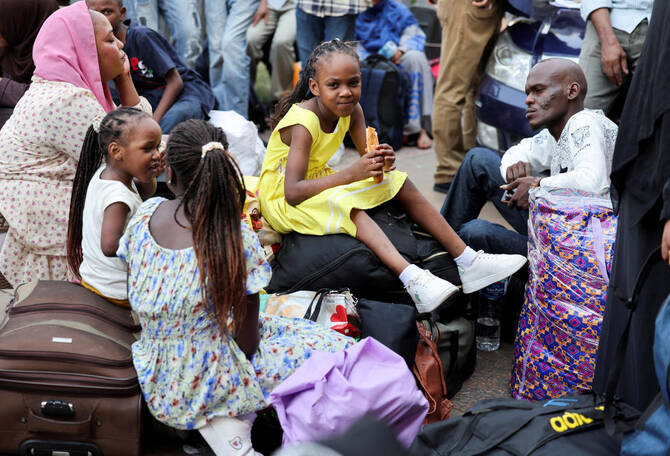
CAIRO: Hundreds of people who have been displaced by fighting in Sudan gathered Monday at the central train station in Cairo to begin a free journey home.
The Egyptian government is funding train rides to Khartoum, Sudan's capital, which recently was recaptured by the Sudanese Armed Forces from its rival, the paramilitary Rapid Support Forces, or RSF.
Sudan has been in the throes of civil war since April 2023. The battle for power between the military and the RSF has caused a humanitarian crisis. Over 40,000 people have been killed and the war has caused one of the world’s largest displacement emergencies.
Egypt hosts the largest number of Sudanese refugees from the war with over 1.5 million people who fled north across the border. Over 7 million have been displaced internally as the war engulfed much of the country. The RSF took Khartoum at the start of the fighting in 2023 and held the capital until the government declared its recapture on May 20.
Khartoum was largely destroyed, including the presidential palace and the airport, but is experiencing a slow rebirth as residents return and markets reopen. Electricity and basic services are not fully operational around the city.
The journey from Cairo to Khartoum is about 2,080 kilometers (1,292 miles) and will include a train ride of about 12 hours to the southern Egyptian city of Aswan, where riders will change to ferries and buses to cross into Sudan.
People packed their lives in small suitcases as they as they filled the train Monday. Some cried with “overwhelming emotions” including sadness and joy about leaving Egypt and returning home, said Sudanese journalist Asem al-Taieb, one of the train riders.
“I am happy because I am finally going back to my family and my children,” said Awatef al Hassan, originally from Omdurman, Sudan, who is returning with her daughter.

Egypt provides free train rides for Sudanese refugees returning home
https://arab.news/43kye
Egypt provides free train rides for Sudanese refugees returning home
- Egypt hosts the largest number of Sudanese refugees from the war with over 1.5 million people who fled north across the border
UN warns of abuse of Palestinians returning to Gaza through Rafah crossing
- Human Rights Office describes pattern of ill-treatment, abuse and humiliation of returnees by Israeli forces, and by armed Palestinians allegedly backed by Israeli military
- Meanwhile, reports continue of airstrikes, gunfire and shelling across Gaza, and Israeli forces demolish a UN-run school
NEW YORK CITY: The Rafah crossing on the border between Gaza and Egypt opened for a fourth consecutive day on Thursday, allowing a limited number of people to pass through.
However, the UN voiced concerns about reported mistreatment of Palestinians returning to the war-ravaged enclave.
The UN’s Office for the Coordination of Humanitarian Affairs also said reports continue across civilian areas in Gaza of airstrikes, gunfire and shelling, resulting in casualties and damage to infrastructure.
And Israeli forces on Wednesday demolished Jabalya Preparatory Boys’ School in northern Gaza, OCHA said. Run by the UN Relief and Works Agency for Palestine Refugees, it was the last remaining school in a compound of six. Its destruction means the entire educational complex has been razed to the ground.
A limited flow of people were allowed to use the Rafah crossing, Gaza’s main physical connection to the outside world, for four days in a row since it reopened on Monday, OCHA said. Only 98 returnees were received by UN teams inside Gaza between Monday and Thursday, it added, and the crossing remains closed on Fridays.
The UN Human Rights Office warned of what it described as a pattern of ill-treatment, abuse and humiliation of returnees by Israeli forces, and by armed Palestinians allegedly backed by the Israeli military.
According to accounts collected by the UN’s Human Rights Office, armed Palestinians handcuffed and blindfolded returnees, threatened and intimidated them, conducted searches and stole personal belongings and money. Returnees also reported violence, degrading interrogations and invasive body searches upon arrival at Israeli checkpoints.
The accounts point to conduct that violates the rights of Palestinians to personal security and dignity, and freedom from torture and other ill-treatment, the Human Rights Office said.
Meanwhile, the UN said it attempted to coordinate 11 humanitarian missions with the Israeli authorities on Wednesday and Thursday. Six were fully facilitated, but four faced lengthy delays at holding points along designated routes. Two of those missions were only partially completed, the other two eventually went ahead despite the delays.
A mission to monitor humanitarian cargo at the Kissufim crossing, east of Khan Younis, was denied on Wednesday after the crossing was closed.
The purposes of the missions included the collection of water, sanitation supplies, fuel and other items, medical evacuations through the Rafah crossing, and the transportation of returnees to Nasser Hospital in Khan Younis, OCHA said.


