

At UN forum, Pakistan urges global financial reforms, debt relief to bridge SDG funding gaps

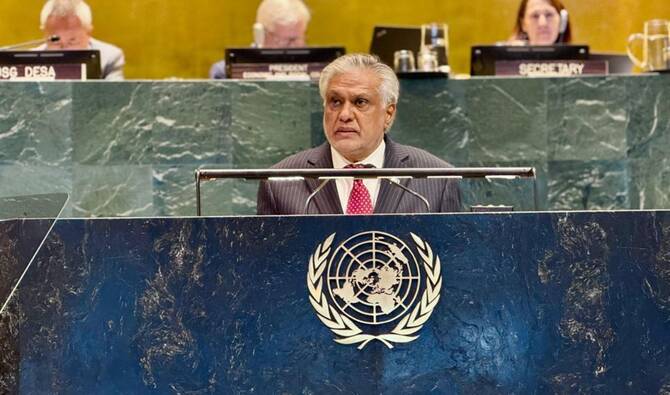
Pakistan’s Deputy Prime Minister Ishaq Dar speaks during his address at a debate of the High-Level Political Forum on Sustainable Development’s (HLPF) Ministerial Segment in New York on July 21, 2025. (@MIshaqDar50/ X)
Short Url
Updated 22 July 2025
Follow

At UN forum, Pakistan urges global financial reforms, debt relief to bridge SDG funding gaps

  • The comments by Pakistani deputy PM came at a debate of the High-Level Political Forum on Sustainable Development in New York
  • Deputy PM Ishaq Dar will preside over key events at the UN Security Council during Pakistan’s presidency for the month of July

ISLAMABAD: Pakistan’s Deputy Prime Minister Ishaq Dar on Monday stressed the need for concessional financing and debt relief for developing nations to bridge funding gaps in meeting global sustainable development goals (SDGs).

The comments came during Dar’s address at a debate of the High-Level Political Forum on Sustainable Development’s (HLPF) Ministerial Segment in New York for the follow-up and review of the 2030 Agenda for Sustainable Development and its 17 SDGs.

The 2025 HLPF is themed around advancing sustainable, inclusive, science- and evidence-based solutions for the 2030 Agenda and its SDGs, including good health and well-being, gender equality, decent work and economic growth.

Speaking at the forum, Dar said only 35 percent of the Agenda 2030 SDGs were on track and the compounding effects of the pandemic, food, fuel and finance crises as well as intensifying climate impacts had reversed the hard-won development gains and deepened inequalities.

“While national efforts are essential, these cannot succeed in isolation,” he said, calling for a “deep reform” of the international financial architecture to implement the SDGs.

“Developing countries need scaled up access to concessional and grant-based resources, meaningful debt relief, and scaled-up climate finance in order to bridge the SDG financing gap.”

The statement comes as Pakistan treads a long path to economic recovery while facing adverse impacts of climate change, with extreme weather events frequently affecting the South Asian country in recent years. So far this monsoon, more than 200 people have lost their lives in Pakistan as heavy rains continue to last parts of the country.

Dar said his country was scaling up climate action, targeting 60 percent renewable energy by 2030, and enhancing resilience through various initiatives.

“Our revised nationally determined contribution is nearing finalization,” he said. “We have also undertaken key macroeconomic reforms to stabilize our fiscal outlook and make the investment climate even more attractive.”

The Pakistani deputy PM said the Compromiso de Seville, a renewed global framework adopted at the Fourth International Conference on Financing for Development this month, offered a clear roadmap to tackle the challenges of financing sustainable development.

The framework focuses on closing the $4 trillion annual financing gap for the SDGs, addressing debt crises, and reforming the international financial system.

“Its implementation must begin without delay,” Dar added.

Dar is on a week-long visit to the United States to preside over the key events in the UN Security Council during Pakistan’s presidency for the month of July, according to the Pakistani foreign office.

He is also scheduled to hold a meeting with UN secretary-general as well as president of the UN General Assembly in New York.


Pakistan engages Saudi Arabia, China in bid to ease surging Middle East tensions 

Updated 10 March 2026
Follow

Pakistan engages Saudi Arabia, China in bid to ease surging Middle East tensions 

  • Pakistan’s foreign minister stresses need for de-escalation in conversations with Chinese, Saudi counterparts
  • Tensions in the Middle East continue to remain high as conflict between US, Israel and Iran intensifies

ISLAMABAD: Pakistan’s Deputy Prime Minister Ishaq Dar spoke to the foreign ministers of Saudi Arabia and China on Tuesday, stressing the importance of diplomatic engagement to de-escalate tensions in the Middle East as the Iran war intensifies. 

Pakistan has constantly engaged regional countries in efforts to broker a ceasefire in the Middle East, after the US and Isreal launched coordinated strikes against Iran on Feb. 28. 

Iran launched fresh attacks on Gulf countries on Tuesday morning, where it has targeted US military bases in recent weeks. In addition to firing missiles and drones at Israel and American bases in the region, Iran has also been targeting energy infrastructure which, combined with its stranglehold on the Strait of Hormuz, has sent oil prices soaring worldwide. 

Dar spoke to Saudi Foreign Minister Prince Faisal bin Farhan to discuss developments in the Middle East and ongoing deliberations at the UN Security Council, Pakistan’s foreign office said in a statement. 

“DPM/FM shared Pakistan’s perspective, underscoring the importance of continued coordination and diplomatic engagement to support de-escalation and promote peace and stability across the region and beyond,” the statement said. 

Dar, who also serves as Pakistan’s foreign minister, spoke to Chinese foreign minister Wang Yi over the telephone separately. The two discussed the evolving regional situation and broader global developments.

Dar underscored the need to ease tensions in the Middle East and the wider region during the conversation, the foreign office said. 

Yi appreciated Pakistan’s constructive efforts aimed at promoting de-escalation and stability in the region, it added. 

“The two leaders stressed the importance of de-escalation and emphasized the need to pursue dialogue and diplomacy in accordance with the principles of the UN Charter,” the foreign office’s statement said. 

The conflict in the Middle East has hit Pakistan hard as well, forcing Islamabad to hike petrol and diesel prices by Rs55 per liter last Friday. 

Pakistan’s government has also announced a set of austerity measures, which include closing schools and cutting down on government expenditures, as it evaluates petrol stocks and looks for alternative supply routes.