

Militants use drones to target Pakistani security forces, officials say

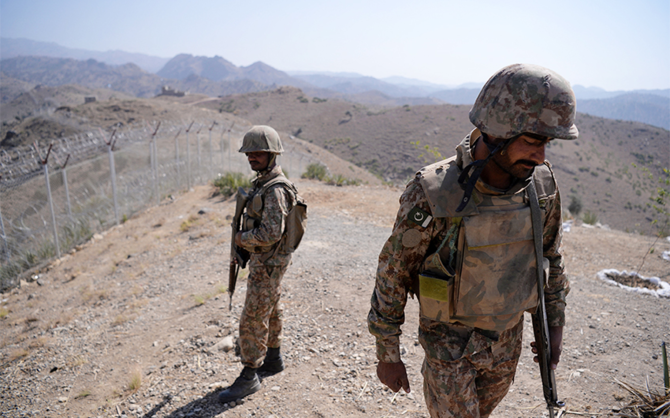
Pakistani soldiers patrol next to a newly fenced border fencing along Afghan border at Kitton Orchard Post in northwest Pakistan on October 18, 2017. (AFP/File)
Short Url
Updated 21 July 2025
Follow

Militants use drones to target Pakistani security forces, officials say

  • The use of such drones is worrying the overstretched, under-equipped police force, the frontline against militant attacks
  • At least eight such drone attacks have targeted police, security forces in Bannu and adjacent areas in two and a half months

PESHAWAR: Militants in Pakistan have started using commercially acquired quadcopter drones to drop bombs on security forces in the country’s northwest, police said, a potentially dangerous development in the volatile region.

The use of such drones, which are powered by four rotors allowing for vertical take-off and landing, is worrying the overstretched and under-equipped police force, the frontline against militant attacks, officials said.

Two quadcopters sent by the militants targeted a police station earlier this month, killing a woman and injuring three children in a nearby house in Bannu district, said police officer Muhammad Anwar.

A drone spotted over another police station on Saturday was shot down with assault rifles, he said. It was armed with a mortar shell, he said.

At least eight such drone attacks have targeted police and security forces in Bannu and adjacent areas in the last two and a half months, he said.

Regional police chief Sajjad Khan said militants were still trying to master the use of the drones.

“The militants have acquired these modern tools, but they are in the process of experimentation and that’s why they can’t hit their targets accurately,” he added. The militants are using the quadcopters to drop improvised explosive devices or mortar shells on their targets, five security officials said. They said these explosive devices were packed with ball bearings or pieces of iron.

Provincial police chief Zulfiqar Hameed said the police lacked resources to meet the new challenge.

“We do not have equipment to counter the drones,” he told the local Geo News channel on Sunday. “The militants are better equipped than we are,” he said.

No militant group has claimed responsibility for the drone strikes.

The main militant group operating in the northwest is the Tehreek-e-Taliban Pakistan (TTP), also known as the Pakistani Taliban. But they denied using the drones. “We are trying to acquire this technology,” a TTP spokesman told Reuters.

In 2024, militants carried out 335 countrywide attacks, killing 520 people, according to the Pakistan Institute for Peace Studies, an independent organization.

In recent weeks, thousands of residents from the border region have staged protests, aimed against both the attacks by militants and what they fear is an offensive planned by the army, according to a statement issued by the demonstrators.

They said they feared that a military operation against the militants would displace them from their homes.

A sweeping operation against militants in 2014 was preceded by a forced evacuation of hundreds of thousands of residents. They spent months, and in many cases years, away from their homes.

Pakistan’s army did not respond to a request for comment on whether an operation was planned.


From Karachi to Lahore, free iftar spreads relief during Ramadan

Updated 20 February 2026
Follow

From Karachi to Lahore, free iftar spreads relief during Ramadan

  • Pakistan has increasingly experimented with targeted subsidies and digital systems to manage food affordability during Ramadan
  • Last week, PM Shehbaz Sharif launched $136 million relief package, pledging digital cash transfers to 12.1 million low-income families

ISLAMABAD: Mosques in Pakistan’s megacities Karachi and Lahore provide free iftar meal for the poor to break the fast during Ramadan, residents said.

Fasting during the holy month of Ramadan is one of the five pillars of Islam, where Muslims abstain from food and drink from sunrise to sunset.

This is followed by the sighting of the new moon and is marked by Eid-ul-Fitr, a religious holiday and celebration that is observed by Muslims across the world.

In Karachi, hundreds of people rush to sellers of traditional snacks to break the fast.

“You have to be patient, worship Allah, and keep Allah pleased by fulfilling your duties as described by Prophet Muhammad,” said Munir Qadri, a Karachi resident.

A volunteer arranges iftar meals on the first day of the Islamic holy month of Ramadan at the New Memon mosque in Karachi on February 19, 2026. (AFP)

“Yes, Allah has also allowed you to have a good iftar, but we must also think of the poor. All the people should eat equally, and may everyone receives the blessings of this Ramadan.”

Saad Sharif, another Karachi dweller, complained of higher food and commodity prices this Ramadan.

“The prices of everything are increasing,” he said.

“Petrol has become expensive, we can’t do anything about it. Flour has become expensive. Electricity, water, and gas, everything has become costly.”

Muslim devotees pray before breaking their fast on the first day of the Islamic holy month of Ramadan in Karachi on February 19, 2026. (AFP)

Pakistan has increasingly experimented with targeted subsidies and digital systems to manage food affordability during Ramadan, when consumption rises sharply and lower-income households face pressure after years of high inflation.

Last week, Prime Minister Shehbaz Sharif launched a Rs38 billion ($136 million) Ramadan relief package, pledging direct digital cash transfers of Rs13,000 ($47) each to 12.1 million low-income families across Pakistan.

Yet hundreds of Muslims flock to the Data Darbar, a historical shrine in the eastern city of Lahore, and sit on floor as volunteers distribute free food and drinks during iftar and sehri, post-sunset and pre-dawn meals.

Qari Muhammad Younus, an elderly man in Lahore, said that collective iftar holds great importance and there is huge divine reward for the ones who offer iftar to those with no means.

“There are countless [people] here, 24 hours, day and night, and there is more than enough food from iftar till sehri,” he said.

“There is so much food here that iftar at Data Darbar is second only to iftar at Prophet’s Mosque.”

Mushtaq Ahmad, a Lahore resident, said Allah Almighty asks Muslims to “spend out of what I have provided for you as sustenance.”

“And that includes these iftar meals. May Allah Almighty incline us toward such good deeds,” he added.