

Eight Pakistan paramilitary troops, seven militants killed in separate engagements

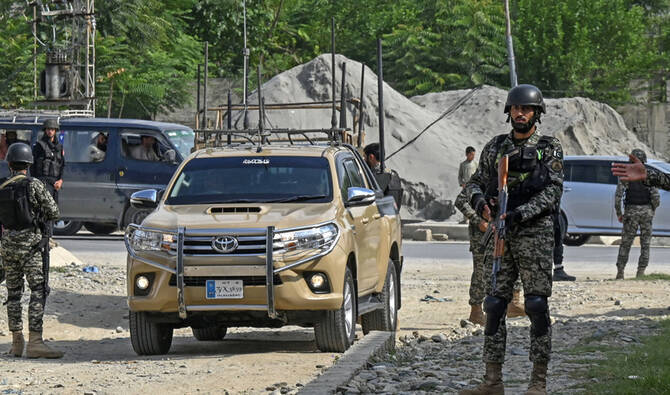
Security personnel stand guard at the site of a bomb blast in Bajaur district of Khyber-Pakhtunkhwa province, Pakistan, on July 31, 2023. (AFP/File)
Short Url
Updated 21 July 2025
Follow

Eight Pakistan paramilitary troops, seven militants killed in separate engagements

  • The fresh incidents of violence took place in the Orakzai and Mastung districts
  • Pakistan is battling twin insurgencies in its western regions bordering Afghanistan

QUETTA: At least eight Pakistani paramilitary troops and seven militants were killed in separate clashes in the country’s northwestern Khyber Pakhtunkhwa (KP) and southwestern Balochistan provinces, officials said on Monday.

A high-value Daesh militant, who was under custody for the kidnapping and murder of a young boy, was killed during a police “encounter” with his accomplices, who attempted to free him while he was being taken for the identification of a Daesh hideout in Balochistan’s Mastung district, according to a CTD statement.

The suspect’s accomplices present inside opened heavy fire on the CTD team, resulting in a fierce exchange that resulted in the killing of the suspect, Hasham, by “his group’s fire,” while two militants were also neutralized on the spot, the CTD said. The claim could not be independently verified.

“All three killed suspects were linked to Daesh (ISKP) and were planning future acts of terror. The group was also involved in targeted killings and extortion networks, using child abductions to fund militant operations,” the CTD said in a statement.

Muhammad Musawir Khan Kakar, a third-grade student, was kidnapped from a school van by unidentified armed men while on his way to school in Quetta on Nov. 15, 2024, according to his family and police. His body was found in Mastung’s Dasht area on June 23.

Separately, eight Pakistani paramilitary troops and four militants were killed in a clash in KP’s Orakzai district that borders Afghanistan, AFP news agency reported, citing local officials.

“Armed terrorists attacked a Frontier Corps (FC) convoy with heavy weapons... The fighting continued for several hours,” the news agency quoted a senior local security official as saying.

“Eight FC personnel were killed, and 11 were injured.”

Three injured soldiers are in critical condition, while the clash also killed four militants, he added.

Pakistan is currently battling twin insurgencies: one led my religiously motivated groups, including the Tehreek-e-Taliban Pakistan (TTP), mainly in its Khyber Pakhtunkhwa province and the other by ethno-nationalist Baloch separatist groups, Daesh and other smaller groups in Balochistan.

In recent months, Islamabad has frequently accused India of backing militant groups and Afghanistan of allowing the use of its soil for attacks against Pakistan. Kabul and New Delhi deny the allegation.

— With additional input from AFP


Pakistan says multilateralism in peril, urges global powers to prioritize diplomacy over confrontation

Updated 8 sec ago
Follow

Pakistan says multilateralism in peril, urges global powers to prioritize diplomacy over confrontation

  • The country tells the UN international security system is eroding, asks rival blocs to return to dialogue
  • It emphasizes lowering of international tensions, rebuilding of channels of communication among states

ISLAMABAD: Pakistan warned the world community on Monday that multilateralism was “in peril” amid rising global tensions, urging major powers to revive diplomacy and dialogue to prevent a further breakdown in international security.

Speaking at a UN Security Council briefing, Pakistan’s ambassador to the UN, Asim Iftikhar Ahmad, said the world was drifting toward confrontation at a time when cooperative mechanisms were weakening.

His comments came during a session addressed by Finland’s foreign minister Elina Valtonen, chairing the Organization for Security and Co-operation in Europe (OSCE), the world’s largest regional security body.

Formed out of the 1975 Helsinki Final Act, the OSCE was designed during the Cold War to reduce tensions, uphold principles of sovereignty and human rights and promote mechanisms for peaceful dispute resolution.

“Today, the foundational ethos of international relations, multilateralism, cooperation and indivisible security, as envisaged in the preamble of Helsinki Final Act, is perhaps facing its biggest challenge in decades,” Ahmed said. “The OSCE, too, is navigating a difficult geopolitical landscape, with conflict raging in the heart of Europe for nearly four years, depletion of trust and unprecedented strains on peaceful co-existence.”

He said a return to the “Helsinki spirit” of dialogue, confidence-building and cooperative security was urgently needed, not only in Europe but globally.

“This is not a matter of choice but a strategic imperative to lower tensions, rebuild essential channels of communication, and demonstrate that comprehensive security is best preserved through cooperative instruments, and not by the pursuit of hegemony and domination through military means,” he said. “Objective, inclusive, impartial, and principle-based approaches are indispensable for success.”

Ahmed’s statement came in a year when Pakistan itself fought a brief but intense war after India launched missile strikes at its city in May following a militant attack in Indian-administered Kashmir. New Delhi blamed Pakistan for the assault, an allegation Islamabad denied while calling for a transparent international investigation.

The Pakistani diplomat said the international system was increasingly defined by bloc politics, mistrust and militarization, warning that such trends undermine both regional stability and the authority of multilateral institutions, including the UN itself.

He urged member states to invest more in preventive diplomacy and the peaceful settlement of disputes as reaffirmed by the Council in Resolution 2788.

Ahmad said Pakistan hoped the OSCE would continue reinforcing models of cooperative security and that the Security Council would back partnerships that strengthen international law and the credibility of multilateral frameworks.

The path forward, he added, required “choosing cooperation over confrontation, dialogue over division, and inclusive security over bloc-based divides.”