

Five killed, seven injured in deadly tribal clash in southwestern Pakistan

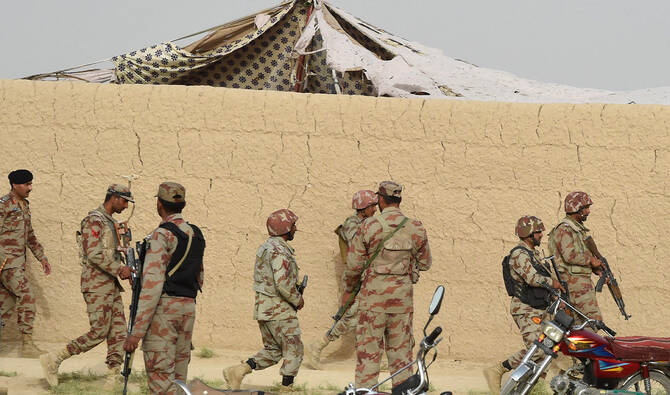
Pakistani Frontier Constabulary (FC) personnel gather in Mastung on July 13, 2018, following a bomb blast here at an election rally. (AFP/File)
Short Url
Updated 21 July 2025
Follow

Five killed, seven injured in deadly tribal clash in southwestern Pakistan

  • Clash broke out among Achakzai, Kakar tribes in Killa Abdulah district over an old dispute, says official
  • Says both rival parties agreed to a ceasefire brokered by Levies, FC Balochistan and tribal elders

QUETTA: Five people were killed while seven others were injured in Pakistan’s southwestern Killa Abdullah district on Sunday after an armed clash between two tribes, a senior official said. 

The clash broke out on Sunday evening between members of the ethnic Pashtun tribes of Achakzai and Kakar, lasting for several hours before tribal elders, the paramilitary Levies force and Frontier Corps (FC) Balochistan brokered a ceasefire between them.

“Five people have been killed and seven injured in the latest clashes that erupted between Achakzai and Kakar tribesmen in Killa Abdullah district,” Shahzaib Kakar, commissioner of Quetta Division, told Arab News on Sunday. 

He said members of both tribes were involved in “an old tribal dispute,” adding that both sides agreed to a ceasefire after security forces arrived in the area. 

Hayat Achakzai, a local journalist based in Killa Abdullah district, said clashes broke out at 6:30 p.m. on Sunday when members of both tribes came face to face at the district’s Tot Adda area.

“Both tribes were engaged in a dispute since March 2025 following a motorbike snatching,” Achakzai said. “They were chasing each other for the last two weeks but today met with an armed clash.”

Balochistan, Pakistan’s largest province by land mass but its most backward one by almost all social and economic indicators, has a strong tribal system with powerful chieftains. 

Disputes between rival tribes over honor, land and decades-old feuds are common here, often resulting in armed clashes. 

Ethnic Baloch militant groups have launched a low-level insurgency against the state for years in Balochistan, accusing Islamabad of exploiting the province’s mineral resources and denying locals a share in it.

The government denies the allegations and points to health, development and educational projects that it says have been launched to empower the people of Balochistan. 


Pakistan says defense pact with Saudi Arabia elevated brotherly ties to ‘new heights’

Updated 25 February 2026
Follow

Pakistan says defense pact with Saudi Arabia elevated brotherly ties to ‘new heights’

  • Pakistan, Saudi Arabia signed strategic defense pact last year pledging aggression against one will be treated as attack on both
  • Deputy PM Ishaq Dar says enduring bonds with Islamic and Arab nations form vital pillar of Pakistan’s foreign policy 

ISLAMABAD: Deputy Prime Minister Ishaq Dar said on Wednesday that Pakistan’s defense pact with Saudi Arabia elevated its brotherly ties with the Kingdom to “new heights,” stressing that close ties with Arab and Islamic nations form a key pillar of Islamabad’s foreign policy. 

Pakistan and Saudi Arabia signed a Strategic Mutual Defense Agreement on Sept. 17 last year, pledging that aggression against one country would be treated as an attack on both, enhancing joint deterrence and formalizing decades of military and security cooperation.

Both nations agreed in October 2025 to launch an economic cooperation framework to strengthen trade and investment ties. 

“In the Middle East, our landmark Strategic Mutual Defense Agreement with Saudi Arabia has elevated our brotherly ties to new heights,” Dar said while speaking at the Pakistan Governance Forum 2026 event in Islamabad. 

The Pakistani deputy prime minister was speaking on the topic “Navigating International Relations Amidst Changing Geo-Politics.”

Dar noted that Pakistan has reinforced partnerships with other Middle Eastern nations such as the UAE, Qatar, Jordan, Oman, Egypt and Bahrain. He said these partnerships have yielded “concrete agreements” in investment, agriculture, infrastructure, and energy sectors. 

“Our enduring bonds with Islamic and Arab nations form a vital pillar of our foreign policy, and we will continue to expand our partnerships across Asia, Latin America, and Africa,” he said. 

Dar pointed out that the presidents of Kazakhstan, Uzbekistan and Kyrgyzstan have undertaken visits to Pakistan in recent months, reflecting Central Asian nations’ desire to boost cooperation with Islamabad.

On South Asia, the Pakistani deputy PM said Pakistan has successfully transformed its fraternal ties with Bangladesh into “a substantive partnership.”

“Similarly, the trilateral mechanism involving China, Pakistan, and Bangladesh has been launched with a view to expanding and deepening regional cooperation and synergy,” the Pakistani minister said. 

He said Islamabad has strengthened its “all-weather” partnership with China via the second phase of the multi-billion-dollar China-Pakistan Economic Corridor agreement and “unwavering support” from both sides for each other’s core interests. 

Dar said Pakistan had also reinvigorated its partnership with the US, advancing cooperation in trade, technology, investment, and regional stability. 

“This calibrated approach has enhanced our ability to navigate complexity with skill and confidence, ensuring that our national interests are served without compromising our core foreign policy principles,” he said.