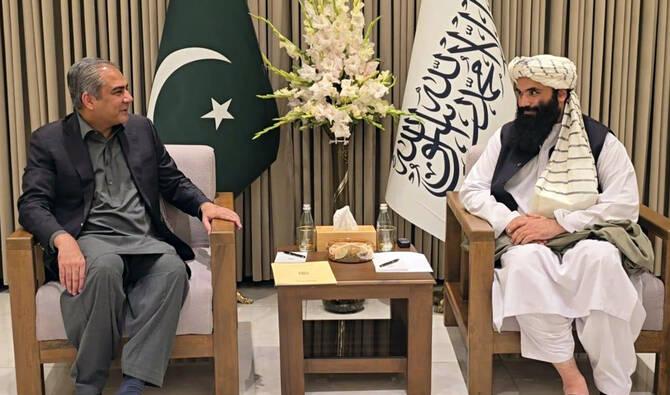

ISLAMABAD: Pakistan and Afghanistan have reaffirmed their commitment to countering militancy and improving border management, the Pakistani interior ministry said on Sunday, following a meeting between the two interior ministers in Kabul.
Pakistan’s Interior Minister Mohsin Naqvi arrived in Kabul on Sunday for a day-long visit to hold talks with Sirajuddin Haqqani, his counterpart in the Afghan interim government, days after top Pakistani officials visited Kabul to sign a framework agreement for a joint feasibility study on the Uzbekistan-Afghanistan-Pakistan (UAP) Railway Project.
Naqvi’s visit also followed the inaugural additional secretary-level talks between both sides in Islamabad to discuss trade, visas, security, connectivity and refugee issues as well as a meeting of the Pakistani, Afghan and Chinese foreign ministers in Beijing, which resulted in the upgradation of Pakistan-Afghanistan diplomatic relations to the ambassador’s rank.
During their meeting, the Pakistani and Afghan interior ministers discussed bilateral relations and matters relating to the Pakistani Taliban and counter-terrorism, border management, narcotics control and the process of repatriation of Afghan citizens illegally residing in Pakistan, according to the Pakistani interior ministry.
“Both interior ministers emphasized the need for peaceful coexistence, stability, and cooperation,” the Pakistani ministry said in a statement. “They agreed to strengthen mutual cooperation to eliminate the scourge of terrorism and Pak-Afghan border management.”
The TTP, which mainly operates in Pakistan’s northwestern Khyber Pakhtunkhwa province that borders Afghanistan, has stepped up its attacks against Pakistani security forces and law enforcers in recent months. Islamabad has often said the group has sanctuaries in Afghanistan, an allegation denied by Kabul.
Naqvi said militant groups were causing chaos and instability in the region, and that Pakistan wishes brotherly and lasting relations with Afghanistan, according to the statement.
“We have to stop it [militancy] together,” he was quoted as saying. “Pakistan has selflessly hosted millions of Afghan refugees for decades, and its doors are open for the legal entry of Afghan citizens.”
Pakistan this year said it wanted 3 million Afghans to leave the country, including 1.4 million people with Proof of Registration cards and some 800,000 with Afghan Citizen Cards. There are a further 1 million Afghans in the country illegally because they have no paperwork, according to officials.
Analysts link the recent high-level engagements between Pakistan and Afghanistan to a growing effort toward regional peace, suggesting that the process should continue to address militancy, refugee resettlement, and broader bilateral cooperation.
“These continued high-level engagements are crucial for promoting peace in our surrounding, but they should not be one-off efforts, instead, a sustained and continuous process of engagement is needed,” former Pakistan foreign office spokesperson Dr. Nafees Zakaria told Arab News.
“Constructive engagement with Afghanistan is important to help stabilize the [security] situation, which is ultimately in Pakistan’s interest,” he said, adding that it was essential for Kabul to not provide space to “inferior elements” for bilateral relations to have a stable trajectory.
Zakaria said both countries needed to consider all other aspects of their relationship, including cultural cooperation and refugee issues.
“They (Afghan refugees) are now returning to their country... their proper resettlement is crucial, otherwise, it could become a humanitarian catastrophe,” he said.
Qamar Cheema, executive director of the Sanober Institute think tank that focuses on South Asia issues, said these continued engagements were essential to fill “gaps” in bilateral relations between the two countries.
“Pakistan wants the Afghan Taliban to hold the Tehreek-e-Taliban Pakistan accountable and for this matter, multiple means are being used, including the multilateral and or trilateral forum like Pakistan, Afghanistan and China,” he told Arab News.
“Pakistan is seeking further assurances and aims to persuade the Afghan Taliban to continue summoning the TTP leadership and issuing clear political statements in order to prevent the TTP from launching attacks or crossing the border into Pakistan.”
Syed Muhammad Ali, an Islamabad-based analyst, said the visit follows a trilateral push for a trans-regional rail link that offers major benefits for war-torn Afghanistan.
“Sino-Pakistan offer to include Afghanistan in the multi-billion-dollar worth of CPEC (China-Pakistan Economic Corridor) reflects Islamabad’s intent to offer lucrative geo-economic incentives to the Kabul administration,” he said.
“These incentives aim to encourage recognition of Pakistan’s security concerns regarding terrorist organizations operating from Afghan soil and to reduce their space and capacity.”