

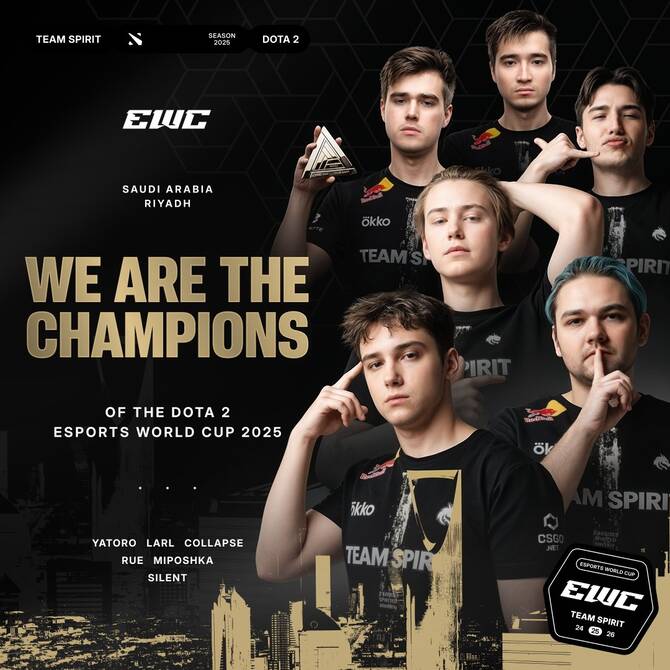
Team Spirit crowned Dota 2 champions at Esports World Cup 2025

1 / 3
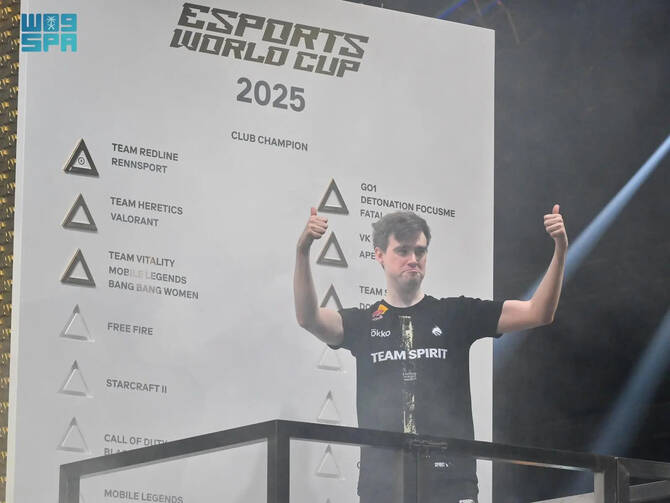
Team Spirit lost only one match on their road to the Championship. (X: @TSpirit_Dota2)
2 / 3
Team Spirit’s Magomed "Collapse" Khalilov was named MVP for his outstanding performances winning $10,000. (SPA)
3 / 3
Magomed "Collapse" Khalilov was also named the tournament MVP in Dota 2 winning $10,000 f
Short Url
Updated 20 July 2025
Follow

Team Spirit crowned Dota 2 champions at Esports World Cup 2025

  • Team Spirit lost only one match on their road to the Championship and overcame challenges from the reigning champions Gaimin Gladiators and Saudi Arabia’s Team Falcons 
  • The Dota 2 tournament featured 16 teams competing for the $3 million prize pool

RIYADH: Team Spirit stormed to victory in the Grand Final of the Dota 2 tournament at the Esports World Cup 2025, defeating Team Falcons 3-0 to secure their first Esports World Cup Championship win.

Team Spirit dominated the tournament, losing only one match in the opening round of the group stage against Xtreme Gaming. Team Spirit went on to claim a 2-0 victory over Talon Esports and a 2-0 win over Navus Vincere in the group stages before defeating Gaimin Gladiators 2-0 in the quarterfinal and winning 2-0 against Parivision in the semifinal.

In the final, Saudi Arabia’s Team Falcons could not halt Team Spirit’s momentum as they roared to a 3-0 clean sweep to win the Grand Final and secure their first championship at the Esports World Cup.


Team Spirit’s Magomed "Collapse" Khalilov was named MVP for his outstanding performances winning $10,000. (SPA)

“There is not really much emotions as the Grand Final was not that hard,” said Team Spirit captain Yaroslav “Miposhka” Naidenov.

“I enjoyed to play in this tournament, every player in my team is the best of the best. There was a lot of fans here also, thank you everyone so much for your support.”

Team Spirit players Naidenov, Illya “Yatoro” Mulyarchuk, Magomed “Collapse” Khalilov, Denis “Larl” Sigitov and Aleksandr “Rue” Filin saw off 15 other clubs to win a $1 million prize and secure 1,000 Club Championship points.

Khalilov was also named the tournament MVP in Dota 2, winning $10,000 for his outstanding performances during the Esports World Cup 2025.

Team Spirit’s win is their first championship at the Esports World Cup 2025, taking the title from Gaimin Gladiators who won the tournament in the inaugural edition of the Esports World Cup last year.

“It feels amazing of course, I’m very happy,” said Filin. “It was an amazing tournament and thank you to everyone for supporting us and watching us.”

Showing no lack of confidence about Team Spirit’s dominant win, Mulyarchuk said: “I truly think we are the greatest Dota 2 team of all time.”

The second week of EWC 2025 continues until Sunday, July 20, with finals in League of Legends and Free Fire.

For more information and tickets, including access to all tournament days and festival experiences, visit esportsworldcup.com.


‘Finally!’: Esports Nations Cup will provide new experiences for gamers and fans

Updated 24 February 2026
Follow

‘Finally!’: Esports Nations Cup will provide new experiences for gamers and fans

  • Ralf Reichert, CEO of Esports World Cup Foundation, spoke to Arab News about the new tournament that will pit countries against each other for the first time

RIYADH: With the inaugural Esports Nations Cup set for Riyadh in November, Ralf Reichert, CEO of the Esports World Cup Foundation, spoke to Arab News about the new tournament that will pit countries against each other for the first time.

How do you see the Nations Cup impacting the esports landscape in Saudi Arabia?

The Esports Nations Cup can be a meaningful catalyst for Saudi esports for two reasons. It expands the audience by adding national pride as a simple, universal entry point, and it accelerates ecosystem building by making talent pathways and country level coordination real and visible.

The Nations Cup adds a new layer next to club competition through national teams and national narratives. Club esports is the cultural backbone of the sport, but national teams widen the target group immediately because people may not follow a specific club or title, yet they will show up for their flag, in the arena and online.

It also strengthens the local ecosystem because a credible Nations Cup requires alignment across publishers, clubs, and development structures such as coaching, scouting, and youth programs. That coordination is where long-term impact comes from.

The Esports World Cup Foundation is an independent, nonprofit organization that designs and operates leading global esports competitions.

Saudi Arabia is the original host and the originator of this platform, and we are building the Nations Cup in close partnership here in Riyadh, with the long-term ambition for it to travel and become a truly global competition over time.

Did the success of the Esports World Cup play a role in the idea of the Nations Cup?

Esports grew up as a digital-first sport. From day one it was borderless, and clubs became the cultural backbone because they’re not defined by geography. Fans followed skill, story, and community across regions.

That’s why a Nations Cup isn’t the default format in esports. It’s a different layer, one that only works when the club ecosystem is stable and when you can operate cross-title competition at the highest level without compromising integrity.

The Esports World Cup proved that layer: multi-game competition at global scale, built with publishers, clubs, and players, with the operational credibility to align calendars, uphold consistent standards, and create a connected story across weeks.

Once that platform existed, adding national representation became realistic, not as EWC 2.0, but as a complementary format that brings identity and pride on top of a strong club foundation.

What has been the reaction in the gaming world to this new competition?

The reaction has been: Finally! If you do it properly.

Fans love the clarity of the story. National teams are instantly understandable, even for people who don’t follow a specific title or club. Players feel the difference too.

Representing your country is a distinct kind of pressure and pride, and it creates a new career milestone that hasn’t existed in esports in a consistent, credible way.

Clubs have been engaged from the start, because they are the backbone of esports and we are treating them that way. The Nations Cup is designed to sit next to club competition, not on top of it, with clear rules around eligibility, scheduling, and player release, and with incentives that keep the ecosystem aligned.

Publishers have reacted the way you want serious partners to react: supportive but focused on execution. They care about integrity, calendar alignment, and long-term sustainability. So the feedback isn’t make it louder, it’s make it durable.

Will we see many high-profile players from different clubs playing under the same flag, or will teams be based mostly on established clubs?

You will absolutely see high-profile players from different clubs coming together under the same flag, and that is one of the defining features of national team competition.

The Nations Cup is designed to avoid simply replicating club rosters under a national banner. The goal is real national representation, not convenience.

To reinforce that, we apply a maximum number of players per club on any national roster. That rule ensures the strongest eligible talent can still be selected, while preventing a national team from effectively becoming a club team in disguise.

Just like in traditional sports, rivals at the club level often become teammates when they represent their country. That creates new stories, new chemistry, and a different kind of pressure. It also changes how fans experience the competition, because you are no longer just watching a roster, you are watching a nation.

Selection is based on eligibility and competitive merit, not club affiliation. However, no more than two thirds of the national roster can come from the same club, providing the ability to still feature a core club line-up, if that is truly the best option, while creating exciting new teams that fans don’t get to see in club competitions.

The result can be pathways for new talents to showcase themselves next to established players or all-star rosters that are formed to represent their nation. Through this rule we will not only see new rivalries between national teams, but also some rivalries between players on the same club suddenly competing for spots on the national roster.

Will this new format bring a bigger audience to esports, including fans who may not follow clubs closely?

Yes, and that is one of the biggest opportunities.

Club esports creates the deepest fandom and the strongest stories, but it naturally speaks first to gaming and esports fans who already follow teams, leagues, and titles closely.

National teams widen the target group immediately. They are instantly understandable, they tap into national pride, and they give casual viewers a clear reason to care from the first match. You do not need to know every roster to know who you support when your country is playing.

That is how this format can bring new audiences into esports, while still respecting and strengthening the club ecosystem that built the sport in the first place.

What can fans expect that they haven’t seen before?

Fans can expect a layer of emotion and identity that club esports cannot create in the same way.

You will see flags and anthems, real national rivalries, and star players becoming teammates under one badge, fighting for something bigger than a title.

And you will get moments that stick. First appearances for countries, unexpected heroes, and matchups that return year after year and start to feel like true international classics.