

West Bank ‘plane chalet’ helps aviation dreams scale newer heights

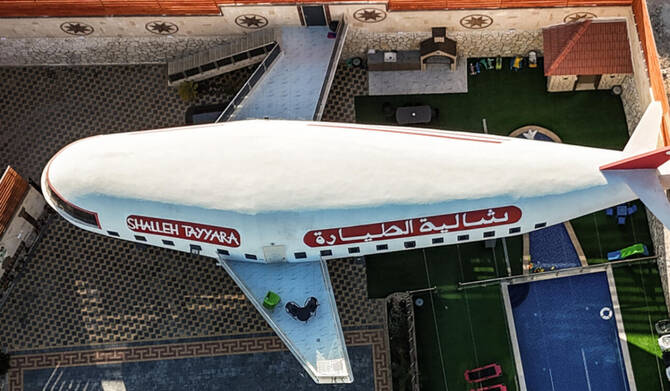
A guest house built in the shape of an aeroplane in the town of Qaffin, occupied West Bank. (AFP)
Short Url
Updated 19 July 2025
Follow

West Bank ‘plane chalet’ helps aviation dreams scale newer heights

  • Red and white concrete ‘plane’ has become a local landmark
  • ‘So many kids want to come,’ said 27-year-old Harsha, who built the guest house in the hills of the northern West Bank. However, the price tag, between $300 and $600 per night, is out of reach for most Palestinians, particularly as unemployment soars due

QAFFIN, West Bank: A guest house in the shape of a plane would stand out anywhere in the world, but in the occupied West Bank, devoid of airports, Minwer Harsha’s creation helps aviation dreams take flight.

“So many kids want to come,” said 27-year-old Harsha, who built the guest house in the hills of the northern West Bank, within view of the separation barrier between Israel and the Palestinian territory.
“And that’s the goal: Since we don’t have planes or airports, people come here instead,” he said.
Harsha said he designed the concrete plane himself, with a master bedroom in the cockpit and a children’s bedroom in the tail.
The price tag, between 1,000 and 2,000 shekels (about $300-$600) per night, is out of reach for most Palestinians, particularly as unemployment soars due to the war in Gaza.

He has nonetheless been pleased with the reactions to his chalet, having initially faced skepticism.
“I wanted to bring something unique, something new to the area and to Palestine,” Harsha said of the unit, which opened a month ago.
Since its launch, his red and white concrete plane has become a local landmark, featuring in local media and on social networks.
Harsha said he originally wanted to place a Palestinian flag on his chalet and call it the “Palestinian Queen,” but avoided such signs out of caution.
The guest house is located in the West Bank’s Area C, which covers more than 60 percent of the territory and is under full Israeli control.
“I just made it look like a plane. I avoided politics entirely because of the hardships our people are going through,” he said.
“We’re a people who are constantly losing things — our land, our rights, our lives.”
Israel has occupied the West Bank since 1967, and frequently demolishes homes it says are built without permission in the mostly rural Area C.
Though no airport currently services the Palestinian territories, both the West Bank and Gaza once had their own terminals, in East Jerusalem and the southern Gaza city of Rafah, respectively.
Both were closed during the Second Intifada, the Palestinian uprising of the early 2000s, and what remains of East Jerusalem’s airport is now isolated from the rest of the West Bank by Israel’s separation barrier.
Despite difficulties and threats of demolition, Harsha believes that Palestinians can find freedom and fulfilment in projects like his.
“I encourage everyone who has land to work on it and invest in it — with creativity and ambition,” he said, flanked by his two brothers who helped him build the unit.
Harsha himself has more plans for his land.
“After this airplane, we’ll build a ship next year,” he said.
“It will be something unique and beautiful,” he said, pointing out that while many West Bank Palestinians have seen planes flying overhead, a large number of people from the landlocked territory have never seen a real ship at all.


Hundreds mourn in Syria’s Homs after deadly mosque bombing

Updated 27 December 2025
Follow

Hundreds mourn in Syria’s Homs after deadly mosque bombing

  • Officials have said the preliminary investigations indicate explosive devices were planted inside the mosque but have not yet publicly identified a suspect

HOMS: Hundreds of mourners gathered Saturday despite rain and cold outside of a mosque in the Syrian city of Homs where a bombing the day before killed eight people and wounded 18.
The crowd gathered next to the Imam Ali ibn Abi Talib Mosque in the Wadi Al-Dhahab neighborhood, where the population is predominantly from the Alawite minority, before driving in convoys to bury the victims.
Officials have said the preliminary investigations indicate explosive devices were planted inside the mosque but have not yet publicly identified a suspect.
A little-known group calling itself Saraya Ansar Al-Sunna claimed responsibility for the attack in a statement posted on its Telegram channel, in which it indicated that the attack intended to target members of the Alawite sect, an offshoot of Shia Islam whom hard-line Islamists consider to be apostates.
The same group had previously claimed a suicide attack in June in which a gunman opened fire and then detonated an explosive vest inside a Greek Orthodox church in Dweil’a, on the outskirts of Damascus, killing 25 people as worshippers prayed on a Sunday.
A neighbor of the mosque, who asked to be identified only by the honorific Abu Ahmad (“father of Ahmad“) out of security concerns, said he was at home when he heard the sound of a “very very strong explosion.”
He and other neighbors went to the mosque and saw terrified people running out of it, he said. They entered and began trying to help the wounded, amid blood and scattered body parts on the floor.
While the neighborhood is primarily Alawite, he said the mosque had always been open to members of all sects to pray.
“It’s the house of God,” he said. “The mosque’s door is open to everyone. No one ever asked questions. Whoever wants to enter can enter.”
Mourners were unable to enter the mosque to pray Saturday because the crime scene remained cordoned off, so they prayed outside.
Some then marched through the streets chanting “Ya Ali,” in reference to the Prophet Muhammad’s cousin and son-in-law whom Shiite Muslims consider to be his rightful successor.