Pakistan says Kashmir tourist attack probe ‘inconclusive’ as US blacklists militant group

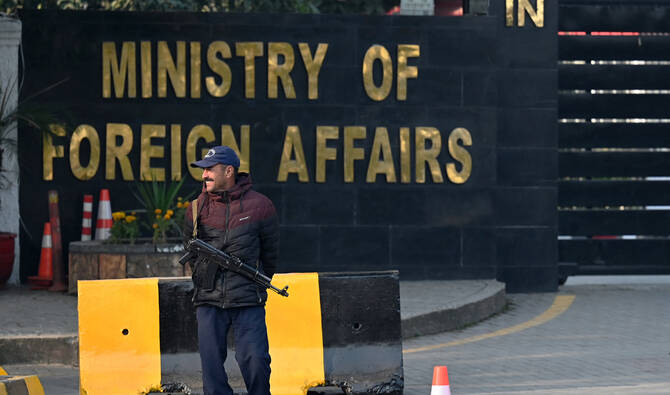
A Pakistani police officer stands guard outside the Ministry of Foreign Affairs in Islamabad on January 18, 2024. (AFP/File)
Short Url
Updated 18 July 2025
Follow

Pakistan says Kashmir tourist attack probe ‘inconclusive’ as US blacklists militant group

  • US designated The Resistance Front a ‘terrorist organization’ for briefly claiming responsibility for Pahalgam attack
  • Islamabad says New Delhi has ‘a track record of exploiting such designations to push anti-Pakistan propaganda’

ISLAMABAD: Pakistan said on Friday a probe into the April killing of 26 tourists in Indian-administered Kashmir remained inconclusive, hours after the United States designated a Lashkar-e-Taiba-affiliated group as a terrorist entity, and accused India of using such listings to spread an anti-Pakistan narrative internationally.

The group in question, The Resistance Front (TRF), also known as Kashmir Resistance, was blacklisted by Washington on Thursday as a “foreign terrorist organization” and “specially designated global terrorist” in connection with the April 22 attack in Pahalgam.

In a statement, US Secretary of State Marco Rubio said the group had claimed responsibility for the assault before withdrawing its statement, and described TRF as a “front and proxy” of Lashkar-e-Taiba, a Pakistan-based outfit banned under US law.

Responding to the development, Pakistan’s foreign office said it had “zero tolerance” for militant entities, though any link between TRF and Lashkar-e-Taiba “belies ground realities,” noting the latter was a defunct group that had been banned in Pakistan.

“Investigations into the Pahalgam incident, that happened in the internationally recognized disputed region of IIOJK, are still inconclusive,” the statement read, using Pakistan’s official abbreviation for Indian Illegally Occupied Jammu and Kashmir.

“Pakistan has effectively and comprehensively dismantled concerned outfits, arrested and prosecuted the leadership, and deradicalized its cadres,” it continued.

The foreign office also said India had a track record of leveraging such terror listings to deflect global scrutiny from its human rights record in Kashmir and elsewhere.

“India has a track record of exploiting such designations to push anti-Pakistan propaganda with a view to divert international attention from its irresponsible and rogue behavior, including ongoing human rights atrocities, especially in IIOJK,” the statement said.

Pakistan cited its cooperation with international partners against extremist groups and the arrest of high-profile militants, including Sharifullah, the alleged mastermind of the 2021 Abbey Gate bombing in Kabul that killed 13 US service members and about 170 Afghan civilians.

In April, after India blamed Pakistan for the Pahalgam attack, Islamabad called for a neutral and impartial investigation.

The attack triggered days of cross-border hostilities, with India targeting what it described as “terrorist infrastructure” in Pakistan on May 7. The escalation — involving missiles, drones and artillery — left dozens dead before a ceasefire was announced on May 10.

The foreign office said Pakistan urged the international community to adopt “objective and non-discriminatory policies” on counterterrorism and called for other groups, such as the Majeed Brigade of the Balochistan Liberation Army (BLA), to be designated under US law.

Pakistan has repeatedly accused the BLA and other separatist groups operating in the volatile southwestern province of Balochistan of being Indian proxies, a claim New Delhi denies.

With input from Reuters


Pakistan’s Mahnoor Omer named among TIME’s ‘Women of the Year’ for 2026

Updated 01 March 2026
Follow

Pakistan’s Mahnoor Omer named among TIME’s ‘Women of the Year’ for 2026

  • Omer moved a Pakistani court against the so-called ‘period tax’ in Sept. 2025 which has since sparked a national debate
  • Taxes on sanitary pads in Pakistan can add up to 40 percent to retail price, UNICEF says only around 12 percent women use such products

ISLAMABAD: Pakistani women’s rights activist Mahnoor Omer, who fought against taxes on menstrual products, has been named among the TIME magazine’s ‘Women of the Year’ for 2026.

Omer’s efforts have been recognized alongside 16 activists, artists, athletes and businesswomen in the TIME’s Women of the Year 2026 list, including Olympic gold medalist Sydney McLaughlin-Levrone and Oscar-nominated filmmaker Chloe Zhao.

Dissatisfied with the efforts to educate Pakistani girls about sexual violence, Omer founded the Noor Foundation at the age of 14 and held her own workshops with village girls about everything from climate change to menstruation, according to the TIME magazine.

Two years later, a conversation with a domestic worker about the price of pads made her realize that not everyone could afford these essentials. She moved a court against the so-called “period tax” in Sept. 2025 and the case has sparked a national debate on the subject, considered a taboo by many in Pakistan, since its first hearing late last year.

“A decade and one law degree after her interest in activism was sparked, Omer, now 25, is putting her passion and expertise to work in the name of gender equity,” TIME wrote about Omer on its website.

Taxes imposed on sanitary products in Pakistan can add up to 40 percent to the retail price. UNICEF estimates just 12 percent of women in the country use commercially produced pads or tampons. The alternative, using cloth, risks health impacts including rashes and infections, and can make it impossible for girls to attend school while menstruating.

Omer’s suit, which awaits the government response, has sparked a national discussion. She says she spoke about menstruation to her father and male cousins, who thanked her for standing up for their daughters.
The 25-year-old, who is currently enrolled in a master’s degree in gender, peace, and security at the London School of Economics, sees this case as just the first of many.

“I’m not free until every woman is free,” she was quoted as saying by TIME. “I want to leave no stones unturned in terms of what I can do with the next few decades, as a lawyer for the women in my country and gender minorities in general.”