

Pakistan bans new hotel construction around tourist lakes

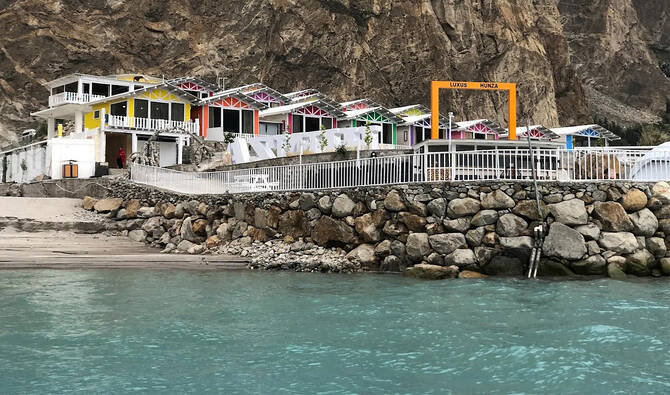
The picture shows the exterior view of Luxus Hotel Hunza near Attabad Lake in Pakistan's Gilgit Baltistan region in August 2021. (UT Malik/Google Images/File)
Short Url
Updated 18 July 2025
Follow

Pakistan bans new hotel construction around tourist lakes

  • Unregulated construction of hotels, guest houses in Gilgit-Baltistan has sparked major environmental concerns
  • The region is home to towering peaks looming over Old Silk Road, cherry orchards, glaciers and ice-blue lakes

GILGIT: Pakistan will ban for five years the construction of new hotels around picturesque lakes in the north that attract tens of thousands of tourists each year, a government agency said.

Unregulated construction of hotels and guest houses in Gilgit-Baltistan — which boasts around 13,000 glaciers, more than any other country on Earth outside the polar regions — has sparked major concerns about environmental degradation.

The natural beauty of the region has made it a top tourist destination, with towering peaks looming over the Old Silk Road, and a highway transporting tourists between cherry orchards, glaciers, and ice-blue lakes.

However, in recent years construction has exploded led by companies from outside the region, straining water and power resources, and increasing waste.

“If we let them construct hotels at such pace, there will be a forest of concrete,” Khadim Hussain, a senior official at the Gilgit-Baltistan Environmental Protection Authority told AFP on Friday.

“People don’t visit here to see concrete; people come here to enjoy natural beauty,” he added.

Last month, a foreign tourist posted a video on Instagram — which quickly went viral — alleging wastewater was being discharged by a hotel into Lake Attabad, which serves as a freshwater source for Hunza.

The next day, authorities fined the hotel more than $5,000.

Asif Sakhi, a political activist and resident of the Hunza Valley, welcomed the ban.

“We have noticed rapid changes in the name of tourism and development,” he said, adding hotel construction was “destroying our natural lakes and rivers.”

Shah Nawaz, a hotel manager and local resident of the valley, also praised the ban, saying he believes “protecting the environment and natural beauty is everyone’s responsibility.”


Pakistan PM calls for faster CPEC implementation, pledges security for Chinese workers

Updated 27 February 2026
Follow

Pakistan PM calls for faster CPEC implementation, pledges security for Chinese workers

  • Shehbaz Sharif pushes expanded cooperation in agriculture, IT and mining under CPEC phase two
  • Chinese envoy reaffirms Beijing’s support for Pakistan’s sovereignty and economic development

ISLAMABAD: Prime Minister Shehbaz Sharif on Friday called for speeding up projects under the China-Pakistan Economic Corridor (CPEC) and pledged stronger security guarantees for Chinese workers and investments, during a meeting with China’s ambassador in Islamabad.

Sharif made the remarks as the two countries strive to launch the second phase of CPEC, a multibillion-dollar infrastructure and energy initiative launched in 2015 as part of China’s Belt and Road Initiative (BRI).

CPEC’s first phase focused largely on power generation and transport infrastructure aimed at easing Pakistan’s chronic energy shortages and improving connectivity. The second phase seeks to expand cooperation into industrial development, with an emphasis on special economic zones and export-oriented growth.

“While highlighting the importance of accelerating ongoing CPEC projects, the Prime Minister stressed on the need to enhance cooperation in agriculture and IT and mining & minerals,” said a statement circulated by the PM Office after the meeting.

“He also underscored Pakistan’s resolve to provide a secure and conducive environment for Chinese personnel, investments, and institutions in Pakistan,” it added.

Chinese nationals and projects in Pakistan have faced security threats in the past, including attacks by militant groups targeting infrastructure sites and convoys. Islamabad has repeatedly vowed to tighten security and has deployed special protection units for Chinese workers.

China is Pakistan’s closest ally in the region and a key economic partner, with CPEC widely regarded by Islamabad as central to long-term economic growth.

During the meeting, the prime minister conveyed greetings to Chinese President Xi Jinping and Premier Li Qiang, particularly on the occasion of the Chinese New Year.

China’s Ambassador to Pakistan, Jiang Zaidong, reiterated Beijing’s support for Pakistan’s sovereignty and socioeconomic development, according to the statement. Both sides also exchanged views on regional and international issues and agreed to maintain close coordination.