

US designates Pakistani group’s offshoot as ‘terrorist’ over Kashmir attack

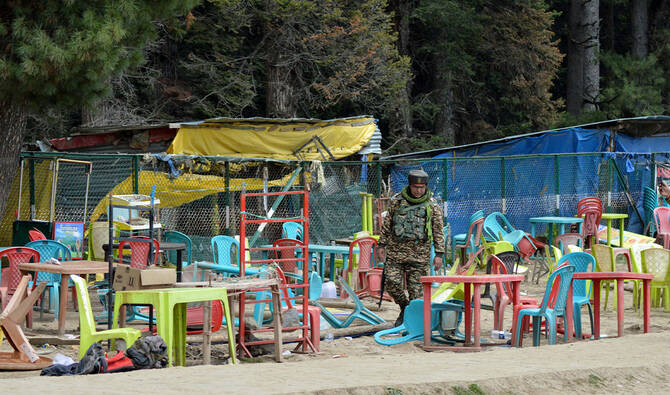
An Indian security force personnel walks amid toppled chairs and tables at the site of a suspected militant attack on tourists in Baisaran near Pahalgam in south Kashmir's Anantnag district, Apr 23, 2025. (Reuters/File)
Short Url
Updated 18 July 2025
Follow

US designates Pakistani group’s offshoot as ‘terrorist’ over Kashmir attack

  • The attack sparked heavy fighting between nuclear-armed Asian neighbors India, Pakistan in the latest escalation of a decades-old rivalry
  • India is an increasingly important US partner in Washington’s effort to counter China’s rising influence in Asia, while Pakistan is a US ally

WASHINGTON: The US government designated The Resistance Front, considered an offshoot of the Pakistani group Lashkar-e-Taiba, as a “foreign terrorist organization” over the April 22 militant attack in India-administered Kashmir that killed 26 people, Secretary of State Marco Rubio said on Thursday.

The Resistance Front, also known as Kashmir Resistance, initially took responsibility for the attack in Pahalgam before denying it days later.

Lashkar-e-Taiba, listed as a “foreign terrorist organization” by the United States, is a group accused of plotting attacks in India and in the West, including the three-day deadly assault on Mumbai in November 2008.

TRF’s designation by Washington as a “foreign terrorist organization” and “specially designated global terrorist” enforced President Donald Trump’s “call for justice for the Pahalgam attack,” Rubio said in a statement.

Rubio called TRF, which emerged in 2019, a “front and proxy” for Lashkar-e-Taiba. It is considered an offshoot of Lashkar-e-Taiba, according to the South Asia Terrorism Portal, a Delhi-based think tank.

The attack sparked heavy fighting between nuclear-armed Asian neighbors India and Pakistan in the latest escalation of a decades-old rivalry. New Delhi blamed the attack on Pakistan, which denied responsibility while calling for a neutral investigation. Washington condemned the attack but did not directly blame Islamabad.

Michael Kugelman, a Washington-based South Asia analyst and writer for Foreign Policy magazine, said in designating TRF, “Washington is flagging its concern about the terrorist attack that provoked the recent India-Pakistan conflict, and siding with New Delhi’s view that the group is linked to Lashkar-e-Taiba.”

He added: “This can be a shot in the arm for a US-India relationship looking to rebound after a few tough months.”

On May 7, Indian jets bombed sites across the border that New Delhi described as “terrorist infrastructure,” setting off an exchange of attacks between the two countries by fighter jets, missiles, drones, and artillery that killed dozens until a ceasefire on May 10.

The ceasefire was first announced by Trump on social media after Washington held talks with both sides, but India has differed with Trump’s claims that it resulted from his intervention and his threats to sever trade talks.

India’s position has been that New Delhi and Islamabad must resolve their problems directly and with no outside involvement.

India is an increasingly important US partner in Washington’s effort to counter China’s rising influence in Asia, while Pakistan is a US ally.

Both Hindu-majority India and Islamic Pakistan claim Muslim-majority Kashmir in full while ruling only parts of the Himalayan territory, over which they have also fought wars.


IMF board to approve Pakistan reviews today ‘if all goes well,’ say officials

Updated 08 December 2025
Follow

IMF board to approve Pakistan reviews today ‘if all goes well,’ say officials

  • IMF’s executive board is scheduled to meet today to discuss the disbursement of $1.2 billion
  • Economists say the money will boost Pakistan’s forex reserves, send positive signals to investors

KARACHI: The International Monetary Fund’s (IMF) executive board is scheduled to meet today, Monday, to approve the release of about $1.2 billion for Pakistan under the lender’s two loan facilities, said IMF officials who requested not to be named.

The IMF officials confirmed the executive board was going to decide on the Fund’s second review under the $7 billion Extended Fund Facility (EFF) and first review under the $1.4 billion Resilience and Sustainability Facility (RSF), a financing tool that provides long-term, low-cost loans to help countries address climate risks.

“The board meeting will be taking place as planned,” an IMF official told Arab News.

“The board is on today yes as per the calendar,” said another.

A well-placed official at Pakistan’s finance ministry also confirmed the board meeting was scheduled today to discuss the next tranche for Pakistan.

The IMF executive board’s meeting comes nearly two months after a staff-level agreement (SLA) was signed between the two sides in October.

Procedurally, the SLAs are subject to approval by the executive board, though it is largely viewed as a formality.

“If all goes well, the reviews should pass,” said the second IMF official.

On approval, Pakistan will have access to about $1 billion under the EFF and about $200 million under the RSF, the IMF said in a statement in October after the SLA.

The fresh transfer will bring total disbursements under the two arrangements to about $3.3 billion, it added.

Experts see smooth sailing for Pakistan in terms of the passing of the two reviews, saying the IMF disbursements will help the cash-strapped nation to strengthen its balance of payments position.

Samiullah Tariq, group head of research at Pakistan Kuwait Investment Company Limited, said the IMF board’s approval will show that Pakistan’s economy is on the right path.

“It obviously will help strengthen [the country’s] external sector, the balance of payments,” he told Arab News.

Until recently, Pakistan grappled with a macroeconomic crisis that drained its financial resources and triggered a balance of payments crisis.

Pakistan has reported financial gains since 2022, recording current account surpluses and taming inflation that touched unprecedented levels in mid-2023.

Economists also viewed the IMF’s bailout packages as crucial for cash-strapped Pakistan, which has relied heavily on financing from bilateral partners such as Saudi Arabia, China and the United Arab Emirates, as well as multilateral lenders.

Saudi Arabia, through the Saudi Fund for Development, last week extended the term of its $3 billion deposit for another year to help Pakistan boost its foreign exchange reserves, which stood at $14.5 billion as of November 28, according to State Bank of Pakistan statements.

“In our view this [IMF tranche] will be approved,” said Shankar Talreja, head of research at Karachi-based brokerage Topline Securities Limited.

“This will help strengthen reserves and will eventually help a rating upgrade going forward,” he said.

The IMF board’s nod, Talreja said, would also send a signal to the international and local investors regarding the continuation of the reform agenda by Pakistan’s government.