

US designates Pakistani group’s offshoot as ‘terrorist’ over Kashmir attack

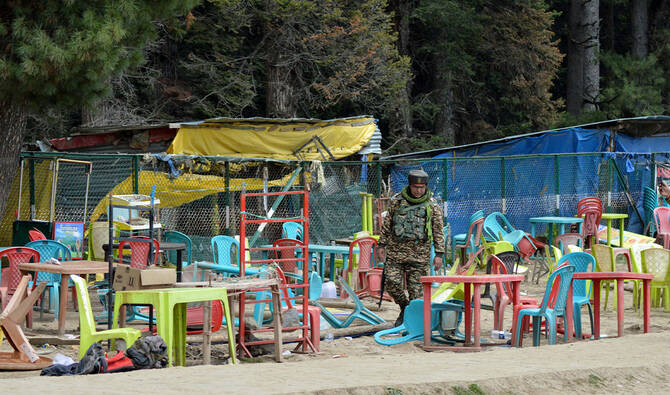
An Indian security force personnel walks amid toppled chairs and tables at the site of a suspected militant attack on tourists in Baisaran near Pahalgam in south Kashmir's Anantnag district, Apr 23, 2025. (Reuters/File)
Short Url
Updated 18 July 2025
Follow

US designates Pakistani group’s offshoot as ‘terrorist’ over Kashmir attack

  • The attack sparked heavy fighting between nuclear-armed Asian neighbors India, Pakistan in the latest escalation of a decades-old rivalry
  • India is an increasingly important US partner in Washington’s effort to counter China’s rising influence in Asia, while Pakistan is a US ally

WASHINGTON: The US government designated The Resistance Front, considered an offshoot of the Pakistani group Lashkar-e-Taiba, as a “foreign terrorist organization” over the April 22 militant attack in India-administered Kashmir that killed 26 people, Secretary of State Marco Rubio said on Thursday.

The Resistance Front, also known as Kashmir Resistance, initially took responsibility for the attack in Pahalgam before denying it days later.

Lashkar-e-Taiba, listed as a “foreign terrorist organization” by the United States, is a group accused of plotting attacks in India and in the West, including the three-day deadly assault on Mumbai in November 2008.

TRF’s designation by Washington as a “foreign terrorist organization” and “specially designated global terrorist” enforced President Donald Trump’s “call for justice for the Pahalgam attack,” Rubio said in a statement.

Rubio called TRF, which emerged in 2019, a “front and proxy” for Lashkar-e-Taiba. It is considered an offshoot of Lashkar-e-Taiba, according to the South Asia Terrorism Portal, a Delhi-based think tank.

The attack sparked heavy fighting between nuclear-armed Asian neighbors India and Pakistan in the latest escalation of a decades-old rivalry. New Delhi blamed the attack on Pakistan, which denied responsibility while calling for a neutral investigation. Washington condemned the attack but did not directly blame Islamabad.

Michael Kugelman, a Washington-based South Asia analyst and writer for Foreign Policy magazine, said in designating TRF, “Washington is flagging its concern about the terrorist attack that provoked the recent India-Pakistan conflict, and siding with New Delhi’s view that the group is linked to Lashkar-e-Taiba.”

He added: “This can be a shot in the arm for a US-India relationship looking to rebound after a few tough months.”

On May 7, Indian jets bombed sites across the border that New Delhi described as “terrorist infrastructure,” setting off an exchange of attacks between the two countries by fighter jets, missiles, drones, and artillery that killed dozens until a ceasefire on May 10.

The ceasefire was first announced by Trump on social media after Washington held talks with both sides, but India has differed with Trump’s claims that it resulted from his intervention and his threats to sever trade talks.

India’s position has been that New Delhi and Islamabad must resolve their problems directly and with no outside involvement.

India is an increasingly important US partner in Washington’s effort to counter China’s rising influence in Asia, while Pakistan is a US ally.

Both Hindu-majority India and Islamic Pakistan claim Muslim-majority Kashmir in full while ruling only parts of the Himalayan territory, over which they have also fought wars.

Peace can only prevail if Afghanistan renounces support for ‘terrorism’— Pakistan defense chief

Updated 04 March 2026
Follow

Peace can only prevail if Afghanistan renounces support for ‘terrorism’— Pakistan defense chief

  • Pakistan’s chief of defense forces visits South Waziristan district bordering Afghanistan
  • Pakistan says has killed 481 Afghan Taliban operatives since clashes began last Thursday

ISLAMABAD: Pakistan’s Chief of Defense Forces Field Marshal Syed Asim Munir said on Wednesday that peace with Afghanistan can only prevail if Kabul renounces support for “terrorism” and “terrorist” organizations, the military’s media wing said as the two countries remain locked in conflict. 

Fighting between the two neighbors, the worst in decades, broke out last Thursday night after Afghan forces attacked Pakistan’s military installations along their shared border. Afghanistan said its attacks were in response to earlier airstrikes by Pakistan against alleged militant hideouts in its country. 

Pakistan accuses Afghanistan of sheltering militant outfits such as the Tehreek-e-Taliban Pakistan (TTP) on its soil who have launched attacks against Pakistani civilians and security forces in recent years. Kabul denies the allegations. 

Munir visited Wana town in Pakistan’s South Waziristan district to review the security situation and troops’ operational preparedness at the Afghan border, the Pakistani military’s media wing said in a statement. 

“The Field Marshal reiterated that peace could only prevail between both sides if the Afghan Taliban renounced their support for terrorism and terrorist organizations,” the Inter-Services Public Relations (ISPR) said. 

The military chief said the use of Afghan soil by militant outfits to launch attacks against Pakistan was unacceptable, vowing that “all necessary measures” would be taken to neutralize cross-border threats. 

During the visit, Munir was briefed by military commanders about ongoing intelligence-based operations and measures being taken by the military to manage the border with Afghanistan.

He was also briefed about “Operation Ghazab Lil Haq” or “Wrath for the Truth,” the name Pakistan has given to its military operation against Afghan forces, the ISPR said. 

The Pakistani military chief spoke to troops deployed in the area, praising their vigilance, professional conduct and high morale, the ISPR said. 

Pakistan’s Information Minister Attaullah Tarar said on Wednesday that the military has killed 481 Taliban operatives, injured more than 690 and destroyed 226 Afghan checkposts since clashes began. 

Arab News has been unable to verify claims by both sides about the damages they claim to have inflicted on each other.

Afghanistan has signaled it is open for dialogue but Pakistan rejected the offer, saying it would continue its military operations till its objectives were achieved. 

Since the conflict began, diplomatic efforts have intensified with several countries, including global bodies such as the European Union and United Nations, urging restraint and calling for talks.

Turkish President Recep Tayyip Erdogan told Pakistani Prime Minister Shehbaz Sharif that ⁠Ankara would help ⁠reinstate a ceasefire, the Turkish Presidency said on Tuesday, as other countries that had offered to mediate have since been hit by the conflict in the Gulf.