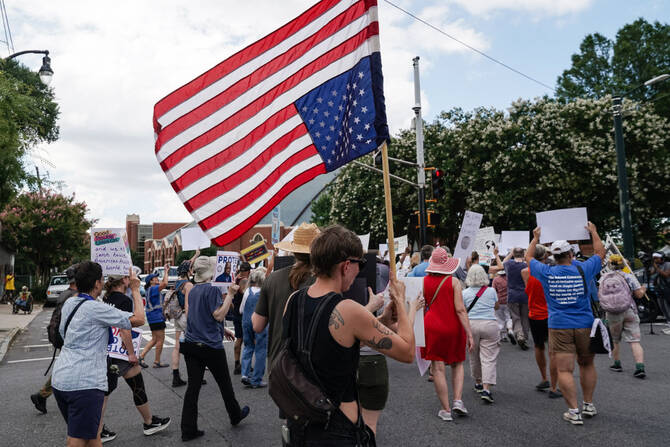
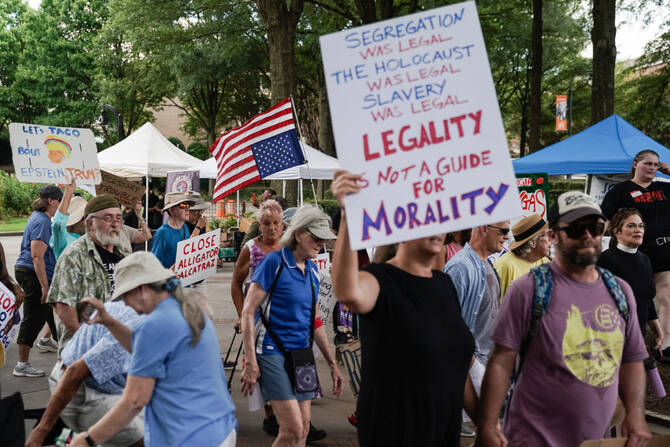
CHICAGO: Protests and events against President Donald Trump’s controversial policies that include mass deportations and cuts to Medicaid and other safety nets for poor people have started Thursday at more than 1,600 locations around the country.
The “Good Trouble Lives On” national day of action honors the late congressman and civil rights leader John Lewis. Protests were being held along streets, at court houses and other public spaces. Organizers have called for them to be peaceful.
“We are navigating one of the most terrifying moments in our nation’s history,” Public Citizen co-president Lisa Gilbert said during an online news conference Tuesday. “We are all grappling with a rise of authoritarianism and lawlessness within our administration ... as the rights, freedoms and expectations of our very democracy are being challenged.”
Public Citizen is a nonprofit with a stated mission of taking on corporate power. It is a member of a coalition of groups behind Thursday’s protests.
Major protests were planned in Atlanta and St. Louis, as well as Oakland, California, and Annapolis, Maryland.
Honoring Lewis’ legacy
Lewis first was elected to Congress in 1986. He died in 2020 at the age of 80 following an advanced pancreatic cancer diagnosis.
He was the youngest and last survivor of the Big Six civil rights activists, a group led by the Rev. Martin Luther King Jr. In 1965, a 25-year-old Lewis led some 600 protesters in the Bloody Sunday march across the Edmund Pettus Bridge in Selma, Alabama. Lewis was beaten by police, suffering a skull fracture.
Within days, King led more marches in the state, and President Lyndon Johnson pressed Congress to pass the Voting Rights Act that later became law.
“Get in good trouble, necessary trouble, and redeem the soul of America,” Lewis said in 2020 while commemorating the 1965 voting rights marches from Selma to Montgomery, Alabama.
Chicago will be the flagship city for Thursday’s protests as demonstrators are expected to rally downtown in the afternoon.
Betty Magness, executive vice president of the League of Women Voters Chicago and one of the organizers of Chicago’s event, said the rally will also include a candlelight vigil to honor Lewis.
Much of the rest of the rally will have a livelier tone, Magness said, adding “we have a DJ who’s gonna rock us with boots on the ground.”
Protesting Trump’s policies
Pushback against Trump so far in his second term has centered on deportations and immigration enforcement tactics
Earlier this month, protesters engaged in a tense standoff as federal authorities conducted mass arrests at two Southern California marijuana farms. One farmworker died after falling from a greenhouse roof during a chaotic raid.
Those raids followed Trump’s extraordinary deployment of the National Guard outside federal buildings and to protect immigration agents carrying out arrests on Los Angeles. On June 8, thousands of protesters began taking to the streets in Los Angeles.
And organizers of the June 14 “No Kings” demonstrations said millions of people marched in hundreds of events from New York to San Francisco. Demonstrators labeled Trump as a dictator and would-be king for marking his birthday with a military parade.


![]()
![]()
![]()

Nationwide protests begin against Trump’s immigration crackdown and health care cuts

Short Url
https://arab.news/wscxb
Nationwide protests begin against Trump’s immigration crackdown and health care cuts
- Protest actions held Thursday in more than 1,600 locations around the country
- Major protests planned in Atlanta and St. Louis, Oakland in California, and Annapolis in Maryland


Latest updates


© 2026 SAUDI RESEARCH & PUBLISHING COMPANY, All Rights Reserved And subject to Terms of Use Agreement.