

Pakistan expresses solidarity as fire at Iraq shopping center kills over 60

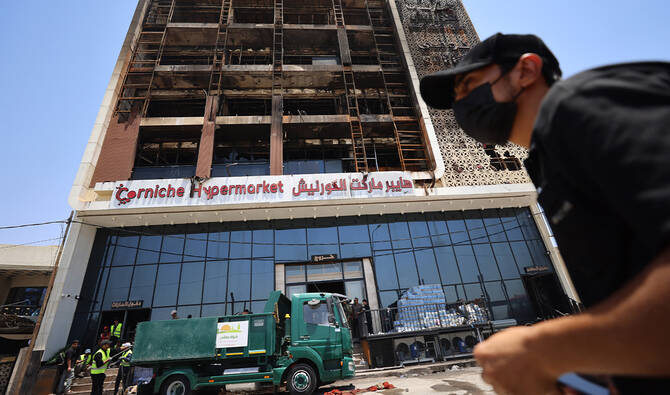
A cleaning operation starts outside the charred building on July 17, 2025, after a fire tore through the newly opened Hyper Mall overnight in the eastern Iraqi city of Kut, killing at least 60 people, according to Iraqi authorities. (AFP)
Short Url
Updated 17 July 2025
Follow

Pakistan expresses solidarity as fire at Iraq shopping center kills over 60

  • Iraqi officials say several remain missing after huge fire broke out at Iraq’s Kut city on Wednesday night
  • Prime Minister Shehbaz Sharif prays for speedy recovery of injured, offers condolences to victims’ families

ISLAMABAD: Prime Minister Shehbaz Sharif on Thursday expressed solidarity with the people and government of Iraq after a fire erupted at a shopping center in Kut city, killing more than 60 people while others remained missing.

Iraqi officials say at least 61 people have been killed and several remain missing after a huge fire broke out at a hypermarket in eastern Iraq’s Kut city on Wednesday night.

Videos on social media showed flames engulfing a five-story building in Kut overnight, where firefighters were trying to contain the fire. The mall, which had opened only a week earlier, also contained a restaurant and supermarket.

“Deeply saddened by the tragic fire in Al-Kut, Iraq, that has caused tragic loss of lives of innocent people,” the Pakistani premier wrote on social media platform X.

“My heartfelt condolences to the families who lost their loved ones in this tragedy. May the injured recover swiftly. Pakistan stands in solidarity with the people of Iraq in this hour of grief.”

Iraq’s federal cabinet on Thursday announced three days of mourning over the loss of lives. The government has also launched an investigation into the incident, saying that results will be released within 48 hours.

Unregulated buildings have caused tragic fires in Iraq in the past. In July 2021, a blaze at a hospital in Nasiriyah killed over 60.

Subsequent investigations showed the building was fueled by a highly flammable, low-cost type of “sandwich panel” cladding illegal in Iraq.


Pakistan minister orders measures to ease port congestion, speed up sugar and cement handling

Updated 08 November 2025
Follow

Pakistan minister orders measures to ease port congestion, speed up sugar and cement handling

  • Meeting in Islamabad reviewed congestion at Port Qasim and its impact on export shipments
  • Ports directed to enforce first-come, first-served berthing and penalize unnecessary delays

KARACHI: Pakistan’s Maritime Affairs Minister Junaid Anwar Chaudhry on Saturday directed authorities to streamline sugar and cement operations at Port Qasim after reports of severe congestion caused by the slow unloading of sugar consignments disrupted export activities.

The government has been working to ease port bottlenecks that have delayed shipments and raised logistics costs for exporters, particularly in the cement and clinker sectors. The initiative is part of a broader effort to improve operational efficiency and align port management with national trade and logistics priorities.

“Improving operational efficiency is vital to prevent port congestion, which can cause delays, raise costs, and disrupt the supply chain,” Chaudhry told a high-level meeting attended by senior officials from the maritime and commerce ministries, port authorities and the Trading Corporation of Pakistan.

The meeting was informed that sugar was being unloaded at a rate below Port Qasim’s potential capacity. The minister instructed the Port Qasim Authority to optimize discharge operations in line with its daily capacity of about 4,000 to 4,500 tons.

Participants also reviewed directives from the Prime Minister’s Office calling for up to 60 percent of sugar imports to be redirected to Gwadar Port to ease the load on Karachi terminals.

Officials said all vessels at Port Qasim and Karachi Port would now be berthed on a first-come, first-served basis, with penalties to be applied for unnecessary delays.

The TCP was told to improve operational planning and coordinate vessel arrivals more closely with port authorities.

Chaudhry commended the engagement of all participants and said consistent adherence to performance standards was essential to sustaining port efficiency and preventing a recurrence of logistical disruptions.