

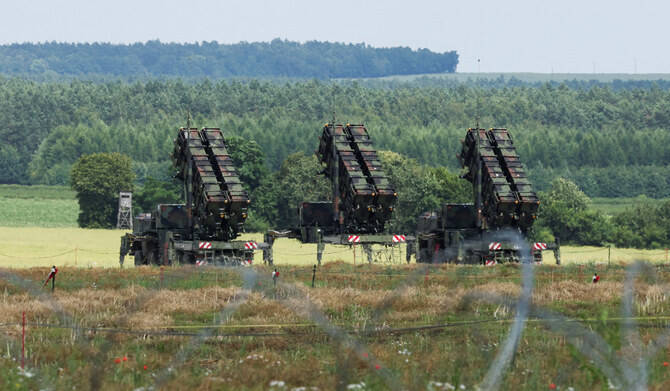
Ukraine seeks surge in domestic arms production as US diverts Swiss order for Patriots to Kyiv

A new Ukrainian government approved Thursday will race to expand domestic arms production to meet half the country’s weapons needs within six months as it tries to push back Russia’s invasion, Ukrainian President Volodymyr Zelensky said. (Reuters/File)
Short Url
Updated 17 July 2025
Follow

Ukraine seeks surge in domestic arms production as US diverts Swiss order for Patriots to Kyiv

  • The Swiss Defense Ministry said Thursday it has been informed by the US Defense Department that it will “reprioritize the delivery of Patriot systems to support Ukraine”
  • “What we need is greater capacity to push the war back onto Russia’s territory,” Zelensky said

KYIV: A new Ukrainian government approved Thursday will race to expand domestic arms production to meet half the country’s weapons needs within six months as it tries to push back Russia’s invasion, Ukrainian President Volodymyr Zelensky said.

Meanwhile, Switzerland said Thursday that the US Defense Department had informed it that Washington is diverting a Swiss order for Patriot air defense systems to Ukraine, which badly needs to improve its response to increasingly heavy Russian aerial attacks.

The Swiss Defense Ministry, which in 2022 ordered five Patriot systems, said Thursday it has been informed by the US Defense Department that it will “reprioritize the delivery of Patriot systems to support Ukraine.”

Delivery to Switzerland of the systems, worth billions of dollars, was scheduled to begin in 2027 and be completed in 2028. But the Swiss government said Washington informed it of the delay on Wednesday, adding that it was unclear how many systems would be affected.

Domestic defense manufacturing already accounts for almost 40 percent of weapons used by the Ukrainian military, according to Zelensky. As uncertainty grows about how many more weapons shipments Western countries can provide — and how quickly — Ukraine is keen to increase its output and widen its strikes on Russian soil.

“What we need is greater capacity to push the war back onto Russia’s territory — back to where the war was brought from,” Zelensky said late Wednesday in his nightly video address.

“We must reach the level of 50 percent Ukrainian-made weapons within the first six months of the new government’s work by expanding our domestic production.”

The need to adequately arm Ukraine’s military is pressing as Russia looks to drive forward its summer offensive and pounds Ukrainian cities with hundreds of drones and ballistic and cruise missiles.

Meanwhile, it remained unclear when promises of US-made weapons, especially Patriot missile systems crucial for stretched Ukrainian air defenses, might reach Ukraine. US President Donald Trump agreed to send the weaponry, but it will be paid for by European countries.

NATO’s Supreme Allied Commander Europe, Gen. Alexus Grynkewich, told the Associated Press Thursday that “preparations are underway” for weapons transfers to Ukraine and that NATO is working “very closely” with Germany to transfer Patriot systems.

Grynkewich said at a military event in Wiesbaden, Germany, that he had been ordered to “move (the weapons) out as quickly as possible.” He said the number of weapons being transferred is classified.

“We’re already in preparation phase for the first tranche of capability to start moving with respect to Patriots,” he said.

An expert working group under NATO’s Supreme Allied Commander Europe will discuss concrete planning “very quickly but also with corresponding caution,” German Defense Ministry spokesperson Mitko Müller said Wednesday.

He said details were still being worked out.

“Regarding the systems that we are talking about, I can’t confirm that anything is currently on the way. I’m not aware of that,” he said.

NATO chief Mark Rutte said in Washington on Monday that the alliance is coordinating the military support with funding from allies in Europe and Canada. He said there were commitments from Germany, Finland, Denmark, Sweden, Norway, the United Kingdom, the Netherlands and Canada “with more expected to follow.”

Ukraine has also developed its own long-range drones, which it uses to strike deep inside Russia.

Russian air defenses shot down 122 Ukrainian drones overnight, the country’s defense ministry said Thursday. The wave of drones caused flights to be grounded at airports in Moscow and St. Petersburg, although most of the drones were reportedly destroyed over the border regions of Bryansk and Kursk.

Meanwhile, Russia attacked Ukraine with 64 Shahed and decoy drones overnight, killing at least one person, the Ukrainian air force reported. The assault centered on the industrial Dnipropetrovsk region, officials said.

In other developments:
Russia on Thursday sent to Ukraine 1,000 bodies, including some of the country’s fallen soldiers, the Ukrainian Coordination Headquarters for the Treatment of Prisoners of War said.

At the same time, Russia received the bodies of 19 soldiers, Russian presidential aide Vladimir Medinsky said.

The exchange was part of a deal reached at direct peace talks last May and June that produced few other agreements between the sides.


Myanmar, Afghan hopeful scholars mourn UK study visa ban

Updated 4 sec ago
Follow

Myanmar, Afghan hopeful scholars mourn UK study visa ban

  • Myanmar, Afghanistan, Sudan and Cameroon citizens will be barred from obtaining university visas
  • Britain’s travel block is “really painful” for Afghan women hoping to escape to an education abroad, said one female

YANGON, Myanmar: Aspiring students are lamenting Britain’s ban on education visas for their war-weary countries — dashing dreams of bettering themselves and their home nations.
Myanmar, Afghanistan, Sudan and Cameroon citizens will be barred from obtaining university visas, London announced this week, saying asylum applications by visiting students had “rocketed” nearly 500 percent from 2021 to 2025.
“It’s like the country is punishing the weak, the most vulnerable people,” said one woman from Myanmar.
She was preparing for a scholarship interview for a master’s in climate change finance when her plans were upended by Downing Street’s decree on Wednesday.
“I could not focus the whole morning,” the 28-year-old told AFP from Yangon, speaking on condition of anonymity for security reasons in a country riven by civil war since a 2021 military coup.
“I can’t picture my future.”
Like in much of the developed world, immigration has become a divisive issue in Britain.
Efforts to beat back arrivals mirror the sweeping travel bans issued by US President Donald Trump which have shut out citizens of Myanmar, Sudan and Afghanistan.
Since the chaotic military withdrawal of Britain, the United States and other NATO nations in 2021, Afghanistan has been ruled by a resurgent Taliban government which has banned women over age 12 from attending school.
Britain’s travel block is “really painful” for Afghan women hoping to escape to an education abroad, said one female child social worker in Ghazni province, who asked to remain anonymous for security reasons.
She has now canceled her plans to study for a master’s in both the US and the UK.
“Now I am trying to be hopeful, but I think it would also be a mistake,” said the 27-year-old.
In the summer of 2024, Arefa Mohammadi fled to neighboring Pakistan, living in limbo as she applied to universities.
She got an offer to study public health in England but now cannot accept it.
“It was truly shocking for me,” said the 24-year-old.
“This situation put me in a place where I haven’t any goals, because all my goals and all my futures are unpredictable.”

- ‘Cruel and short-sighted’ -
In Kabul, a 39-year-old man faces similar heartbreak.
He was accepted to study specialist subjects related to water management at three universities in England and Scotland.
“When I was a child I witnessed several challenges like flash floods, water scarcity, environmental neglect, inefficient irrigation systems,” he said, asking to remain anonymous for security reasons. “To address these challenges I made my application.”
“I hoped to acquire modern knowledge. It’s impossible to acquire in Afghanistan,” he added.
Some 33 million people in the country face severe water shortages, aid agencies say, a result of compounding multi-year droughts, climate change and infrastructure battered by decades of war.
Britain’s Labour government made the decision to curb visas as the right-wing Reform UK party surges in opinion polls with its hard-line stance against immigration.
The UK Home Office said almost 135,000 asylum seekers had entered the country through legal routes since 2021.
Activist organization Burma Campaign UK called the visa ban “exceptionally cruel and shortsighted.”
“The opportunity to come to the UK to study is life-changing for the individual student but also an investment in the future of Myanmar,” said program director Zoya Phan in a statement.
One exiled Myanmar journalist has been living over the border in Thailand after escaping the military rule which has clamped down on press freedoms.
“When the military coup happened I was just 22, so I had a lot of dreams,” she said. “But over the past five years there have been a lot of struggles — I couldn’t complete my dreams.”
Every year since the junta takeover she applied for further education to buoy her spirits.
But she received an email Thursday morning canceling her place to study for a master’s at a London university.
“Everything is gone,” she said. “My UK dream is all disappeared.”