Disneyland is celebrating 70 years of being “The Happiest Place on Earth.”
The summerlong festivities in southern California include the opening of “Walt Disney – A Magical Life,” a show featuring a lifelike animatronic of the company’s founder that debuts Thursday and also marks Disneyland’s official anniversary.
Walt Disney’s vision of creating a getaway for families revolutionized the amusement park industry with immersive attractions featuring robotic figures and holographs, and shows and characters appealing to children.
The park’s emphasis on storytelling and attention to detail is still evident today in theme parks across the world.
Disneyland now ranks as the world’s second-most visited theme park, closely behind Magic Kingdom at Disney World in Florida, which opened in 1971. According to the Themed Entertainment Association, Disneyland drew more than 17 million people in 2023, bouncing back from an unprecedented 13-month closure during the COVID-19 pandemic.
The park was built on what was once orange groves in Anaheim, just outside Los Angeles. It opened on July 17, 1955 — a year that also saw Ray Kroc start his first McDonald’s restaurant and Jim Henson introduce his original version of Kermit the Frog.
Disneyland’s first day was famously a disaster, all broadcast on a live television special. The park opened just a year after its groundbreaking and simply wasn’t ready for its big day.
Attractions broke down, there weren’t enough restrooms, food and drinks were in short supply, traffic backed up for miles and the shoes of the first guests sank into freshly paved asphalt.
Among the original rides still around today are the Mad Tea Party, Peter Pan’s Flight and Jungle Cruise.
The cost to get in that first year was $1 for adults and 50 cents for children, although tickets for most rides were an additional 10 to 50 cents.
Today, a one-day ticket starts at more than $100 and on some days can double that.
Over the years, the park has hosted US presidents, kings and queens, and countless celebrities. A few even got their start at Disneyland — actor Kevin Costner was a skipper on the Jungle Cruise and comedian Steve Martin worked at a magic shop where he learned about being a performer.
The Walt Disney Co. now has six resorts with a dozen theme parks worldwide. The parks have become one of its most successful and important business segments.
The resort in Anaheim now includes Disney California Adventure and Downtown Disney, a shopping and entertainment district.
While Disneyland still features many of the touches Walt Disney oversaw himself, the original park is ever-evolving, sometimes to the dismay of its loyal fans.
Some of the moves have been made to keep up with a changing society, while others have been made to introduce more thrilling attractions with the latest technology to keep up with competitors.
Just last year, Disney received approval to expand its Southern California theme parks. A new parking structure and transit hub are the first steps in its plans to open more space for new attractions.

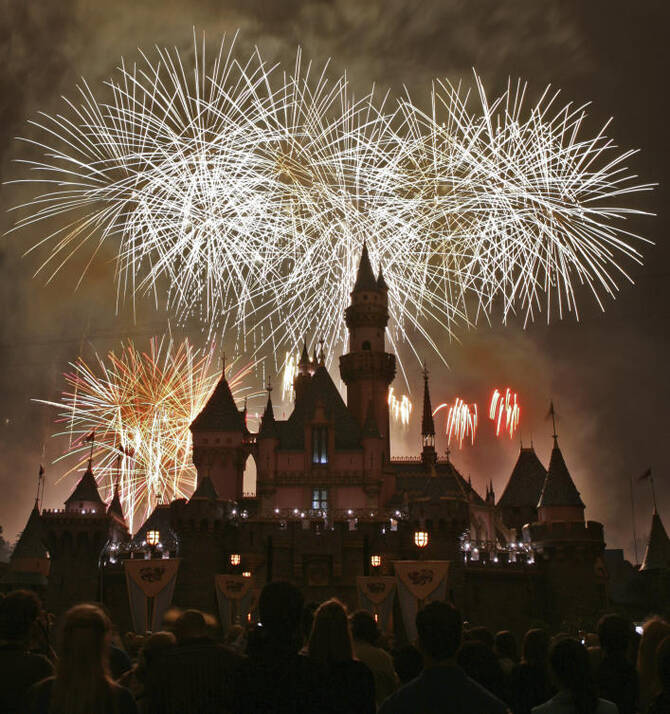
Disneyland is celebrating its 70th anniversary: Here’s a look at the park then and now
https://arab.news/6qudr
Disneyland is celebrating its 70th anniversary: Here’s a look at the park then and now
- It revolutionized amusement parks with immersive attractions and an emphasis on storytelling
- Disneyland is now the world’s second-most visited park despite a rocky first day 70 years ago
Egypt reveals restored colossal statues of pharaoh in Luxor
- Amenhotep III, one of the most prominent pharaohs, ruled during the 500 years of the New Kingdom, which was the most prosperous time for ancient Egypt
LUXOR: Egypt on Sunday revealed the revamp of two colossal statues of a prominent pharaoh in the southern city of Luxor, the latest in the government’s archeological events that aim at drawing more tourists to the country.
The giant alabaster statues, known as the Colossi of Memnon, were reassembled in a renovation project that lasted about two decades. They represent Amenhotep III, who ruled ancient Egypt about 3,400 years ago.
“Today we are celebrating, actually, the finishing and the erecting of these two colossal statues,” Mohamed Ismail, secretary-general of the Supreme Council of Antiquities, said ahead of the ceremony.
Ismail said the colossi are of great significance to Luxor, a city known for its ancient temples and other antiquities. They’re also an attempt to “revive how this funerary temple of King Amenhotep III looked like a long time ago,” Ismail said.
Amenhotep III, one of the most prominent pharaohs, ruled during the 500 years of the New Kingdom, which was the most prosperous time for ancient Egypt. The pharaoh, whose mummy is showcased at a Cairo museum, ruled between 1390–1353 BC, a peaceful period known for its prosperity and great construction, including his mortuary temple, where the Colossi of Memnon are located, and another temple, Soleb, in Nubia.
The colossi were toppled by a strong earthquake in about 1200 BC that also destroyed Amenhotep III’s funerary temple, said Ismail.
They were fragmented and partly quarried away, with their pedestals dispersed. Some of their blocks were reused in the Karnak temple, but archeologists brought them back to rebuild the colossi, according to the Antiquities Ministry.
In late 1990s, an Egyptian German mission, chaired by German Egyptologist Hourig Sourouzian, began working in the temple area, including the assembly and renovation of the colossi.
“This project has in mind … to save the last remains of a once-prestigious temple,” she said.
The statues show Amenhotep III seated with hands resting on his thighs, with their faces looking eastward toward the Nile and the rising sun. They wear the nemes headdress surmounted by the double crowns and the pleated royal kilt, which symbolizes the pharaoh’s rule.
Two other small statues on the pharaoh’s feet depict his wife, Tiye.
The colossi — 14.5 meters and 13.6 meters respectively — preside over the entrance of the king’s temple on the western bank of the Nile. The 35-hectare complex is believed to be the largest and richest temple in Egypt and is usually compared to the temple of Karnak, also in Luxor.
The colossi were hewn in Egyptian alabaster from the quarries of Hatnub, in Middle Egypt. They were fixed on large pedestals with inscriptions showing the name of the temple, as well as the quarry.
Unlike other monumental sculptures of ancient Egypt, the colossi were partly compiled with pieces sculpted separately, which were fixed into each statue’s main monolithic alabaster core, the ministry said.
Sunday’s unveiling in Luxor came just six weeks after the inauguration of the long-delayed Grand Egyptian Museum, the centerpiece of the government’s bid to boost the country’s tourism industry. The mega project is located near the famed Giza Pyramids and the Sphinx.
In recent years, the sector has started to recover after the coronavirus pandemic and amid Russia’s war on Ukraine — both countries are major sources of tourists visiting Egypt.
“This site is going to be a point of interest for years to come,” said Tourism and Antiquities Minister Sherif Fathy, who attended the unveiling ceremony. “There are always new things happening in Luxor.”
A record number of about 15.7 million tourists visited Egypt in 2024, contributing about 8 percent of the country’s GDP, according to official figures.
Fathy, the minister, has said about 18 million tourists are expected to visit the country this year, with authorities hoping for 30 million visitors annually by 2032.


