- More than 5,800 children diagnosed with acute malnutrition last month, triple the number compared with February
- UNICEF chief Catherine Russell says children are being killed and maimed as they queue for food and medicine
NEW YORK: Children in Gaza are suffering from the worst starvation rates since the war between Israel and Hamas began in October 2023, aid officials told the UN Security Council on Wednesday, in a devastating assessment of the conditions young Palestinians in the territory face as they try to survive.
“Starvation rates among children hit their highest levels in June, with over 5,800 girls and boys diagnosed as acutely malnourished,” said the UN’s humanitarian chief, Tom Fletcher.
Israel imposed an 11-week blockade on humanitarian aid earlier this year, and has only allowed a trickle of relief supplies to enter the territory since the end of May. The effects on the health of children have been catastrophic, according to the details presented to members of the Security Council. Levels of acute malnutrition have nearly tripled since February, just before the total blockade on aid was imposed.
“Children in Gaza are enduring catastrophic living conditions, including severe food insecurity and malnutrition,” UNICEF’s executive director, Catherine Russell, told the council.
“These severely malnourished children need consistent, supervised treatment, along with safe water and medical care, to survive.”
Yet youngsters in the territory are being killed and maimed as they queue for lifesaving food and medicine, she added. Last week, nine children were among 15 Palestinians killed by an Israeli strike in Deir Al-Balah while they waited in line for nutritional supplies from UNICEF.
“Among the survivors was Donia, a mother seeking a lifeline for her family after months of desperation and hunger,” Russell said.
“Donia’s 1-year-old son, Mohammed, was killed in the attack after speaking his first words just hours earlier. When we spoke with Donia, she was lying critically injured in a hospital bed, clutching Mohammed’s tiny shoe.”
Russell painted a bleak picture of desperation for the 1 million Palestinian children in the territory, where more than 58,000 people have been killed during the 21 months of war.
Among the dead are 17,000 children — an average of 28 each day, the equivalent of “a whole classroom of children killed every day for nearly two years,” Russell said.
Youngsters also struggle to find clean water supplies, she added, and are therefore forced to drink contaminated water, increasing the risk of disease outbreaks; waterborne diseases now represent 44 per cent of all healthcare consultations.
“Thousands of children urgently need emergency medical support,” Russell said, and many of those suffering from traumatic injuries or severe preexisting medical conditions are at risk of death because medical care is unavailable.
She repeated calls from other UN officials for Israel to allow the delivery of humanitarian aid to Gaza “at sufficient speed and scale to meet the urgent needs of children and families.”
A new aid-distribution system, introduced and run by Israel and the US, has sidelined traditional UN delivery mechanisms and restricted the flow of humanitarian supplies to a fraction of what was previously available.
Since the new system, run by the newly formed Gaza Humanitarian Foundation, began operating, hundreds of people, including children, have been shot dead as they gathered to collect aid.
Russell urged the Security Council to push for a return to UN aid-delivery systems so that essentials such as medicine, vaccines, water, food, and nutrition for babies can reach those in need.
Fletcher, the humanitarian chief, told the council that the shattered healthcare system in Gaza meant that in some hospitals, five babies share a single incubator and pregnant women give birth without any medical care.
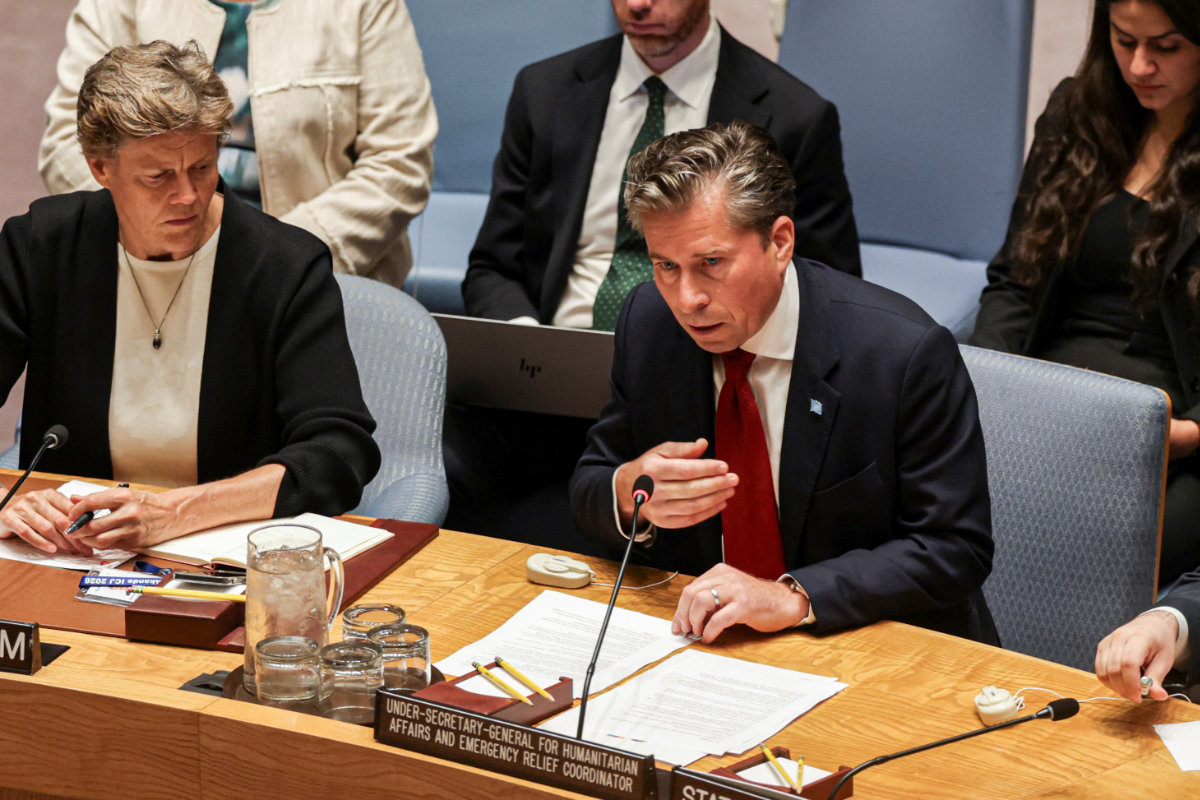
He said the International Court of Justice has demanded that Israel “take immediate and effective measures to enable the provision of urgently needed basic services and humanitarian assistance,” and added: “Intentionally using the starvation of civilians as a method of warfare would, of course, be a war crime.”
During the meeting, Israel faced strong criticism from permanent Security Council members France and the UK.
The British ambassador to the UN, Barbara Woodward, described the shooting of Palestinians as they attempted to reach food-distribution sites as “abhorrent.”
She called for an immediate ceasefire in Gaza and said the UK “strongly opposes” the expansion of Israeli military operations.
French envoy Jerome Bonnafont said Israel must end its blockade of humanitarian aid, and denounced the Gaza Humanitarian Foundation system as “unacceptable and incompatible” with the requirements of international law.
He said an international conference due to take place on July 28 and 29 at the UN headquarters in New York, co-chaired by France and Saudi Arabia, would offer a “pathway toward the future” and identify tangible ways in which a two-state solution might be reached to end the wider conflict between Israelis and Palestinians.
Dorothy Shea, the ambassador to the UN from Israel’s main international ally, the US, said the blame for the situation in Gaza lay with Hamas, which continues to hold hostages taken during the attacks against Israel on Oct. 7, 2023, that ignited the conflict in Gaza.