

Saudi project clears 1,171 mines in Yemen

1 / 3
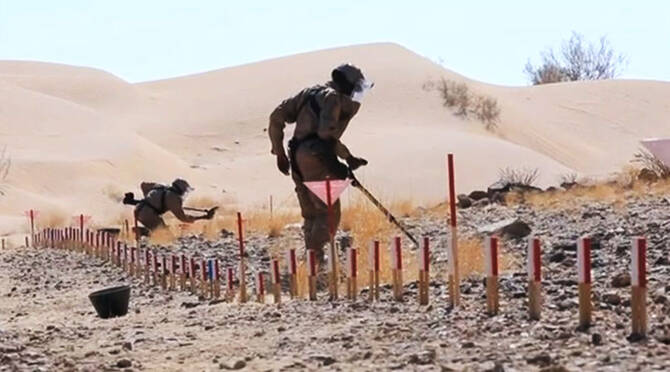
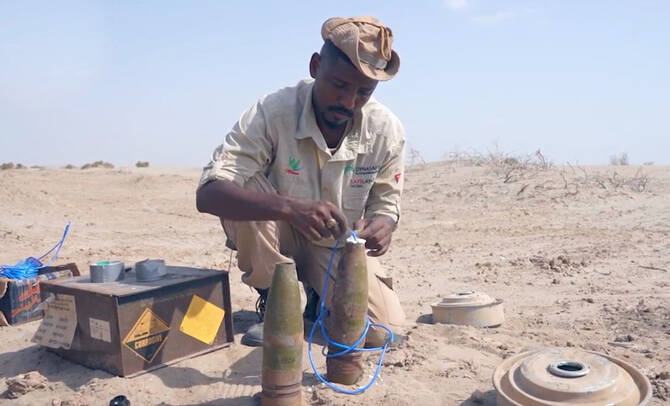
Members of Saudi Arabia’s Project Masam removed 1,171 explosive devices from various regions of Yemen last week. (Supplied)
2 / 3
Members of Saudi Arabia’s Project Masam removed 1,171 explosive devices from various regions of Yemen last week. (Supplied)
3 / 3
Members of Saudi Arabia’s Project Masam removed 1,171 explosive devices from various regions of Yemen last week. (Supplied)
Short Url
Updated 16 July 2025
Follow

Saudi project clears 1,171 mines in Yemen

  • Ousama Al-Gosaibi, the initiative’s managing director, said that 505,466 mines have been cleared since the project began in 2018

RIYADH: Members of Saudi Arabia’s Project Masam removed 1,171 explosive devices from various regions of Yemen last week.

The total included 1,124 unexploded ordnances, 46 anti-tank mines and one anti-personnel mines, the Saudi Press Agency reported.

Ousama Al-Gosaibi, the initiative’s managing director, said that 505,466 mines have been cleared since the project began in 2018.

The explosives were planted indiscriminately and posed a threat to civilians, including children, women and the elderly.

The demining operations took place in Marib, Aden, Jouf, Shabwa, Taiz, Hodeidah, Lahij, Sanaa, Al-Bayda, Al-Dhale and Saada.

The project trains local demining engineers and provides them with modern equipment. It also offers support to Yemenis injured by the devices.

Teams are tasked with clearing villages, roads and schools to facilitate the safe movement of civilians and delivery of humanitarian aid.


King Abdulaziz Foundation reveals rare images from king’s 1916 Basra visit

Updated 20 December 2025
Follow

King Abdulaziz Foundation reveals rare images from king’s 1916 Basra visit

  • Photographs form part of a wider collection documented by British photographer Gertrude Bell

RIYADH: The King Abdulaziz Foundation has revealed archival photographs documenting King Abdulaziz’s tour of the outskirts of Basra in 1916, a visit that came at an early stage of his efforts to build regional relationships.

One of the photographs, taken by British photographer Gertrude Bell, shows King Abdulaziz standing with his men in the Basra desert, the Saudi Press Agency reported. 

The image reflects his early political and diplomatic engagement in the region, as he sought to strengthen ties with neighboring areas and engage with the wider Arab and international community, SPA added.

The photograph forms part of a wider collection documented by Bell, which records key developments and transformations across the Arabian Peninsula during the early 20th century.

The Basra visit holds particular significance in King Abdulaziz’s journey as a unifying leader. 

Rather than crossing borders in pursuit of power, the visit reflected an approach focused on stability, cooperation and long-term regional harmony, laying the groundwork for a leadership style defined by pragmatism and openness, SPA said.