

Pakistan says Iran’s envoy has diplomatic immunity after FBI links him to 2007 agent abduction

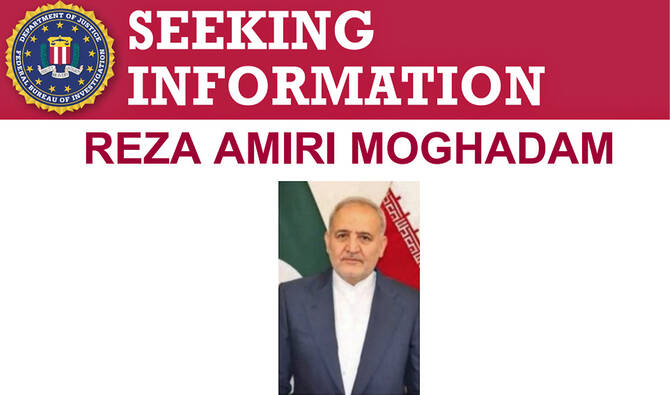
The picture posted by FBI on July 15, 2025, shows Iran’s ambassador to Pakistan, Reza Amiri Moghadam, added to its list of most wanted individuals. (FBI)
Short Url
Updated 16 July 2025
Follow

Pakistan says Iran’s envoy has diplomatic immunity after FBI links him to 2007 agent abduction

  • Special Agent Robert Levinson disappeared from Iran’s Kish Island, with US blaming three Iranian officials
  • FBI says Tehran tried to shift blame onto a militant group operating in Pakistan’s volatile Balochistan region

ISLAMABAD: Pakistan said on Wednesday Iranian Ambassador Reza Amiri Moghadam enjoys diplomatic immunity after the Federal Bureau of Investigation (FBI) added him to its most-wanted list over his alleged role in the 2007 abduction of a retired US special agent from Iran’s Kish Island.

The FBI said the release of “Seeking Information” posters featuring the three senior Iranian officials was part of its ongoing investigation into Robert A. “Bob” Levinson’s disappearance and Iran’s alleged efforts to conceal its responsibility.

The other two named individuals are Taghi Daneshvar, identified as a counterespionage officer in Iran’s Ministry of Intelligence and Security (MOIS) and Gholamhossein Mohammadnia, a senior MOIS deputy who served as Iran’s ambassador to Albania before being expelled in 2018.

"As far as Pakistan is concerned the Ambassador of Iran is widely respected for his role in promotion of Pakistan-Iran relations," the foreign office spokesperson, Ambassador Shafqat Ali Khan, told Arab News. "He is entitled to all the privileges, immunities and respect due to an ambassador that too from a friendly neighboring country.”

In a statement issued a day earlier, Steven Jensen, Assistant Director in Charge of the FBI Washington Field Office, said the three Iranian officials were among those who allegedly facilitated Levinson’s 2007 abduction and the subsequent cover-up.

“Bob likely later perished in captivity far away from his family, friends, and colleagues,” he said.

“The FBI will continue its relentless pursuit to hold anyone involved in his abduction to account for their reprehensible actions,” he added.

According to the FBI, Moghadam, also known as Ahmad Amirinia, led MOIS’s operations unit at the time of Levinson’s abduction. The agency said European-based MOIS agents reported to him in Tehran.

The statement said authorities in Tehran attempted to shift blame for the FBI agent’s abduction onto a militant group operating in Pakistan’s Balochistan region.

The FBI continues to offer a reward of up to $5 million for information that leads to Levinson’s location, recovery and return.

In addition, the US State Department’s Rewards for Justice program is offering up to $20 million for relevant information in the case.


Pakistan PM calls for faster CPEC implementation, pledges security for Chinese workers

Updated 27 February 2026
Follow

Pakistan PM calls for faster CPEC implementation, pledges security for Chinese workers

  • Shehbaz Sharif pushes expanded cooperation in agriculture, IT and mining under CPEC phase two
  • Chinese envoy reaffirms Beijing’s support for Pakistan’s sovereignty and economic development

ISLAMABAD: Prime Minister Shehbaz Sharif on Friday called for speeding up projects under the China-Pakistan Economic Corridor (CPEC) and pledged stronger security guarantees for Chinese workers and investments, during a meeting with China’s ambassador in Islamabad.

Sharif made the remarks as the two countries strive to launch the second phase of CPEC, a multibillion-dollar infrastructure and energy initiative launched in 2015 as part of China’s Belt and Road Initiative (BRI).

CPEC’s first phase focused largely on power generation and transport infrastructure aimed at easing Pakistan’s chronic energy shortages and improving connectivity. The second phase seeks to expand cooperation into industrial development, with an emphasis on special economic zones and export-oriented growth.

“While highlighting the importance of accelerating ongoing CPEC projects, the Prime Minister stressed on the need to enhance cooperation in agriculture and IT and mining & minerals,” said a statement circulated by the PM Office after the meeting.

“He also underscored Pakistan’s resolve to provide a secure and conducive environment for Chinese personnel, investments, and institutions in Pakistan,” it added.

Chinese nationals and projects in Pakistan have faced security threats in the past, including attacks by militant groups targeting infrastructure sites and convoys. Islamabad has repeatedly vowed to tighten security and has deployed special protection units for Chinese workers.

China is Pakistan’s closest ally in the region and a key economic partner, with CPEC widely regarded by Islamabad as central to long-term economic growth.

During the meeting, the prime minister conveyed greetings to Chinese President Xi Jinping and Premier Li Qiang, particularly on the occasion of the Chinese New Year.

China’s Ambassador to Pakistan, Jiang Zaidong, reiterated Beijing’s support for Pakistan’s sovereignty and socioeconomic development, according to the statement. Both sides also exchanged views on regional and international issues and agreed to maintain close coordination.