

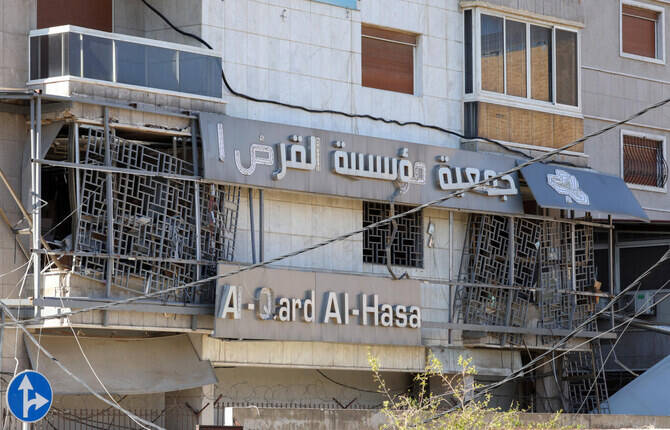
Lebanon’s central bank bans transactions with Hezbollah financial affiliate

Lebanon’s central bank has banned licensed financial institutions from any direct or indirect interactions with Iran-backed Hezbollah’s financial institution Al-Qard Al-Hassan. (Reuters)
Short Url
Updated 15 July 2025
Follow

Lebanon’s central bank bans transactions with Hezbollah financial affiliate

  • 12 people killed and several injured in series of surprise Israeli attacks on targets in Bekaa Valley
  • Members of the Lebanese parliament criticize government for delays in efforts to ensure possession of weapons is restricted to state forces

BEIRUT: Karim Souaid, the governor of Lebanon’s central bank, on Tuesday banned banks and other organizations from doing business with Al-Qard Al-Hassan, a financial institution affiliated with Hezbollah.

Seen as a major step by the Lebanese state, the move coincided with the launch by the Israeli army of more than 10 surprise raids on targets in western and eastern mountain ranges of the Bekaa Valley. The Lebanese Ministry of Health said six people were wounded in the strikes.

A subsequent raid struck a well-drilling machine in the border town of Wadi Faara, killing 12 people, including five Lebanese nationals and seven Syrians from the same family, and injuring several more. Israeli strikes also hit the towns of Bodai, Kasarnaba, Shmistar and Brital. One missile landed near Shmistar Secondary School while exams were taking place, shattering windows and causing panic and distress among students.

Israeli Defense Minister Israel Katz said the strikes sent a clear message to Hezbollah, as he accused the organization of attempting to rebuild its forces to threaten his country.

A resident of Shmistar told Arab News the areas targeted by the attacks were “abandoned sites.” The Israeli army said its fighter jets, “guided by the Intelligence Directorate and Northern Command,” had targeted military compounds in the Bekaa Valley affiliated with Hezbollah.

Avichay Adraee, a military spokesperson, said the strikes focused on camps that were used by Hezbollah’s elite Radwan Force to store weapons and train for attacks against Israeli forces. Hezbollah members and weapons depots were identified at the sites, he added, as he accused the militant group of violating the November 2024 ceasefire agreement.

Meanwhile, Banque du Liban, Lebanon’s central bank, said: “Lebanese financial institutions are banned from providing or facilitating financial, monetary or transfer services or brokerage services in favor of unlicensed institutions, companies and associations.”

The statement specifically identified “Al-Qard Al-Hassan Association, Tasheelat S.A.L., Al-Yusr for Finance and Investment, Bayt Al-Mal Lil Muslimin, and any entity listed on international sanctions lists.”

The ban also covers “establishing or implementing financing, leasing or lending arrangements, or facilitating access for such entities or their branches to the Lebanese banking system, in any currency.”

The central bank said the decision was part of “preventive measures aimed at protecting Lebanon’s financial and economic sectors from dealing with unlicensed or internationally sanctioned entities.”

It continued: “Violations of this decision will trigger strict legal action, which may include the suspension or revocation of licenses, freezing of accounts and assets, and referral to the Special Investigation Commission.”

The US Department of State designates Hezbollah as a Foreign Terrorist Organization and a Specially Designated Global Terrorist. It has imposed sanctions on Al-Qard Al-Hassan and affiliated officials, and accused them this month of facilitating attempts by Hezbollah to evade sanctions and enable Al-Qard Al-Hassan to conduct millions of dollars of transactions through “shadow” accounts. Israeli forces struck branches of the institution during the war against Hezbollah last year.

In other developments, during a plenary session, members of the Lebanese parliament criticized delays by the government in efforts to ensure possession of weapons is restricted to state forces; its failure to disclose a US proposal for a mechanism to implement the ceasefire agreement with Israel and UN Resolution 1701; for diluting the issue of recovery of depositors’ funds in Lebanese banks; and for failing to resolve the issue of Syrian refugees in Lebanon.

Resolution 1701 was adopted by the Security Council in 2006 with the aim of resolving the conflict that year between Israel and Hezbollah. It calls for an end to hostilities, the withdrawal of Israeli forces from Lebanon, the withdrawal of Hezbollah and other forces from parts of the country south of the Litani River, and the disarmament of Hezbollah and other armed groups.

The criticisms from opposition MPs came during a discussion about the performance of Prime Minister Nawaf Salam’s government after its first 150 days in office.

Lebanese Forces MP George Adwan condemned “the government’s failure to set a timetable for dismantling and handing over weapons and imposing sovereignty.”

He added: “The government must move quickly to end the presence of military structures on Lebanese territory. No one can hope for the return of Arab and international relations to Lebanon if this is not done,” given that “the government is unable to protect the UNIFIL (the UN’s Interim Force in Lebanon peacekeeping mission) forces that support Lebanon.”

MP Gebran Bassil, head of the Free Patriotic Movement, said: “The current authority is acting as a bystander, neither starting to disarm nor to take possession of the weapons. What is happening is a process of buying time until a US-Iranian agreement takes place.

“The question is, if that does not happen, do we remain like this? Instead of taking the initiative to present a Lebanese paper to address this issue, we wait for the US paper and discuss what can be done with it.”

Independent MP Michel Moawad said: “Lebanon is facing a historic opportunity to address weapons and the military groups outside state control, rebuild the nation and break free from isolation.

“While the government’s stance is good, it lacks implementation. The opportunity is present now; failure to act will lead to further occupation, destruction and isolation, and ultimately everything will be lost.”

Fouad Makhzoumi, also an independent MP, expressed regret that “the government’s decision has devolved into negotiating with every weapon outside the state’s authority.”

He added: “What is required of those who carry weapons is to hand them over to the state. Those bearing arms are required to surrender them to the state, enabling it to defend itself against the threat of war, have the means to recover and liberate the five points from the renewed occupation (by Israeli forces), secure the return of prisoners, and initiate negotiations to delineate the Blue Line.”

He urged the government to “fully implement the ceasefire agreement, the Taif Agreement and Resolution 1701 in all its provisions, and to mandate the army to prevent any of the repeated and systematic attacks on UNIFIL.”

Hezbollah MP Ibrahim Al-Moussawi criticized what he described as a failure to provide the Lebanese army with “weapons to protect the homeland against the enemy.”

He said: “We are among the first advocates for a just Lebanese state for all its citizens but where is this state? We do not question anyone’s patriotism and the army is our army, but there is a foreign ‘veto’ that prevents arming the army.

“Lebanon has fully implemented all its obligations under the ceasefire agreement, while Israel has failed to implement a single clause.”

He warned that “whoever thinks they are dealing with others based on a political logic of victors and vanquished is a traitor to Lebanon,” and added: “What we are witnessing is an existential threat, and any understanding on any other basis will put us all in a circle of loss.”


US says it destroyed 16 mine-laying vessels as Iran threatens to block Gulf oil exports

Updated 4 sec ago
Follow

US says it destroyed 16 mine-laying vessels as Iran threatens to block Gulf oil exports

DUBAI, United Arab Emirates: The US said it took out more than a dozen mine-laying Iranian vessels Tuesday, and the Islamic Republic vowed to block the region’s oil exports, saying it would not allow “even a single liter” to be shipped to its enemies.
As concerns grew about the war’s effect on a strategic waterway, the American military said it destroyed 16 minelayers, though President Donald Trump said in social media posts that there were no reports of Iran planting explosives in the Strait of Hormuz, through which 20 percent of the world’s oil is shipped.
The American military released the figure, along with unclassified footage of some of the vessels, after Trump threatened to hit Iran at “a level never seen before” if the country failed to immediately remove any mines it might have deployed in the channel.
Both sides sharpened their rhetoric as the war entered its 11th day. US Defense Secretary Pete Hegseth promised the most intense strikes yet while the Pentagon detailed the broader toll of injuries sustained by US troops.
The conflict’s effects rippled across the Middle East and beyond. Iranian leaders ruled out talks, threatened Trump and launched new attacks against Israel and Gulf Arab countries.
In Iran, residents of Tehran said they experienced some of the war’s heaviest strikes. A woman said she saw a residential building get hit. She and others reached by The Associated Press spoke on condition of anonymity to prevent reprisals. Tens of thousands of Iranians have sought shelter in the countryside.
Lebanon reports more deaths
Multiple Israeli strikes across southern Lebanon killed seven people, the Lebanese Health Ministry said early Wednesday.
Other deaths included a Red Cross member who died early Wednesday after an Israeli strike targeted his team Monday while they were rescuing people following an earlier attack, the health ministry said. On Tuesday, Israeli airstrikes killed four people, including a paramedic who worked for the Hezbollah-affiliated Islamic Health Authority who was treating the wounded.
Also Tuesday, an Israeli strike killed a Lebanese soldier, the Lebanese army said, bringing the number of troops killed there to five since the conflict began.
Israel said it was working to intercept missiles from Iran and Hezbollah, which began firing on Israel after the start of the war.
Saudi Arabia’s Defense Ministry said early Wednesday that it intercepted multiple missiles launched toward several sites, including Prince Sultan Air Base, a major US- and Saudi-operated air facility. The ministry said it also destroyed drones near two major cities and more headed toward the kingdom’s vast Shaybah oil field in the Empty Quarter desert.
In Iraq, drones targeted military bases inside Baghdad International Airport late Tuesday, two security officials told AP on condition of anonymity because they were not authorized to speak to the press. Some drones fell near Iraqi security positions, while others landed near logistical support sites used by US-led coalition forces, one official said.
The United Arab Emirates said early Wednesday that its air defenses were firing at incoming Iranian fire. The wealthy Gulf nation — home to the business and travel hub of Dubai — said Iranian attacks have killed six people and wounded 122 others.
Bahrain sounded sirens early Wednesday, warning of an incoming Iranian attack. The warnings came a day after an Iranian attack hit a residential building in the capital, Manama, and killed a 29-year-old woman and wounding eight people.
Pentagon says 140 US troops wounded since war began
Gen. Dan Caine, chairman of the Joint Chiefs of Staff, said US forces hit more than 5,000 targets.
The Pentagon separately said Tuesday that about 140 US service members have been wounded in the war, and the “vast majority” of the injuries were minor, with 108 service members already back on duty. Eight US service members suffered severe injuries, and seven have been killed.
In Iran, at least 1,230 people have been killed, while the death toll is more than 480 in Lebanon and 12 in Israel, according to officials.
Iran’s leaders have remained defiant after days of heavy strikes targeting the country’s leadership, military, ballistic missiles and its disputed nuclear program. Iran’s parliament speaker, Mohammad Bagher Qalibaf, said on X that Iran was “definitely not looking for a ceasefire.”
“We believe that the aggressor should be punched in the mouth so that he learns a lesson so that he will never think of attacking our beloved Iran again,” he said.
A top Iranian security official, Ali Larijani, posted a warning to Trump, writing on X that “Even those bigger than you couldn’t eliminate Iran. Be careful not to get eliminated yourself.” Iran has been accused of plotting attempts to kill Trump in the past.
The Trump administration, meanwhile, faced growing scrutiny at home about the war.
“I’m not sure what the end game is, or what their plans are,” Democratic Sen. Jacky Rosen of Nevada said after a classified briefing that the Trump administration held Tuesday for some lawmakers.
Saudi Arabia’s oil giant says tankers being rerouted to avoid Strait of Hormuz
Iran has repeatedly targeted energy infrastructure with attacks that appear aimed at generating enough global economic pain to pressure the US and Israel to end their strikes. It has also fired on Israel and US military bases in the region.
The US stock market held steadier Tuesday as Wall Street waited for the next clue on when the war with Iran may end.
Oil prices, meanwhile, remained well below their peaks hit on Monday. Such spikes have been rocking financial markets worldwide because of worries that the war could block the global flow of oil and natural gas for a long time.
Iran’s paramilitary Revolutionary Guard said it “will not allow the export of even a single liter of oil from the region to the hostile side and its partners until further notice.”
Amin Nasser, the president and CEO of Saudi Arabia’s oil giant Aramco, said tankers were being rerouted to avoid the strait, and that the company’s east-west pipeline would reach its full capacity this week of 7 million barrels a day being brought to the Red Sea port of the Yanbu.
“The situation at the Strait of Hormuz is blocking sizable volumes of oil from the whole region,” he said. “If this takes a long time, that will have serious impact on the global economy.”
Foreign nationals get out of region
The UN refugee agency said Tuesday that more than 667,000 people in Lebanon had registered as displaced — an increase of over 100,000 since a day earlier — and more than 85,000 people from Lebanon, mostly Syrians, had entered neighboring Syria.
The British government said the number of commercial flights from the UAE to the UK is returning to normal levels, with 32 flights operated Monday from Dubai to Britain and another 36 scheduled Tuesday. British Airways, however, said it suspended flights to and from Jordan, Bahrain, Qatar, Dubai and Tel Aviv until later this month.
Many foreign nationals have been getting out of the Arabian Gulf region since the war began, including over 45,000 UK citizens, the British Foreign Office said. Some 40,000 people returned to the United States, according to the State Department.