

Lebanon’s worst drought on record drains largest reservoir

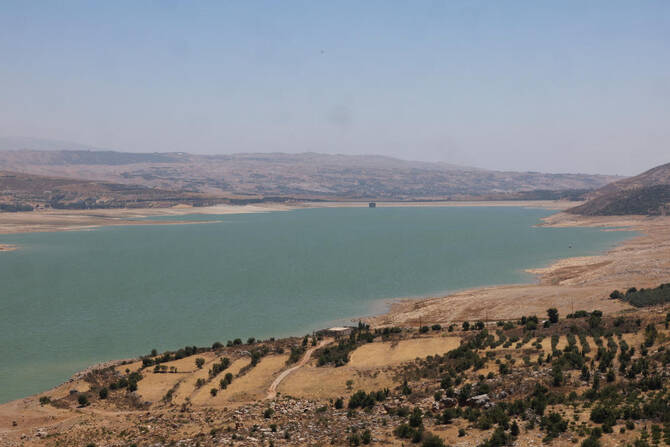
A general view of the drought-stricken Lake Qaraoun, according to The Litani River National Authority, Lebanon's largest reservoir on the Litani River, near Qaraoun village, Lebanon, Jul. 9, 2025. (Reuters)
Short Url
Updated 15 July 2025
Follow

Lebanon’s worst drought on record drains largest reservoir

  • The Litani River National Authority said inflows to Lake Qaraoun during this year’s wet season did not exceed 45 million cubic meters
  • Last year, the figure stood at 230 million

QARAOUN, Lebanon: Water levels at Lebanon’s largest reservoir on the Litani River have fallen to historic lows amid what experts describe as the country’s worst drought on record, threatening agriculture, electricity production, and domestic water supplies.

The Litani River National Authority said inflows to Lake Qaraoun during this year’s wet season did not exceed 45 million cubic meters, a fraction of the 350 million cubic meters annual average.

Last year, the figure stood at 230 million. The water currently available in Lake Qaraoun — around 61 million cubic meters — was unusable due to severe pollution, the authority said.

“There were dry years in 1989, 1990 and 1991, but this year is the driest,” said Sami Alawieh, head of the river authority. “We are facing a water scarcity problem across all Lebanese territories and water basins.”

Drone footage of Lake Qaraoun shows a dramatically receded shoreline, exposing cracked earth and dead vegetation.

Lebanon’s hydroelectric plants tied to the Litani basin have been shut down, Alawieh said, causing financial losses and intensifying electricity rationing by Electricite du Liban.

“We have two factors: the decline in rainfall and the pressure on groundwater,” he said.

A study by the authority found climate warming and shifting weather patterns have contributed to more frequent dry seasons and higher temperatures, exacerbating soil moisture loss and reducing the recharging of groundwater reservoirs.

The state utility has slashed supply in some areas from 20 hours a day to as little as 10.

In the fertile area around Qaraoun village, in the Bekaa Valley, farmers were already feeling the impact.

“I have never seen such drought or scarcity of rain as this year,” said Safa Issa. “We used to get snow up to a meter high. Now, it’s been 10 years since we’ve seen any.”

The strain has been compounded by erratic supply of electricity needed to run irrigation systems.

“You irrigate for three hours, then stop for three,” said Fayez Omais, another local farmer.

Suzy Hoayek, an adviser to the Ministry of Energy and Water in Beirut, said a nationwide awareness campaign to reduce consumption would be launched within 10 days.

“The most important thing is to manage demand,” she said.


GCC ambassadors hold discussions with Japan’s ruling party regarding Iran

Updated 55 min 25 sec ago
Follow

GCC ambassadors hold discussions with Japan’s ruling party regarding Iran

  • KONO Taro, head of international relations for the LDP, participated in the high-level discussions alongside other senior officials
  • Dr. Ghazi Faisal Binzagr, Saudi Arabia’s ambassador to Japan, described the meeting as a timely opportunity to exchange views on the evolving regional situation

TOKYO: Gulf Cooperation Council (GCC) ambassadors met on Tuesday with leaders of Japan’s ruling Liberal Democratic Party (LDP) to explore deeper collaboration across multiple fields and tackle pressing issues related to Iran.

KONO Taro, head of the party’s international relations, participated in the high-level discussions alongside other senior officials.

Dr. Ghazi Faisal Binzagr, Saudi Arabia’s ambassador to Japan, described the meeting as a timely opportunity to exchange views on the evolving regional situation.

Ambassador Binzagr emphasized that during periods of heightened tension, open dialogue with trusted partners like Japan is essential. He noted that diplomacy and clear communication are vital for defusing conflict and maintaining regional stability.

Saudi Ambassador Binzagr further noted that the Gulf countries and Japan share a longstanding history of cooperation founded on mutual trust and common objectives of stability and prosperity. He stated, “In times such as these, it is precisely these enduring partnerships that allow constructive dialogue to prevail, and that help ensure that wisdom and restraint guide the path toward peace and stability in our region."

Kono underscored the strong bonds and active cooperation between Japan and the GCC, noting that Japan views its ties with the GCC as a strategic partnership.