

Pakistan monsoon death toll rises to 116 after five more killed in last 24 hours

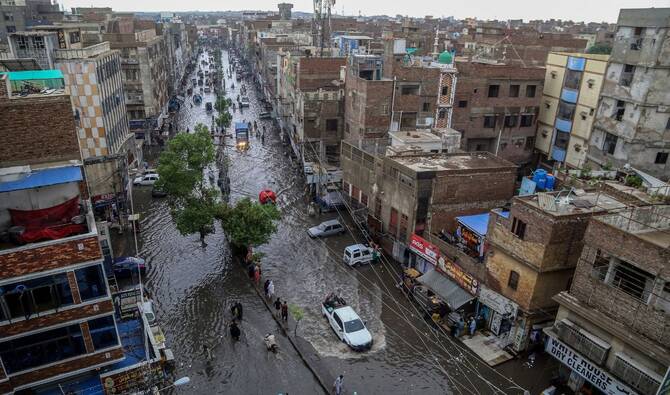
Commuters make their way through a flooded street during heavy monsoon rains in Hyderabad, in Sindh province, on July 14, 2025. (AFP)
Short Url
Updated 15 July 2025
Follow

Pakistan monsoon death toll rises to 116 after five more killed in last 24 hours

  • The development comes as authorities warn of more downpours, flooding over the next two days
  • At least 253 people have been injured in rain-related incidents since monsoon began in late June

ISLAMABAD: At least five more people were killed in rain-related incidents in Pakistan in the last 24 hours, the National Disaster Management Authority (NDMA) said on Tuesday, taking the overall monsoon death toll to 116 since late June.

In Punjab, two children died after being struck by lightning in Okara, while two others were killed in a house collapse in Bahawalnagar. A man was killed in a house collapse in Sindh’s Hyderabad. At least 253 people have been injured in rain-related incidents since monsoon began in late June.

In its latest report on Tuesday, the NDMA said monsoon currents from the Arabian Sea and the Bay of Bengal were penetrating into central parts of Pakistan and were likely to cause thunderstorm and heavy rains.

“Scattered to widespread thunderstorm/rain with isolated heavy falls and torrential rains at few places is expected over Bahawalpur, Multan, DG Khan, Sahiwal, Lahore, Gujranwala and Faisalabad Divisions,” it said.

“Scattered thunderstorm/rain with isolated heavy falls is expected over the upper catchments of all rivers along with Islamabad, upper Sindh, east Balochistan, Peshawar, Kohat, Bannu, DI Khan, Rawalpindi and Sargodha Divisions.”

The authority said flash flooding due to hill torrents is expected in DG Khan and east Balochistan on July 15-16, while urban flooding is expected in major Punjab cities over the next two days.

The NDMA earlier directed authorities to ensure deployment of emergency teams, improve drainage systems and coordinate closely with local administration. It advised public to stay away from weak structures and electricity poles, avoid unnecessary travel and relocate vehicles and livestock to safer locations.

Monsoon season brings South Asia 70 to 80 percent of its annual rainfall, arriving in early June in India and late June in Pakistan, and lasting through until September.

The annual rains are vital for agriculture and food security, and the livelihoods of millions of farmers. But increasingly erratic and extreme weather patterns are turning the rains into a destructive force.

Pakistan is one of the world’s most vulnerable countries to the effects of climate change, and its 240 million residents are facing extreme weather events with increasing frequency.

In 2022, unprecedented monsoon floods submerged a third of Pakistan and killed 1,700 people, with some areas yet to recover from the damage. In May, at least 32 people were killed in severe storms, including strong hailstorms.


Pakistan kills 11 militants in separate operations in western provinces

Updated 27 December 2025
Follow

Pakistan kills 11 militants in separate operations in western provinces

  • Military says five Baloch separatist fighters were killed in an intelligence-based operation in Kohlu district
  • Police say six Pakistani Taliban died in Lakki Marwat during a joint operation after drone attacks on homes

ISLAMABAD/PESHAWAR: Pakistani security forces and police killed at least 11 militants in separate counterterrorism operations in the country’s western provinces of Balochistan and Khyber Pakhtunkhwa, authorities said on Friday, highlighting the distinct insurgencies confronting the country along its border with Afghanistan.

In southwestern Balochistan, the military said it killed separatist militants in an intelligence-based operation in Kohlu District on Dec. 25, while police in the northwestern district of Lakki Marwat fought and killed the Pakistani Taliban.

Pakistan’s military said the Balochistan operation targeted fighters it identified as part of “Fitna al Hindustan,” a term authorities use for Baloch separatist outfits, including the Balochistan Liberation Army (BLA), which have waged a decades-long insurgency in the resource-rich province.

“During the conduct of operation, own forces effectively engaged the terrorists’ location, and after an intense fire exchange, five Indian sponsored terrorists were sent to hell,” the military’s media wing, Inter-Services Public Relations (ISPR), said in a statement, adding that weapons and explosives were recovered and follow-up clearance operations were underway.

In Lakki Marwat, police said counterterrorism units and local peace committees launched a coordinated operation against militants they described as “khwarij,” a term the Pakistani state uses for factions aligned with the Tehreek-e-Taliban Pakistan (TTP), an umbrella group of militants that primarily operates in Khyber Pakhtunkhwa.

According to police, six militants were killed and several others wounded during the operation, after authorities said militants had used drone-mounted devices to target residential homes, injuring civilians.

“Protection of life and property of the public is the police’s top priority, and strict, indiscriminate action against khwarij and other anti-peace elements will continue,” Bannu Region Deputy Inspector General Sajjad Khan said in a statement released by the regional police office.

The two operations highlight Pakistan’s parallel security challenges in its western regions.

In Balochistan, separatist groups accuse the federal government and military of marginalizing ethnic Baloch communities and denying them a fair share of the province’s mineral wealth, allegations Islamabad denies.

In Khyber Pakhtunkhwa, the TTP has intensified attacks on security forces and civilians since the Afghan Taliban’s return to power in Kabul in 2021.

Pakistan has repeatedly said these militant groups operating in both provinces receive backing from India and find shelter in Afghanistan, claims denied by New Delhi and Kabul.

Pakistani authorities said counterterrorism operations will continue nationwide under a campaign approved by the federal government to curb militancy and restore security.