

Pakistan regulator unveils gender policy to boost women’s role in corporate, finance sectors

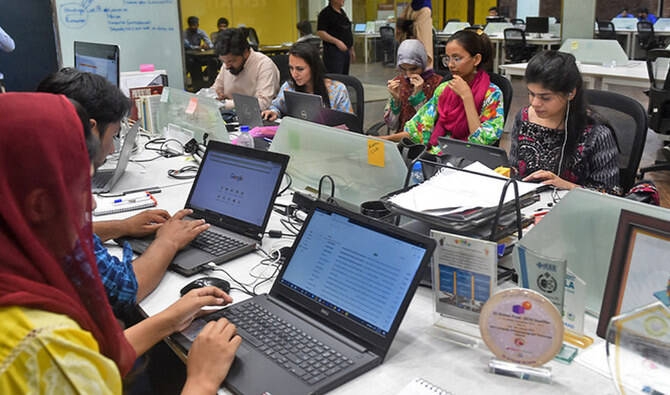
People work at their stations at an incubation centre in Lahore, Pakistan, on May 24, 2019. (AFP/File)
Short Url
Updated 15 July 2025
Follow

Pakistan regulator unveils gender policy to boost women’s role in corporate, finance sectors

  • SECP releases draft Women EquiSmart Policy 2025–2028 for public consultation on its official website
  • It focuses on women’s leadership on boards, inclusive workplaces and gender-smart financial products

KARACHI: Pakistan’s top financial regulator on Tuesday launched a draft policy aimed at tackling gender inequality in the country’s corporate and financial sectors, seeking to improve women’s representation on company boards, expand access to finance for women entrepreneurs and make workplaces more inclusive.

The Securities and Exchange Commission of Pakistan (SECP) published its Women EquiSmart Policy 2025–2028 for public consultation on its website, calling it the first comprehensive gender framework for regulated sectors such as capital markets, insurance and non-banking finance.

“The draft framework reflects the SECP’s strategic shift from fragmented diversity efforts to a structured, cohesive regulatory approach to gender inclusion, aligned with national priorities and global frameworks,” the regulator said in a statement.

The draft policy is built around six pillars, including women’s leadership on boards, gender-disaggregated reporting, women’s entrepreneurship, gender-smart financial products, inclusive workplace practices and institutional capacity building.

The statement said it identifies policy gaps, proposes timelines and regulatory actions and assigns roles to key stakeholders across the public and private sectors.

While Pakistan has seen efforts in recent years to promote workplace equality — such as corporate codes encouraging gender diversity — these have largely remained voluntary and inconsistently implemented.

SECP’s proposed framework seeks to introduce a more enforceable and measurable approach to gender inclusion.


Pakistan PM directs ministries to fast-track foreign investment recommendations

Updated 57 min 57 sec ago
Follow

Pakistan PM directs ministries to fast-track foreign investment recommendations

  • Pakistan’s foreign direct investment fell by over 25 percent during July-November period, official data states
  • Premier directs ministries to provide support via embassies worldwide to facilitate foreign investors

ISLAMABAD: Prime Minister Shehbaz Sharif on Thursday directed all ministries to prepare recommendations for domestic, foreign investment and development projects related to their sectors, state media reported as Islamabad eyes sustainable economic growth. 

The premier’s directives came while he chaired a meeting of the federal ministries on the implementation of economic governance reforms, state broadcaster Radio Pakistan reported. 

Foreign direct investment inflows in Pakistan fell by more than 25 percent to $927 million during the July-November period, as per data from the central bank. Pakistan’s FDI inflows have never surged beyond $3 billion in nearly 20 years, worrying Islamabad as it seeks to escape a prolonged macroeconomic crisis. 

“Prime Minister Shehbaz Sharif has directed all ministries to promptly prepare recommendations for domestic and foreign investment and development projects related to their respective sectors,” Radio Pakistan reported. 
 
Sharif said it was his government’s top priority to provide institutional and administrative facilitation to investors.

The prime minister instructed federal ministries to provide “special importance” to proposals that promote exports.

“The prime minister directed the concerned ministries to provide effective support through Pakistani embassies worldwide to facilitate foreign investors,” the state media said. 

Sharif stressed that equal attention be provided to industrial production, agriculture, and other key sectors to increase investment.

Pakistan’s government has said it is eyeing sustainable economic growth, driven by exports and foreign investment. 

The South Asian country has recently signed agreements worth billions of dollars with regional allies such as Gulf nations, China and Central Asian nations to enhance cooperation in trade, investment, tourism, livestock, mines and minerals, and other sectors.