ISLAMABAD: A Saudi-backed consortium has launched what it says is the world’s first artificial intelligence-powered Umrah advisor, “Ibraheem,” aimed at simplifying pilgrimage planning and reducing costs for millions of Muslims, including more than two million Pakistanis who travel to the Kingdom each year.
Ibraheem has been developed by Pakistani company Umrah Companions and is powered by Funadiq, a Saudi-based Destination Management Company specializing in Hajj and Umrah services.
The tool was launched last week and is designed to offer pilgrims personalized guidance in multiple languages, including Urdu and Roman Urdu, with the goal of cutting Umrah-related expenses by as much as 20 percent.
Pakistan is among the world’s largest pilgrimage markets, with over $5 billion spent annually by citizens traveling for Umrah and Hajj.
“Today, 93% of global Muslims cannot afford Hajj and Umrah. It is too expensive,” said Mohammad Salman Arain, CEO of Umrah Companions, in an interview with Arab News. “It is becoming expensive because we are not removing the inefficiencies in the processes — and that is what our mission is.”

Mohammad Salman Arain, CEO of Umrah Companions, speaks to Arab News during an interview in Islamabad on July 14, 2025, about his newly launched AI-powered Umrah advisor, “Ibraheem.” The tool is designed to simplify pilgrimage planning and reduce costs for millions of Muslims. (AN Photo)
Pakistanis often face language barriers, lack of personalized travel information, and high costs when arranging Umrah trips through human agents, many of whom offer fixed packages with little customization. Arain said the AI assistant overcomes these issues by adapting to each user’s needs, whether they are traveling with elderly parents, young children, or have budget constraints.
The platform currently supports ten languages, including Urdu, Roman Urdu, Arabic and English, and provides real-time recommendations on flights, hotels, food, weather, medical facilities and even services such as wheelchair availability near the Haram in Makkah.

"Ibraheem," the newly launched AI-powered Umrah advisor, responds to a command from Arab News during an interactive session in Islamabad. (AN Photo)
“You can start with a very simple question: ‘I want to travel in August. Give me an estimated budget for four people,’” Arain said. “Ibraheem will then suggest premium or budget options, tell you whether hotels are suitable for elderly companions, and help build your itinerary.”
The tool’s language offerings and its flexibility for use on smartphones and low-bandwidth environments make it particularly suitable for Pakistani blue- and white-collar workers living in the Gulf, a group that often lacks access to transparent and user-friendly tech tools for pilgrimage planning.
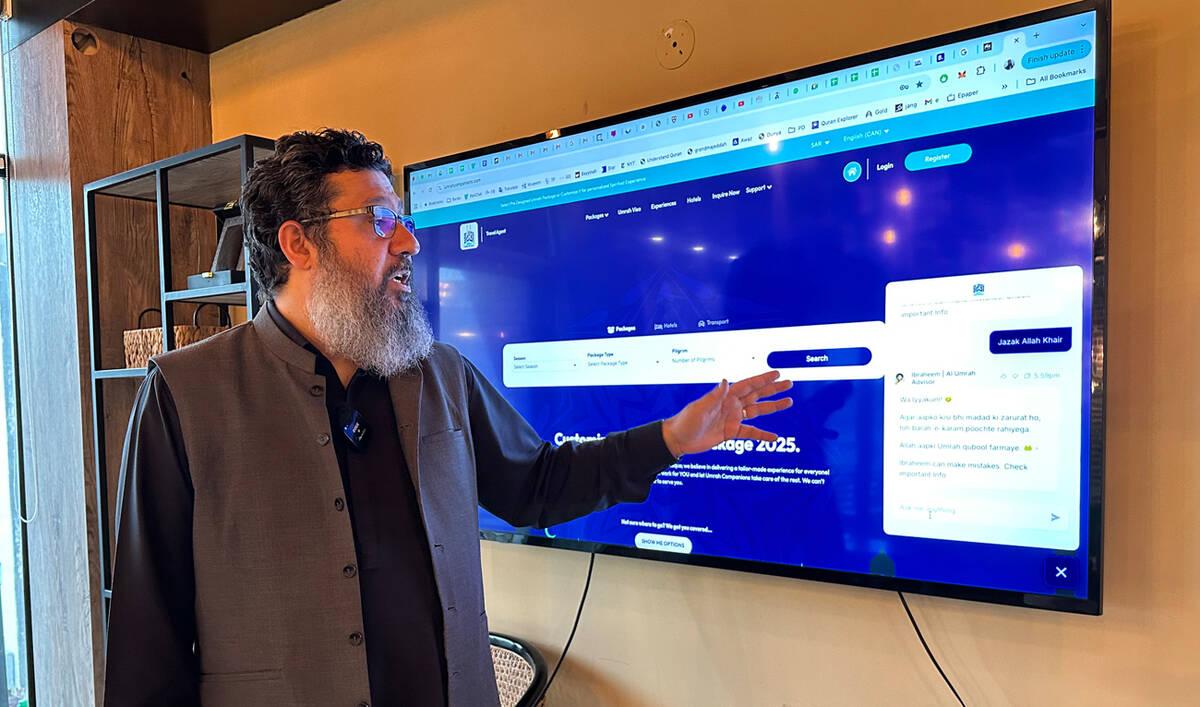
Mohammad Salman Arain, CEO of Umrah Companions, briefs Arab News on his newly launched AI-powered Umrah advisor, “Ibraheem,” during an interview in Islamabad on July 14, 2025. The tool aims to simplify pilgrimage planning and reduce costs for millions of Muslims. (AN Photo)
“We are building to make everybody's life easier. It is not for us only,” Arain added. “This is available for everyone and every single Muslim in the world.”
Umrah Companions is also working on outreach to Pakistani freelancers and overseas workers through diplomatic missions, Pakistani banks, and diaspora associations, especially in Saudi Arabia and the UAE, where a majority of Pakistani pilgrims are based.
While the service is focused on Umrah for now, Arain said it was already learning and being trained for Hajj season.
Once a pilgrim arrives in the Kingdom, the AI agent continues to provide support, from locating wheelchairs at Haram gates to suggesting restaurants and responding to emergencies, the chief executive explained.
The tool has already contributed to a 25% increase in website traffic, according to Arain, and is currently being built as an open platform available for use by all Muslims, regardless of which company they book their pilgrimage through.

The handout photograph released on July 14, 2025, shows Salman Arain (left), CEO of Funadiq.com, Sattam Hamdan M. Algethami (center), CEO of Maather Hospitality Group, and Anas Ammar, CEO of Emaar Al Diyafa Group, posing for a group photo. (Photo Courtesy: Salman Arain)
The launch of the AI platform also aligns with Saudi Arabia’s Vision 2030 goal to improve the pilgrimage experience through digital transformation and accessibility.
Arain said the initiative complements the Kingdom’s efforts to modernize religious tourism and ensure cost-effective pilgrimage options for lower-income Muslims.
“We believe this is going to revolutionize [pilgrimage],” Arain said, “and it is very much in line with what the Saudi Vision 2030 is doing to enhance the pilgrimage experience.”