

Lebanese army shuts illegal crossings along border with Syria

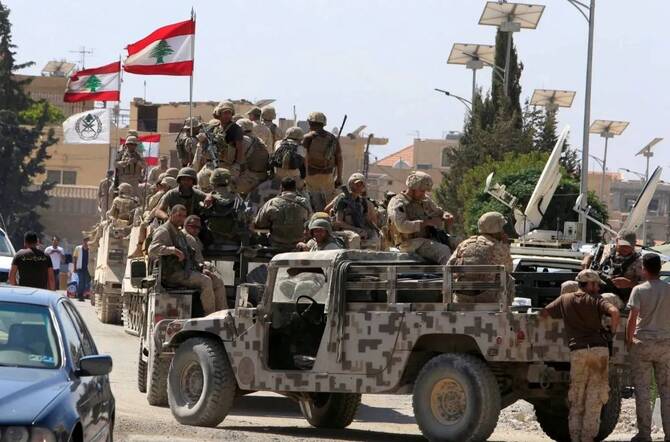
Lebanese army units deploy on the Lebanese-Syrian border. (Reuters)
Short Url
Updated 14 July 2025
Follow

Lebanese army shuts illegal crossings along border with Syria

  • The routes had become havens for human trafficking, smuggling drugs, weapons
  • Army using mounds of earth, rocks to stop vehicles, source says

BEIRUT: A patrol from the Lebanese army and the Intelligence Directorate on Monday closed several smuggling routes in Masharih Al-Qaa, a region between Lebanon and Syria that lacks clearly defined borders.

A Lebanese military source said the area was used for smuggling goods, fuel and people and that the army head “erected dirt mounds and rocks to prevent the passage of vehicles and motorcycles.”

The border between Lebanon and the Syrian Arab Republic stretches about 375 km and runs through towns, villages and mountainous regions. The Lebanese government estimates there to be 136 illegal crossing points, of which more than half are in the Bekaa region.

A shortage of personnel and surveillance equipment means many of these areas are vulnerable to criminal activity, including human trafficking and the smuggling of weapons, drugs and other goods.

These open borders have served the interests of Hezbollah and Palestinian factions allied with Syria. Over the years, Hezbollah has established its own border crossings and helped protect others used by smugglers from its support base.

Palestinian factions also established their border posts, which served as channels for weapons and people. Dismantling them was the first task undertaken by the Lebanese army in implementing the policy of confining weapons to the hands of the state.

The army on Sunday denied claims made on social media that armed men had entered Lebanon from Syria via the eastern mountain range and that it had withdrawn from border areas in the Bekaa.

Military units “continue to carry out their routine missions to control the Lebanese-Syrian border, while also monitoring the internal security situation to prevent any breach,” it said.

It also appealed for “accuracy in reporting news related to the army and the security situation, to act responsibly and to refrain from spreading rumors that lead to tension among citizens.”

Since the regime change in Syria, several meetings between the two countries have been held to improve coordination on border security.

On March 28, Lebanese Defense Minister Michel Menassa and his Syrian counterpart, Murhaf Abu Qasra, signed an agreement in Jeddah regarding border demarcation and the strengthening of security coordination. This came in the wake of violent clashes between the Syrian army and groups affiliated with Hezbollah along the border earlier in the month.

The issue of undefined borders dates back to the Sykes-Picot Agreement of 1916, when France was granted the mandate over the two countries and drew the borders in a vague and incomplete manner. Some parts were demarcated in 1934, but large areas remained undefined. The Syrian regime later refused to officially recognize Lebanon as an independent state and considered it part of “Greater Syria.”

Kuwait expresses solidarity

On Monday, the Kuwaiti First Deputy Prime Minister and Minister of Interior Sheikh Fahad Yousef Saud Al-Sabah met Lebanese President Joseph Aoun, Parliament Speaker Nabih Berri and Prime Minister Nawaf Salam.

He said that Lebanon “will remain Lebanon” and that the “arms issue will be resolved soon.”

He also affirmed Kuwait’s support for Lebanon “in all areas, especially security cooperation” and called for activating the work of the Kuwaiti-Lebanese Higher Joint Committee to explore avenues for assisting Lebanon.

The president’s media office said Aoun told the Kuwaiti minister of the “importance of coordination to address common challenges, particularly in terms of security cooperation to combat drug smuggling and anything that threatens security in both countries.”


First responders enter devastated Aleppo neighborhood after days of deadly fighting

Updated 12 January 2026
Follow

First responders enter devastated Aleppo neighborhood after days of deadly fighting

  • The US-backed SDF, which have played a key role in combating the Daesh group in large swaths of eastern Syria, are the largest force yet to be absorbed into Syria’s national army

ALEPPO, Syria: First responders on Sunday entered a contested neighborhood in Syria’ s northern city of Aleppo after days of deadly clashes between government forces and Kurdish-led forces. Syrian state media said the military was deployed in large numbers.
The clashes broke out Tuesday in the predominantly Kurdish neighborhoods of Sheikh Maqsoud, Achrafieh and Bani Zaid after the government and the Syrian Democratic Forces, the main Kurdish-led force in the country, failed to make progress on how to merge the SDF into the national army. Security forces captured Achrafieh and Bani Zaid.
The fighting between the two sides was the most intense since the fall of then-President Bashar Assad to insurgents in December 2024. At least 23 people were killed in five days of clashes and more than 140,000 were displaced amid shelling and drone strikes.
The US-backed SDF, which have played a key role in combating the Daesh group in large swaths of eastern Syria, are the largest force yet to be absorbed into Syria’s national army. Some of the factions that make up the army, however, were previously Turkish-backed insurgent groups that have a long history of clashing with Kurdish forces.
The Kurdish fighters have now evacuated from the Sheikh Maqsoud neighborhood to northeastern Syria, which is under the control of the SDF. However, they said in a statement they will continue to fight now that the wounded and civilians have been evacuated, in what they called a “partial ceasefire.”
The neighborhood appeared calm Sunday. The United Nations said it was trying to dispatch more convoys to the neighborhoods with food, fuel, blankets and other urgent supplies.
Government security forces brought journalists to tour the devastated area, showing them the damaged Khalid Al-Fajer Hospital and a military position belonging to the SDF’s security forces that government forces had targeted.
The SDF statement accused the government of targeting the hospital “dozens of times” before patients were evacuated. Damascus accused the Kurdish-led group of using the hospital and other civilian facilities as military positions.
On one street, Syrian Red Crescent first responders spoke to a resident surrounded by charred cars and badly damaged residential buildings.
Some residents told The Associated Press that SDF forces did not allow their cars through checkpoints to leave.
“We lived a night of horror. I still cannot believe that I am right here standing on my own two feet,” said Ahmad Shaikho. “So far the situation has been calm. There hasn’t been any gunfire.”
Syrian Civil Defense first responders have been disarming improvised mines that they say were left by the Kurdish forces as booby traps.
Residents who fled are not being allowed back into the neighborhood until all the mines are cleared. Some were reminded of the displacement during Syria’s long civil war.
“I want to go back to my home, I beg you,” said Hoda Alnasiri.