

Saudi-funded university township opens in Sri Lanka’s rural northwest

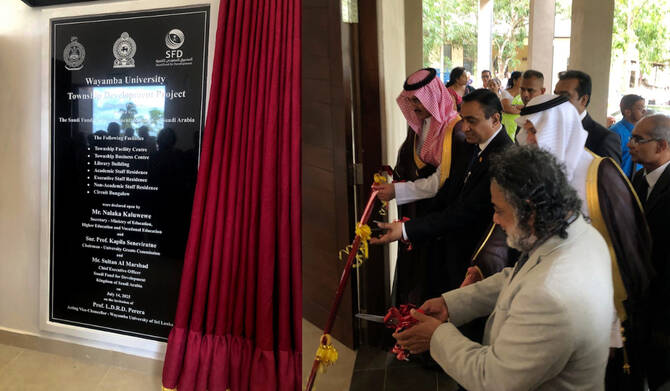
Saudi Fund for Development chief executive Sultan Abdulrahman Al-Marshad, left, inaugurates Wayamba University township project in Kuliyapitiya, Sri Lanka, July 14, 2025. (Khalidh Rizwan/X)
Short Url
Updated 14 July 2025
Follow

Saudi-funded university township opens in Sri Lanka’s rural northwest

  • New university buildings and infrastructure in North Western Province to benefit 5,000 Sri Lankan students
  • Saudi Arabia was the only country that did not suspend developmental projects during Sri Lanka’s economic crisis, envoy says

COLOMBO: The Wayamba University township, financed by the Saudi Fund for Development, was opened to the public on Monday, marking the latest development initiative completed in Sri Lanka with Saudi assistance.

The $28 million project in Sri Lanka’s North Western Province covers new buildings, renovation of existing classrooms, and new equipment.

The ceremonial opening was attended by SFD CEO Sultan Abdulrahman Al-Marshad, Sri Lankan Parliament Deputy Speaker Rizvie Salih, and Saudi Ambassador Khalid Hamoud Al-Qahtani.

“We believe that building universities is not limited to constructing buildings only, but is the foundation for a brighter future and the building of bridges of understanding and knowledge between peoples,” Al-Qahtani told Arab News. 

“This project represents a model of what sincere developmental partnerships can achieve, based on respect and mutual cooperation, away from any agendas or conditions.”

Ameer Ajwad, Sri Lanka’s envoy to Saudi Arabia, said the project includes significant infrastructure development at the Kuliyapitiya and Makandura campuses of the Wayamba University of Sri Lanka, benefiting over 5,000 students of both campuses.

“The project is expected to boost the university’s capacity to provide quality education and contribute to the long-term economic and social development of the surrounding communities living in the region,” he told Arab News.

The SFD has been a long-term partner of Sri Lanka, completing crucial developments such as the Colombo Water Supply and Sewerage Project, which improved the capital city’s urban water supply and sanitation infrastructure and benefitted tens of thousands of households, as well as the Kinniya Bridge — Sri Lanka’s longest bridge — connecting Trincomalee and Kinniya across the Koddiyar Bay.

Among the SFD-financed initiatives are also the Neuro‑Trauma Unit of the Colombo National Hospital and the Epilepsy Hospital and Health Centre — a specialized 242-bed epilepsy facility, also in the capital.

“The Wayamba University township development project is Saudi Arabia’s 11th development project in Sri Lanka. There are three more ongoing projects. One of them is also an educational development project; the Saudi Fund for Development provided $50 million for the construction of a medical faculty at the Sabaragamuwa University of Sri Lanka,” Ajwad said.

“The Saudi Fund for Development continues to play a crucial role in advancing key development projects in Sri Lanka, especially educational, health and infrastructure projects. Saudi Arabia was the only country that did not suspend disbursement of its funds to Sri Lanka and continued to fund despite Sri Lanka’s recent economic downturn.”


Trump expands travel ban, adding 5 more countries and imposing new limits on others

Updated 6 sec ago
Follow

Trump expands travel ban, adding 5 more countries and imposing new limits on others

  • Nationals from Syria, South Sudan, Burkina Faso, Mali and Niger are banned from visiting the US
  • The White House also fully restricted travel on people with Palestinian-Authority-issued travel documents

WASHINGTON: The Trump administration is expanding its travel ban to include five more countries and impose new limits on others.
This move Tuesday is part of ongoing efforts to tighten US entry standards for travel and immigration. The decision follows the arrest of an Afghan national suspect in the shooting of two National Guard troops over Thanksgiving weekend.
In June, President Donald Trump announced that citizens of 12 countries would be banned from visiting the United States and those from seven others would face restrictions. The decision resurrected a hallmark policy of his first term.
At the time the ban included Afghanistan, Myanmar, Chad, the Republic of Congo, Equatorial Guinea, Eritrea, Haiti, Iran, Libya, Somalia, Sudan and Yemen and heightened restrictions on visitors from Burundi, Cuba, Laos, Sierra Leone, Togo, Turkmenistan and Venezuela.
On Tuesday, the Republican administration announced it was expanding the list of countries whose citizens are banned from entering the US to Burkina Faso, Mali, Niger, South Sudan and Syria. The administration also fully restricted travel on people with Palestinian-Authority-issued travel documents.
An additional 15 countries are also being added to the list of countries facing partial restrictions: Angola, Antigua and Barbuda, Benin, Côte d’Ivoire, Dominica, Gabon, Gambia, Malawi, Mauritania, Nigeria, Senegal, Tanzania, Tonga, Zambia and Zimbabwe.
The Trump administration said in its announcement of the expanded travel ban that many of the countries from which it was restricting travel had “widespread corruption, fraudulent or unreliable civil documents and criminal records” that made it difficult to vet their citizens for travel to the US. It also said some countries had high rates of people overstaying their visas, refused to take back their citizens who the US wished to deport or had a “general lack of stability and government control,” which made vetting difficult.
“The restrictions and limitations imposed by the Proclamation are necessary to prevent the entry of foreign nationals about whom the United States lacks sufficient information to assess the risks they pose, garner cooperation from foreign governments, enforce our immigration laws, and advance other important foreign policy, national security, and counterterrorism objectives,” reads the White House proclamation announcing the changes.
The Afghan man accused of shooting the two National Guard troops near the White House has pleaded not guilty to murder and assault charges.