

Pakistan warns of more rains, floods as monsoon death toll hits 105 since June

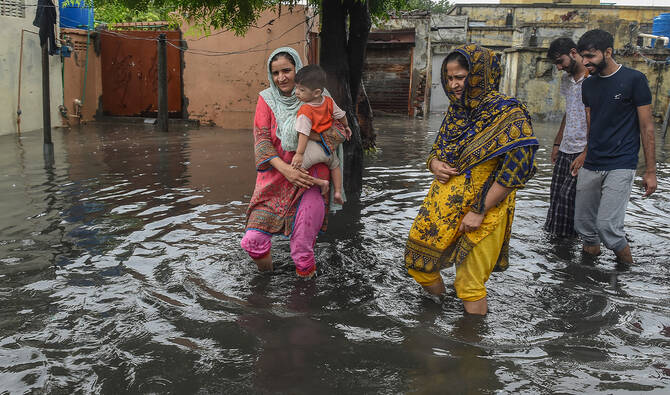
Residents wade through a flooded street following heavy monsoon rainfall in Lahore on July 10, 2025. (AFP)
Short Url
Updated 14 July 2025
Follow

Pakistan warns of more rains, floods as monsoon death toll hits 105 since June

  • Third spell of seasonal rains expected to begin July 14, meteorological department says
  • Punjab reports highest number of fatalities, followed by Khyber Pakhtunkhwa and Sindh

ISLAMABAD: The Pakistan Meteorological Department (PMD) warned on Monday heavy monsoon downpours are likely to trigger flash floods and landslides across several regions of the country this week, as the death toll from rain-related incidents since June 26 rose to 105.

The toll includes 40 deaths in Punjab, Pakistan’s most populous province, followed by 31 in Khyber Pakhtunkhwa (KP), 17 in Sindh, 16 in Balochistan, and one reported fatality in Azad Kashmir, according to official figures.

A total of 211 people have been injured in rain-related incidents, with Punjab again reporting the highest number (111), followed by KP (54), Sindh (7), Azad Kashmir (5), and Balochistan (4).

The National Disaster Management Authority (NDMA) has warned that a third spell of monsoon rains is expected to begin across the country from today, Monday, July 14.

“A low-pressure area (LPA) presently located over northwest Madhya Pradesh (India) is likely to affect Pakistan during next 24 to 72 hours,” the PMD said in its forecast.

“Under the influence of this weather system, strong monsoon currents are expected to penetrate central and upper parts [of the country]. A westerly wave is also present over upper parts of the country.”

The PMD said heavy rains with wind and thunderstorms are likely in most parts of KP, Punjab, Kashmir, Gilgit-Baltistan, Islamabad and northeast and southern Balochistan on Monday.

“Scattered heavy falls (at times very heavy) are likely in Islamabad, Khyber Pakhtunkhwa, Kashmir, Punjab, and northeastern Balochistan,” it added.

Authorities have warned of possible landslides and mudslides in hilly areas such as Murree, Galliyat, KP, Kashmir, and Gilgit-Baltistan, which could result in road closures and blockades.

“Heavy downpour may cause urban flood in low-lying areas of Islamabad/Rawalpindi, Gujranwala, Lahore, Sialkot, Sargodha, Faisalabad, Nowshera, and Peshawar,” the PMD said. “Caution is advised for the public.”

The NDMA has called on provincial and district administrations to prepare emergency response teams, ensure the availability of rescue machinery, and clear drainage systems in urban areas. Tourists have been advised to avoid high-altitude areas during the period of heavy rainfall.

Pakistan, a country of more than 240 million people, is among the nations most vulnerable to climate change. In 2022, record monsoon rains combined with glacial melt caused catastrophic flooding that affected 33 million people and killed more than 1,700.


Police in Pakistan’s Karachi say 71 of 75 extortion cases traced as businesses complain of threats

Updated 20 December 2025
Follow

Police in Pakistan’s Karachi say 71 of 75 extortion cases traced as businesses complain of threats

  • Builders told provincial authorities this week extortion calls were traced to numbers operating from abroad
  • Police say 128 suspects were identified, with 91 arrested and six killed in encounters during investigations

ISLAMABAD: Police in Karachi said on Saturday they traced 71 of 75 confirmed extortion cases this year, arresting 91 suspects and killing six in encounters, amid complaints from businesses about rising threats in Pakistan’s commercial hub.

The disclosure follows recent complaints by builders and developers who told provincial authorities that extortion demands had increased in Karachi, with some calls traced to numbers operating from abroad, prompting assurances of tougher enforcement by the Sindh government.

“In 2025, a total of 171 extortion cases were registered, of which 75 were confirmed as genuine extortion,” police said in a statement. “Of these 75 cases, 71 were traced, representing a 95 percent trace rate.”

According to the report released by the Special Investigation Unit (SIU) of the Crime Investigation Agency (CIA) Karachi, the remaining 96 cases initially registered as extortion were later found to be linked to financial disputes, land and plot conflicts, personal matters, fights and other non-extortion-related disagreements.

Police said 128 suspects were identified in the confirmed extortion cases. Of these, six were killed in encounters with the SIU, while 14 others were arrested in injured condition during operations.

A total of 91 suspects were arrested over the course of the year, the statement said, adding that crackdowns against extortion would continue.

Karachi, Pakistan’s largest and most populous city, is the country’s financial and commercial capital, accounting for a significant share of national revenue, trade and industrial activity.

The city has long struggled with crime, political violence and organized criminal networks, with members of the business community repeatedly warning that extortion poses a persistent threat to investment and economic stability.