

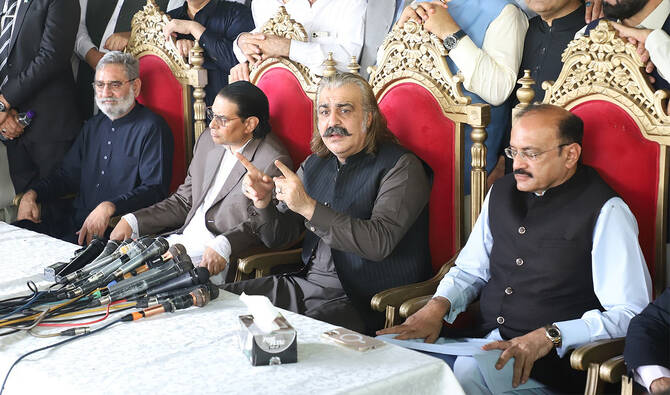

ISLAMABAD: Former prime minister Imran Khan’s Pakistan Tehreek-e-Insaf (PTI) party announced on Sunday that its 90-day “do-or-die” protest movement against the government has begun, saying that it would determine the future of the party.
Earlier this month, the PTI announced it would launch a nationwide protest movement after the Islamic month of Muharram, following a ruling by Pakistan’s top court denying the party reserved parliamentary seats for minorities and women.
Tensions further escalated days earlier when 26 PTI provincial lawmakers were suspended by the speaker of the Punjab Assembly for 15 sessions, after they protested during Chief Minister Maryam Nawaz Sharif’s speech on June 27.
Gandapur arrived in the eastern city of Lahore from KP on Saturday to discuss the party’s political strategy and finalize its protest movement against the government.
“We have announced a 90-day protest movement, which began yesterday [Saturday]… And it will be a do-or-die [movement] for us, whether we remain there [in KP government] or not,” Gandapur, flanked by the PTI’s leadership, told reporters at a news conference in Lahore.
The KP chief minister vowed that the party’s anti-government protest movement will “reach its peak” on August 5, marking two years since Khan was arrested after being convicted by a court for illegally selling state gifts.
Federal Information Minister Attaullah Tarar termed the PTI protest movement a “political gimmick,” saying that Khan’s party had made several such announcements.
“He [Gandapur] has made several such announcements and these are political gimmicks,” Tarar told Arab News.
“PTI has lost street power and its credibility, and is heading toward irrelevance,” the minister added.
Khan, who has remained in prison since then, says the charges against him are politically motivated and has denied wrongdoing. His party has held various protests demanding his release and an independent investigation into the elections of February 2024.
Pakistan’s government has denied the PTI’s allegations and says the elections of February 2024 were transparent. It accuses the former prime minister and his party of attempting to disrupt the government’s efforts to achieve sustainable economic growth through violent protests.
In one of the PTI’s protests in November last year, the government said four troops were killed in clashes with Khan supporters. The PTI rejects this allegation.
‘REAL DECISION-MAKERS’
Gandapur alleged that the PTI was being denied its right to hold peaceful protests, vowing that it would now mobilize people across the country.
“We will announce a plan accordingly, after taking all our local workers and leaders into confidence on how to proceed with this movement,” the chief minister said.
On holding talks with the government, Gandapur said his government was ready to hold talks but with the “real decision-makers,” indirectly referring to the military.
“Imran Khan has very clearly said this, ‘[I] will only negotiate with those who are decision-makers. What’s the point of talking to someone who doesn’t have any authority?’,” Gandapur said.
Pakistan’s military says it does not interfere in political issues and rejects the PTI’s allegations that it conspired with Khan’s political opponents to oust his government in a parliamentary vote in April 2022.


