

Pakistan plans to launch transshipment operations between Gwadar and Gulf region

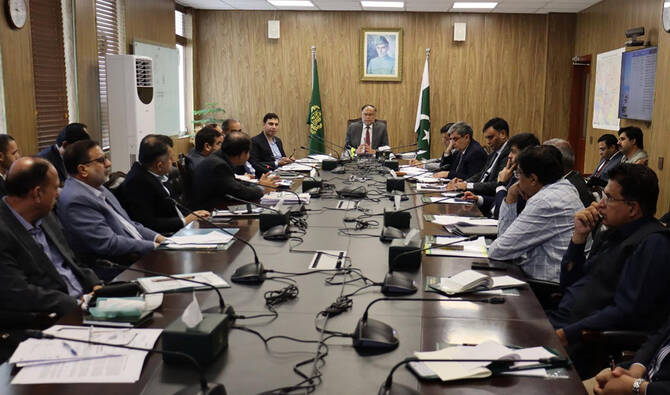
Pakistan’s Planning Minister Ahsan Iqbal chairs a high-level meeting of the Cabinet Committee on Gwadar Port operationalization in Islamabad on July 12, 2025. (PID)
Short Url
Updated 12 July 2025
Follow

Pakistan plans to launch transshipment operations between Gwadar and Gulf region

  • The country has been looking to capitalize on its geostrategic location to boost transit trade and foreign investment
  • Islamabad also seeks to cut container dwell time at ports by up to 70 percent to improve trade competitiveness, ease congestion

ISLAMABAD: The Pakistani government is actively engaging private shipping liners to commence transshipment operations between Gwadar and the Gulf region, Pakistani state media reported on Friday. 

The statement came from officials at a high-level meeting of the Cabinet Committee on Gwadar Port operationalization, which was presided over by Planning Minister Ahsan Iqbal.

Maritime officials informed the participants that initial cargo categories will include minerals, dates, seafood, and cement, targeting sectors such as mining, fisheries, and processing industries.

Iqbal said Gwadar’s geostrategic position as the shortest trade route to the Gulf and Central Asia highlighted the port’s potential as a regional transshipment hub, the Radio Pakistan broadcaster reported.

“Iqbal emphasized the need to showcase Gwadar Port in international road-shows as a strategic trade hub linking the Gulf and Central Asia,” the report read. “He directed stakeholders to promote the port’s cost-effective trade routes and available incentives for international businesses.”

Gwadar, situated along the Arabian Sea, lies at the heart of the China-Pakistan Economic Corridor (CPEC), under which Beijing has funneled tens of billions of dollars into massive transport, energy and infrastructure projects in Pakistan.

Pakistan, slowly recovering from a macroeconomic crisis under a $7 billion International Monetary Fund (IMF) deal, has been looking to capitalize on its geostrategic location to boost transit trade and foreign investment for a sustainable economic recovery.

The country plans to cut container dwell time at its seaports by up to 70 percent to improve trade competitiveness and ease congestion, while it last month reduced port charges for exporters by 50 percent at the country’s second biggest Port Qasim.


Rating firm S&P says it won’t rush Iran war downgrades, sees risks for countries like Pakistan

Updated 12 March 2026
Follow

Rating firm S&P says it won’t rush Iran war downgrades, sees risks for countries like Pakistan

  • Agency says it is monitoring indebted energy importers as higher oil prices strain finances
  • Gulf economies seen better placed to weather shock, though Bahrain flagged as vulnerable

LONDON: S&P Global ‌said it would not make any knee-jerk sovereign rating cuts following the outbreak of war in the ​Middle East, but warned on Thursday that soaring oil and gas prices were putting a number of already cash-strapped countries at risk.

The firm’s top analysts said in a webinar that the conflict, which has involved US and Israeli strikes ‌against Iran and Iranian ‌strikes against Israel, ​US ‌bases ⁠and Gulf ​states, ⁠was now moving from a low- to moderate-risk scenario.

Most Gulf countries had enough fiscal buffers, however, to weather the crisis for a while, with more lowly rated Bahrain the only clear exception.

Qatar’s banking sector could ⁠also struggle if there were significant ‌deposit outflows in ‌reaction to the conflict, although there ​was no evidence ‌of such strains at the moment, they ‌said.

“We don’t want to jump the gun and just say things are bad,” S&P’s head global sovereign analyst, Roberto Sifon-Arevalo, said.

The longer the crisis ‌was prolonged, though, “the more difficult it is going to be,” he ⁠added.

Sifon-Arevalo ⁠said Asia was the second-most exposed region, due to many of its countries being significant Gulf oil and gas importers.

India, Thailand and Indonesia have relatively lower reserves of oil, while the region also had already heavily indebted countries such as Pakistan, Bangladesh and Sri Lanka whose finances would be further hurt by rising energy prices.

“We ​are closely monitoring ​these (countries) to see how the credit stories evolve,” Sifon-Arevalo said.