

Pakistan, UAE agree to ease visa process for Pakistani citizens

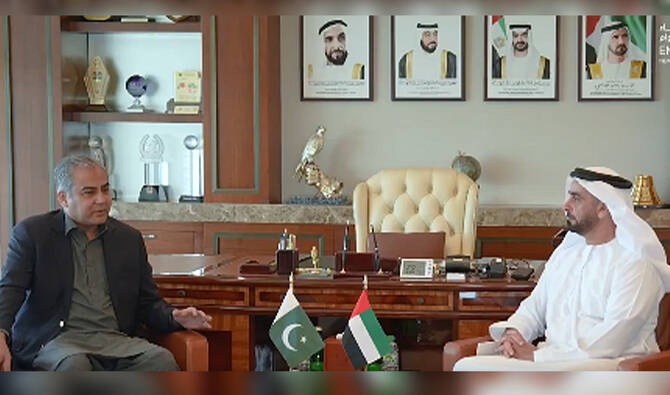
Pakistan's Interior Minister, Mohsin Naqvi (left) in conversation with Emirati counterpart, Sheikh Abdullah bin Zayed, in Abu Dhabi, UAE, on July 11, 2025. (@WAMNEWS_ENG/X)
Short Url
Updated 11 July 2025
Follow

Pakistan, UAE agree to ease visa process for Pakistani citizens

  • Mohsin Naqvi discusses enhanced security, anti-narcotics, and tech cooperation during Abu Dhabi visit
  • Pakistani interior minister briefed on crime prevention and public safety at UAE police operations center

ISLAMABAD: Pakistan and the United Arab Emirates (UAE) agreed to take “necessary steps” to facilitate visa issuance for Pakistani citizens during a high-level meeting between Interior Minister Mohsin Naqvi and his Emirati counterpart in Abu Dhabi, according to an official statement released on Friday.

The development comes amid growing concerns over visa delays and restrictions reportedly faced by Pakistani nationals seeking employment in the UAE. Last month, Deputy Prime Minister Ishaq Dar also raised the issue in a meeting with UAE Foreign Minister Sheikh Abdullah bin Zayed.

The UAE is home to over 1.5 million Pakistanis and remains a major source of remittances.

“It was also mutually agreed to ensure necessary steps to facilitate visas for Pakistani citizens, especially work visas,” the interior ministry said in a statement issued after the meeting. “The UAE Minister of Interior assured full cooperation in this regard.”

Naqvi said the fraternal relations with the UAE were valued by all Pakistanis. He also highlighted that a large number of them were playing a key role in strengthening the UAE’s economy.

“We want Pakistani citizens to be able to come to the UAE easily and easing visa policies will greatly benefit them,” he added.

During his talks with UAE’s Deputy Prime Minister and Minister of Interior Lt. Gen. Sheikh Saif bin Zayed Al Nahyan, both sides reaffirmed their commitment to deepening bilateral cooperation in multiple areas including security, anti-narcotics, anti-smuggling and preventing illegal immigration.

The discussion also included regional peace and the use of advanced technologies such as artificial intelligence to tackle security challenges.

Later, the Pakistani minister visited Abu Dhabi’s state-of-the-art police operations room, where he was briefed on crime prevention and public safety systems.

He expressed particular interest in the UAE’s advanced police monitoring model and praised the country’s use of technology for law enforcement.


Pakistan business body writes to PM seeking ‘clear roadmap’ to spur investment

Updated 5 sec ago
Follow

Pakistan business body writes to PM seeking ‘clear roadmap’ to spur investment

  • Business confidence in Pakistan has fallen sharply amid rising inflation, high energy costs and unpredictable tax environment
  • In a letter written to PM Shehbaz Sharif, the Pakistan Business Forum president highlights challenges facing the business community

KARACHI: The Pakistan Business Forum (PBF), a representative body of traders and businesspersons in the country, on Monday urged Prime Minister Shehbaz Sharif’s intervention in outlining a “clear economic roadmap” to promote long-term investment in Pakistan.

Business confidence in Pakistan has fallen sharply amid rising inflation, high energy costs and an unpredictable tax environment. Currency volatility and slowing demand have prompted many firms to delay investments and scale back expansion plans.

In a letter to PM Sharif, PBF President Khawaja Mehboob-ur-Rehman highlighted the challenges facing the business community, including high input costs, soaring energy tariffs and an increasingly “uncompetitive” tax regime that weakens exports.

“Looking ahead to 2026, the Pakistan Business Forum urged the prime minister to provide the business community with a clear, credible, and forward-looking economic roadmap,” read a PBF statement.

“Such clarity... is essential to restore confidence, encourage investment, and enable long-term planning by businesses.”

The South Asian country of more than 241 million people is currently navigating a tricky path to economic recovery under a $7 billion International Monetary Fund (IMF) program since averting a default in 2023.

Besides introducing structural reforms relating to expansion of the country’s tax base and privatization of loss-making entities, the government of PM Sharif says it is taking various measures to boost foreign investment and trade.

The PBF highlighted the business community is ready to play its role in competing with regional markets, if provided with the “necessary competitive tools.” It outlined critical reforms relating to regionally competitive electricity tariffs and corporate tax rates.

An increase in electricity tariffs would put further strain on industries and could lead to widespread downsizing and the closure of industrial units, according to the PBF.

It urged the government to include business representatives in the policymaking process to ensure it understands “on-ground realities.”