

Pakistani father kills daughter over TikTok account, police say

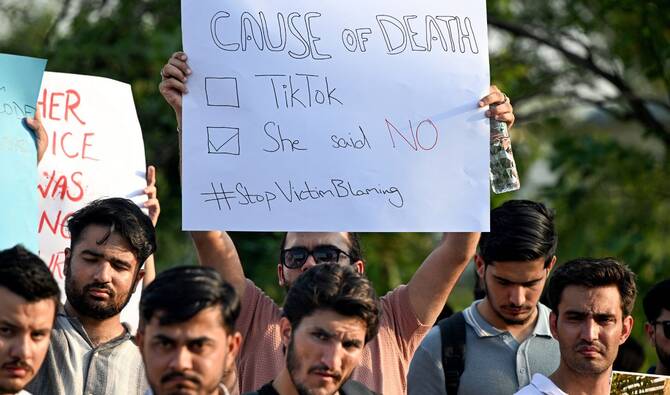
This photograph taken on June 5, 2025 shows demonstrators holding placards and a poster of TikTok star Sana Yousaf during a protest held to condemn violence against women after she was killed for rejecting a man's proposal in Islamabad. (AFP/ file)
Short Url
Updated 11 July 2025
Follow

Pakistani father kills daughter over TikTok account, police say

  • TikTok is wildly popular in Pakistan, in part because of its accessibility to a population with low literacy levels
  • Pakistani authorities have repeatedly blocked or threatened to block the app over what they call ‘immoral behavior’

RAWALPINDI: Pakistan police on Friday said a father shot dead his daughter after she refused to delete her account on popular video-sharing app TikTok.

In the Muslim-majority country, women can be subjected to violence by family members for not following strict rules on how to behave in public, including in online spaces.

“The girl’s father had asked her to delete her TikTok account. On refusal, he killed her,” a police spokesperson told AFP.

According to a police report shared with AFP, investigators said the father killed his 16-year-old daughter on Tuesday “for honor.” He was subsequently arrested.

The victim’s family initially tried to “portray the murder as a suicide” according to police in the city of Rawalpindi, where the attack happened, next to the capital Islamabad.

Last month, a 17-year-old girl and TikTok influencer with hundreds of thousands of online followers was killed at home by a man whose advances she had refused.

Sana Yousaf had racked up more than a million followers on social media accounts including TikTok, where she shared videos of her favorite cafes, skincare products, and traditional outfits.

TikTok is wildly popular in Pakistan, in part because of its accessibility to a population with low literacy levels.

Women have found both audience and income on the app, which is rare in a country where fewer than a quarter of the women participate in the formal economy.

However, only 30 percent of women in Pakistan own a smartphone compared to twice as many men (58 percent), the largest gap in the world, according to the Mobile Gender Gap Report of 2025.

Pakistani telecommunications authorities have repeatedly blocked or threatened to block the app over what they call “immoral behavior.”

In southwestern Balochistan, where tribal law governs many rural areas, a man confessed to orchestrating the murder of his 14-year-old daughter earlier this year over TikTok videos that he said compromised her “honor.”


Pakistani president arrives in Iraq to deepen trade, energy cooperation

Updated 20 December 2025
Follow

Pakistani president arrives in Iraq to deepen trade, energy cooperation

  • Visit follows recent high-level contacts as Islamabad seeks to expand limited commercial ties with Baghdad
  • Talks are expected to cover investment, manpower and facilitation of Pakistani pilgrims visiting holy sites in Iraq

ISLAMABAD: President Asif Ali Zardari arrived in Iraq on Saturday on an official visit aimed at expanding cooperation in trade, energy and investment, as Pakistan seeks to deepen ties with Baghdad after years of limited engagement.

Pakistan and Iraq established diplomatic relations in 1947 and have traditionally maintained cordial ties, though commercial links remain modest, with officials and business groups identifying scope for cooperation in construction services, pharmaceuticals, manpower and agricultural exports.

“President Asif Ali Zardari arrived in Baghdad on a four-day official visit to Iraq,” his office said in a post on X. “He was received by Culture Minister Dr. Ahmed Fakkak Al-Badrani. During the visit, meetings with senior Iraqi leadership are expected to advance cooperation and further strengthen Pakistan-Iraq relations.”

Zardari’s visit follows a series of recent high-level contacts between the two countries, reflecting efforts to broaden bilateral engagement beyond traditional diplomatic ties and explore collaboration across economic, political and people-to-people domains.

According to Pakistan’s foreign office, the president is expected to hold meetings with Iraq’s senior leadership to discuss cooperation in various areas such as trade and investment, energy, technology, education and manpower.

He is also expected to discuss regional and international issues with Iraqi officials.

Earlier this month, Pakistan’s Interior Minister Mohsin Naqvi met his Iraqi counterpart, Abdul Ameer Al-Shammari, on the sidelines of meetings in Brussels, where both sides agreed to enhance cooperation on security and facilitate travel for Pakistani Shia pilgrims to Najaf and Karbala.

The two officials discussed measures to ensure the smoother movement of these pilgrims and their compliance with visa regulations.