

Pakistan tenders to buy 300,000 to 500,000 metric tons of sugar

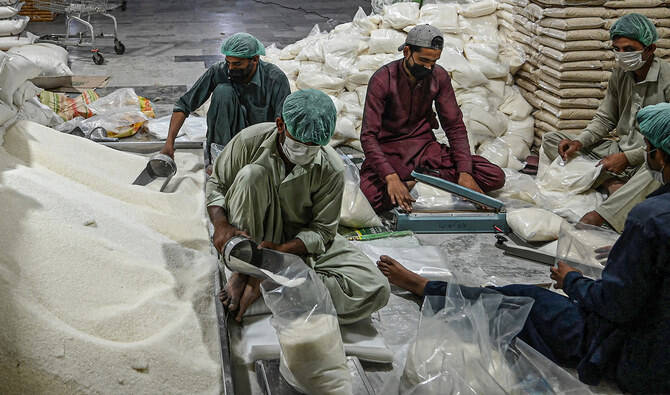
Workers of the Al-Khidmat Foundation, a charity organization, prepare sugar bags to be distributed to people in need, ahead of the Holy month of Ramadan at a warehouse in Islamabad, Pakistan, on April 11, 2021. (AFP/File)
Short Url
Updated 11 July 2025
Follow

Pakistan tenders to buy 300,000 to 500,000 metric tons of sugar

  • The deadline for the submission of price offers is July 18
  • Shipment sought in series of consignments loading in August

HAMBURG: Pakistan’s state agency, the Trading Corporation of Pakistan (TCP), has issued an international tender to purchase and import 300,000 to 500,000 metric tons of white refined sugar, European traders said on Friday.

The deadline for submission of price offers is July 18.

On July 8, Pakistan’s government had approved plans to import 500,000 tons of sugar to help maintain price stability.

Market analysts said that retail sugar prices in the country have risen sharply since January.

The sugar is sought from worldwide origins, packed in bags with a minimum offer of 25,000 tons permitted.

The TCP reserves the right to purchase more or less than the tender volumes, traders said.

Shipment is sought in a series of consignments loading in August. The entire volume purchased must arrive in Pakistan by September 30.

Pakistan’s JF-17 fighter jet draws ‘strong interest’ at Riyadh defense exhibition

Updated 13 sec ago
Follow

Pakistan’s JF-17 fighter jet draws ‘strong interest’ at Riyadh defense exhibition

  • Jets showcased as Pakistan seeks to expand defense exports
  • Interest in JF-17 has heightened after May 2025 conflict with India 

ISLAMABAD: Pakistan’s JF-17 Thunder fighter jet has drawn “strong interest” at the World Defense Exhibition in Riyadh, Pakistan’s state broadcaster said on Sunday, as Islamabad promotes the aircraft to international buyers at one of the region’s largest defense industry events.

The exhibition brings together defense officials, manufacturers and military delegations from dozens of countries, offering a platform for arms exporters to showcase equipment and pursue new contracts amid heightened global and regional security concerns.

Saudi Arabia has sought to position Riyadh as a regional hub for defense and aerospace exhibitions, using such events to foster partnerships and attract international manufacturers as part of broader diversification efforts. 

Last year Islamabad signed a mutual defense pact with Riyadh and is reportedly discussing another defense agreement involving Saudi Arabia and Turkiye, although details have not been made public.

“At the World Defense Exhibition in Riyadh, the Pakistan Air Force’s JF-17 Thunder has attracted strong interest from visitors and defense experts, standing out among fighter jets displayed by the US, Saudi Arabia and other countries,” state broadcaster Pakistan Television reported.

Islamabad is attending the exhibition in the backdrop of talks with at least 13 countries, six to eight of which are in an advanced stage, for deals involving JF-17 jets made jointly with China as well as training aircraft, drones, and weapons systems, according to recent media reports. 

Interest in the JF-17 jets has been bolstered by its operational visibility following the Pakistan-India military confrontation in May 2025, which Pakistani officials and defense analysts have cited as reinforcing the aircraft’s combat credibility.

Islamabad has increasingly positioned the JF-17 as a cost-effective multirole combat aircraft for countries seeking alternatives to high-end Western fighter jets. The aircraft is already in service with several foreign air forces and remains central to Islamabad’s defense export strategy.

Countries engaged in talks include Sudan, Saudi Arabia, Indonesia, Morocco, Ethiopia, and Nigeria as well as the government in eastern Libya led by Khalifa Haftar. Discussions on JF-17s and other weapons with Bangladesh and Iraq have been publicly acknowledged by Pakistan’s military, although more details have not been made public.

Almost all the potential buyers are Muslim-majority nations, like Pakistan. Many are from the predominantly Muslim Middle East, where Pakistan has historically been a security provider.
