

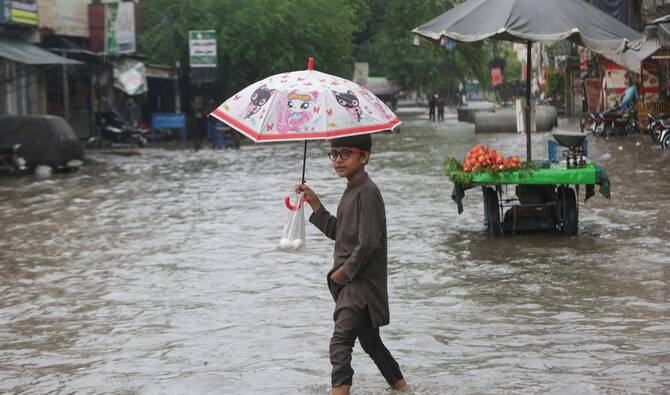

BENGALURU: Each year from June to September, a series of heavy rains known as monsoons, sweep through the Indian subcontinent, providing relief from heat, irrigating the country’s farms and replenishing its rivers.
However, as global heat increases, the rain is becoming more erratic and intense, creating the conditions for deadly floods. Nearly 1,300 people died in India throughout 2024 due to heavy rain and floods. Hundreds of rain-related deaths have already occurred this year in the South Asian region, which includes India, Pakistan, Bangladesh, Bhutan, Sri Lanka, Afghanistan, Maldives and Nepal.
Climate experts say the high temperatures and heavy rain are also contributing to the melting of glaciers in the mountainous Himalayan region, causing catastrophic flooding and landslides.
MONSOON BECOMES MORE DANGEROUS
The South Asian region has traditionally had two monsoon seasons. One typically lasts from June to September, with rains moving southwest to northeast. The other, from roughly October to December, moves in the opposite direction.
But with more planet-warming gases in the air, the rain now only loosely follows this pattern. This is because the warmer air can hold more moisture from the Indian Ocean, and that rain then tends to get dumped all at once. It means the monsoon is punctuated with intense flooding and dry spells, rather than sustained rain throughout.
“We are witnessing a clear climatic shift in monsoon patterns across South Asia,” said Roxy Mathew Koll, a climate scientist at the Indian Institute of Tropical Meteorology in Pune and author of several United Nations climate reports.
Traditionally, people in India and neighboring countries excitedly awaited the monsoon rains, which would finally mean the end of summer heat. But attitudes are changing as disasters increase during the rainy seasons.
“The frequency and intensity of extreme rainfall events are increasing, often overwhelming drainage infrastructure in urban areas and triggering flash floods,” Koll said.
Higher temperatures and longer periods of drought are also making farming harder in South Asia, climate experts said.
“More than 60 percent of the people in South Asia are dependent on agriculture, and almost all of them are dependent on monsoon rainfall,” said Finu Shrestha, a climate scientist at Katmandu, Nepal-based International Center for Integrated Mountain Development.
MOUNTAIN REGIONS SEE MORE GLACIAL LAKES OVERFLOWING
A 2023 report by Shrestha’s organization found that glaciers are melting at unprecedented rates across the Hindu Kush and Himalayan mountain ranges. The study found that at least 200 of the more than 2,000 glacial lakes in the region are at risk of overflowing, which can cause catastrophic damage downstream. Heavy monsoon rains can exacerbate the problem.
“A lot of the mountain areas tend to have more warming than the global average, resulting in more glaciers melting,” said Miriam Jackson, glaciologist at the International Cryosphere Climate Initiative.
An October 2023 glacial lake overflow in the Indian state of Sikkim triggered flooding that killed 55 people and damaged bridges, buildings and a hydropower dam that was under construction.
Heavy rainfall and increasing heat are leading to snow and ice avalanches, rockfalls and other events that can trigger the lakes to breach or overflow, Shrestha said.
“Even small glacial lakes are now breaching and causing damage,” she said.
EARLY WARNING SYSTEMS CAN HELP
Installing early warning systems and building in less risky areas can help reduce damage from heavy rains, climate experts say.
“If you know a flood is coming, then people can get to higher ground and there could be a sort of standard early warning system along a river that sends out a siren,” Jackson said, adding that social media and messaging applications can help people spread warnings to those downstream.
Koll, the Pune-based scientist, said that rapid urbanization, shrinking floodplains and loss of natural drainage also exacerbate damage from heavy rains. Koll said that most government response currently comes after disasters, and there is a lack of long-term planning.
“In the future monsoon, extreme rains are projected to intensify further, in addition to sporadic water shortages. Hence, we need proactive, long-term strategies that combine science, policy, and community engagement,” he said.
Jackson said the biggest issue, however, is to try to reduce emissions of planet-heating gases because there are limits to adapting to extreme weather.
“If we continue with, you know, business as usual, and we have the same kind of emissions, then the world is going to keep on getting warmer and there will be more intense rain and floods. At some point, we could go beyond the limits of adaptation,” she said.


